
Since we are on the subject of ports...

Hecta G
10+ year member

Member
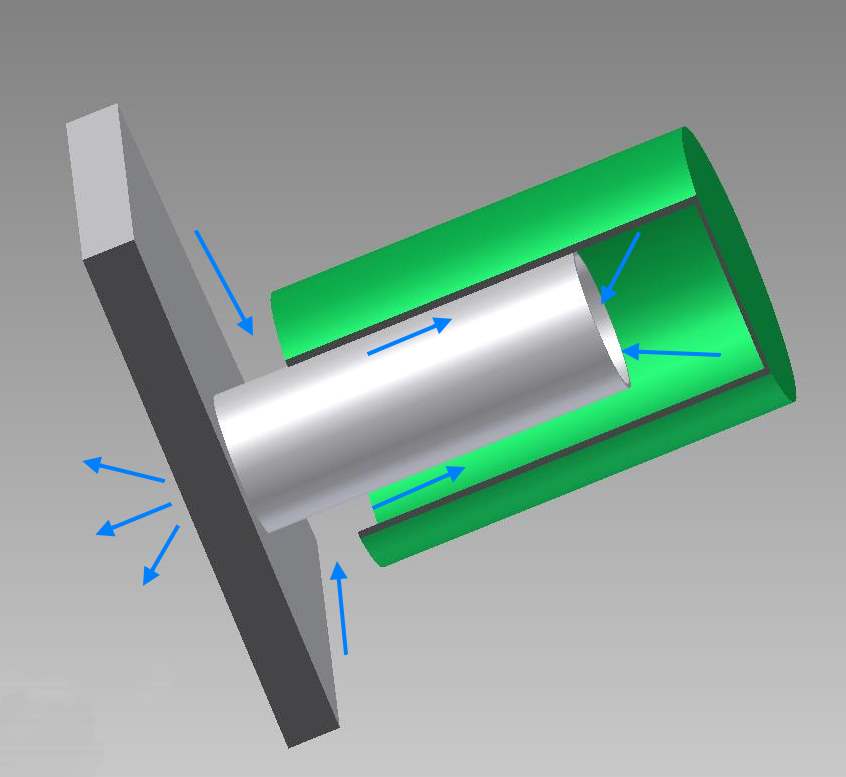
In the rendering below, I have done a cutaway for easier viewing and explaining. The port is behind a 3/4" MDF. The outer tube is open on one end and has an OD of 4".

The inside tube has an OD of 2", both with a wall thickness of 1/16". Each tube is 6" long, and the arrows show the direction of air travel.

My question is how can you calculate effective port length when comparing to standard cylindrical ports?
labrynth.jpg


Actually, it was something that I patented several years ago, and since I was young, had a crazy idea, built a prototype and actually worked.

My problem was why it worked. Until now I haven't wondered too much about it but with some of the guys here really REALLY know more about acoustics than I do. I approached from a mechanical side and was wondering if someone here could explain it to me.

I'm thinking about building some more to test and see if it makes any sense still.

 
It's not really anything that new; take a look at bullhorns--they are a concentric folded horn, just like this but with exponentially increasing flare and loaded from the other end. But I have never seen this concept applied to ports.

 
Activity
No one is currently typing a reply...
Old Thread: Please note, there have been no replies in this thread for over 3 years!
Content in this thread may no longer be relevant.
Perhaps it would be better to start a new thread instead.

About this thread

Hecta G

10+ year member
Member
Thread starter
Hecta G
Joined
Location
ATL, GA
Start date
Participants
Who Replied
Replies
27
Views
1,525
Last reply date
Last reply from
djman37
IMG_20260516_193114554_HDR.jpg

sherbanater

    May 16, 2026
  • 0
  • 0
IMG_20260516_192955471_HDR.jpg

sherbanater

    May 16, 2026
  • 0
  • 0

New threads

Top


