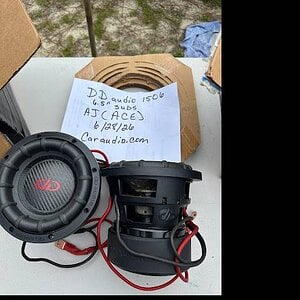
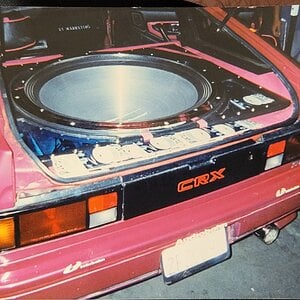
question regarding port area.

the sub as it is in the box it is in is completely fine on 95% of the music i have played through it. the only time i have heard port noise is on extremely low notes at a really really high volume. notes that are either very close to tuning or maybe even slightly below it. the box is tuned to 30hz.

i was thinking of building a new box since the one i have is a tad ghetto(uses a 3" aero that is half external, half internal), i like it and it performs well though. but i was thinking of building a slot ported box tuned to the same number but with a bit more port. i would say around 12sq inches of port. if it'll negatively change the sound then i'll leave it alone. function over form ya know. i like how tight the sound is and how hard it hits. it's a very fun setup to listen to on rock/metal. if adding more port will take away the tightness then no way am i changing it. i listen to metal and rock 90% of the time and the setup right now is just insane sounding for it.

if going from a 3" flared round port to a rectangular slot port with lets say 12sq inches won't benifit me then i'll leave it alone.

 
thanks guys but none of that really answers my question.
No, making the port larger does not change the sound of the system if its not in a compressed state. Making the port smaller can affect the sound if the port becomes undersized for the amount of energy/force the active driver can create. The active driver is going to resonate the air-mass in side the port and box at frequencies in and around the system tuning frequency. Because the air has friction with the walls of the port, this can create a problem if the velocity of the air is large enough. Complex differential equations can model this relationship, but the bottom line is, when the friction is high enough, turbulence starts to increase and cause harmonic distortions that can be audiable. On top of that, the friction losses in the port counter the resonance system and restrict the air mass from moving, thus reducing the SPL created by the port system and dynamically changing the resonance point of the system, typically pushing it up slightly. In other words at high voltage levels at frequencies around Fc (resonance / tuning), losses in SPL relative to a larger port can occur. More so you can measure an amount of distortion as a result of the loss of SPL. Quite literally, the added distortion is created from energy that went into frictional losses from the undersized port - bad design.

The port size and length simply determine the resonance of the ported system and can affect the "sound" because that will dramatically change the frequecny response. When you make a port larger, you have to also make the box larger or the port longer to maintain the same tuning. Two ported boxes with the same driver and the same volume and the same tuning, but with different port diameters and lengths should sound nearly identical at low volumes, the larger port will in theory sound better at higher volumes if in fact it does not compress and the smaller one does.

Be careful not to mix up system alignment and Q differences with port differences, the port can be modeled discretely form the active drivers behavior with a high degree of accuracy.

Good trivia: The tuning frequency depends on the box volume, port dimensions and active driver too!

Most people omit the third variable because its not nearly as dominate as the first two.

 
Activity
No one is currently typing a reply...
Old Thread: Please note, there have been no replies in this thread for over 3 years!
Content in this thread may no longer be relevant.
Perhaps it would be better to start a new thread instead.

About this thread

tcguy85

10+ year member
CarAudio.com Veteran
Thread starter
tcguy85
Joined
Location
Hyde Park, NY
Start date
Participants
Who Replied
Replies
16
Views
1,114
Last reply date
Last reply from
Kyle_Keating
1778578257023.png

Glen Rodgers

    May 12, 2026
  • 0
  • 0
Screenshot_20260511_212804_Amazon Shopping.jpg

Blackout67

    May 11, 2026
  • 0
  • 0

New threads

Top