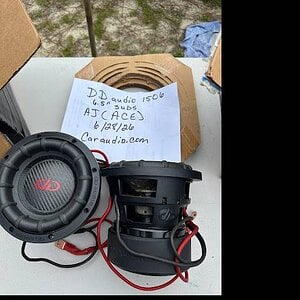
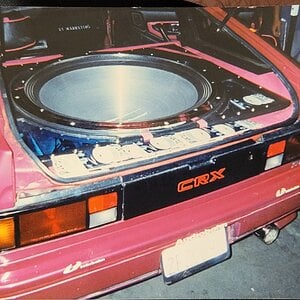
Need help ASAP! Wiring 4 D2s and 2 D4s!

Are you wiring 6 speakers all together? i'm not sure if that's a good idea. while you may have a final ohm load that works with the amp, the D2's wouldn't be getting the same power as the D4's.

 
Are you wiring 6 speakers all together? i'm not sure if that's a good idea. while you may have a final ohm load that works with the amp, the D2's wouldn't be getting the same power as the D4's.
The final ohm load at the amp is what determines how much power it's going to send to the subs, mixing different voice coil configurations shouldn't change anything as far as power. A 1000 watt dual 4 ohm sub and a 1000 watt dual 2 ohm sub would both be getting the same power as the other one, the difference is how you wire them to the amp. One way would draw more power from the amp than the other would. But you can mix the voice coils if you want, you just have to know exactly how to wire them. If you have a DMM you can always try different wiring configurations and measure the resistance at the speaker wires going into the box. If the ohms are a good match for the amp then let them pound.

Your only real options would be a .2, .6 or .8 ohm load, so unless your amp is stable to .5 ohms I wouldn't waste the time. And I believe that Rockford says not to mix them because it's not always a simple process when your trying to mix VC configurations and you could damage the subs or amp if hooked up wrong, telling you not to saves them the hassle of noobs trying to get their gear replaced under warranty.

 
The final ohm load at the amp is what determines how much power it's going to send to the subs, mixing different voice coil configurations shouldn't change anything as far as power. A 1000 watt dual 4 ohm sub and a 1000 watt dual 2 ohm sub would both be getting the same power as the other one, the difference is how you wire them to the amp. One way would draw more power from the amp than the other would. But you can mix the voice coils if you want, you just have to know exactly how to wire them. If you have a DMM you can always try different wiring configurations and measure the resistance at the speaker wires going into the box. If the ohms are a good match for the amp then let them pound.

Your only real options would be a .2, .6 or .8 ohm load, so unless your amp is stable to .5 ohms I wouldn't waste the time. And I believe that Rockford says not to mix them because it's not always a simple process when your trying to mix VC configurations and you could damage the subs or amp if hooked up wrong, telling you not to saves them the hassle of noobs trying to get their gear replaced under warranty.
Bullshit.

That is just not true at all and completely misleading. First off, the different voice coil options for subs in a like series will have different T/S parameters and they will act differently in the same enclosure so that is one reason not to do it.

The main reason is like mentioned before, each voice coil would see a different power, depending on how they are wired. In electronics, power is equal to the voltage times the current and can also be in terms of current and resistance:

P = I*V

P = I²*R

If you have a circuit that has two resistors in series and one is a 2 ohm resistor and the other is a 4 ohm resistor, they would have a different voltage drop in the circuit and the 4 ohm resistor would take twice as much power as the 2 ohm resistor. This happens because current (I) is constant with loads in series and voltage is constant when loads are in parallel. Either way, it spells bad news for equal power dissipation.

The same thing would happen in this situation. The only way to lower that chance would be to wire all of the D4 coils in parallel and then wire each DVC 2 ohm sub's coils separately. But again, I would not recommend using two subs with different coil configurations because the parameters are going to be different.

 
First off, the different voice coil options for subs in a like series will have different T/S parameters and they will act differently in the same enclosure so that is one reason not to do it.


good point but he didn't say if they were all in one box, or seperate boxes, or seperated boxes within a box.....

 
Bullshit.
That is just not true at all and completely misleading. First off, the different voice coil options for subs in a like series will have different T/S parameters and they will act differently in the same enclosure so that is one reason not to do it.

The main reason is like mentioned before, each voice coil would see a different power, depending on how they are wired. In electronics, power is equal to the voltage times the current and can also be in terms of current and resistance:

P = I*V

P = I²*R

If you have a circuit that has two resistors in series and one is a 2 ohm resistor and the other is a 4 ohm resistor, they would have a different voltage drop in the circuit and the 4 ohm resistor would take twice as much power as the 2 ohm resistor. This happens because current (I) is constant with loads in series and voltage is constant when loads are in parallel. Either way, it spells bad news for equal power dissipation.

The same thing would happen in this situation. The only way to lower that chance would be to wire all of the D4 coils in parallel and then wire each DVC 2 ohm sub's coils separately. But again, I would not recommend using two subs with different coil configurations because the parameters are going to be different.

werd, also current follows the path of least resistance so it would go through the lower impedence subs first, depending on how the wiring was and then the subs that were wired at the higher impedence would get less power //content.invisioncic.com/y282845/emoticons/smile.gif.1ebc41e1811405b213edfc4622c41e27.gif

 
werd, also current follows the path of least resistance so it would go through the lower impedence subs first, depending on how the wiring was and then the subs that were wired at the higher impedence would get less power //content.invisioncic.com/y282845/emoticons/smile.gif.1ebc41e1811405b213edfc4622c41e27.gif
That makes sense, hadn't thought of that.

 
werd, also current follows the path of least resistance so it would go through the lower impedence subs first, depending on how the wiring was and then the subs that were wired at the higher impedence would get less power //content.invisioncic.com/y282845/emoticons/smile.gif.1ebc41e1811405b213edfc4622c41e27.gif
While current takes the path of least resistance, it doesn't mean that it travels first to the lower impedance. It does, however, channel more current though lower impedances if the impedances are in parallel and thus lower impedances will receive more current and more power. But when in series, the higher impedances will give more power because the current is constant.

 
Activity
No one is currently typing a reply...
Old Thread: Please note, there have been no replies in this thread for over 3 years!
Content in this thread may no longer be relevant.
Perhaps it would be better to start a new thread instead.

About this thread

86yota

10+ year member
CarAudio.com Elite
Thread starter
86yota
Joined
Location
Gat town, TN
Start date
Participants
Who Replied
Replies
12
Views
1,010
Last reply date
Last reply from
Immacomputer
1778763859842.png

Doxquzme

    May 14, 2026
  • 0
  • 0
IMG_20260513_214311575.jpg

ThxOne

    May 13, 2026
  • 0
  • 0

New threads

Top