lol, how many times do I have to correct your info before you change your mind about me? //content.invisioncic.com/y282845/emoticons/smile.gif.1ebc41e1811405b213edfc4622c41e27.gif
And I never said optima wasn't AGM, don't know why you think I did.
And for the Google Book that you found, did you bother checking the date it was published?
There hasn't been a 'maintenance' type of battery produced in years (at least none that I know of). Unless you have a really old battery, you don't have the option of adding water like the link describes.
Actually, when you talk about an unsealed batt, most are actually sealed and have vent caps for the sole purpose to release pressure so the batt doesn't explode. Vent caps are a safety device. I'm sure you will try to prove me wrong on that. //content.invisioncic.com/y282845/emoticons/smile.gif.1ebc41e1811405b213edfc4622c41e27.gif
There are very few (maybe 10-20% batts or less) that actually have real vents. These are the ones that have a vent connection to the batt in the engine compartment. I've seen group 31's have these vents and I know there are a few other groups that have them...
I stated that Optimas were AGM because previously I was telling another person why using a flooded cell in the trunk was a bad idea. You then showed the MSDS info for a sealed AGM battery, like that was proof that he could use the flooded battery in the trunk. I know you get easily confused, but try to keep up.
As for my link, how much has changed in flooded starting battery construction in the last 30 years? Not too much. Sure they call them maintenance free now, but that just means that you only need to add water back in if you overcharge it. It has not changed the chemical process of battery charging. You still get explosive gassing when charging a battery.
i guess i am gunna get another redtop friday and just wait on the 250amp alt
or would i be ok with the redtop optima in back and wet cell in front with a isolator??
No, do not ever use a Red top in a car audio application. It is a starting battery. If you don't mind buying a new one in a month or less, go ahead and use it. Otherwise, there is no warranty when used in a car audio application. And if you don't think they can tell that you deep cycled that battery, you are wrong. That Red top will last for years if used right. They just don't go bad in a months time without abuse. The dealers know this and will know you abused it.
ok and how would they know it was used for car audio?? i could stick it in my wife truck and drive up there think before you talk
now would it make a difference on crossing the batterys if i have an isolator?
You can use any two batteries you like with the proper isolator. A solenoid type isolator is NOT the correct type. You will need a diode or FET based isolator. The reason being is that a solenoid type only isolates the batteries with the engine off. Once you start the car, they are both connected. At that point, you could still potentially deep cycle the front battery.
As for mixing flooded lead batts (non-sealed) with sealed AGM type batteries, I know plenty of people doing this with no problem at all. Sealed AGM batts tend to sit higher, so the flooded battery drains it down a bit at rest (or it may be the other way around), but nothing that should be killing batteries unless your flooded battery is already going bad.
So you know a guy who did it and he never said he had an issue. *golf clap*
So never mind that the battery manufacturers tell you not to do it. Since your friend did it, the laws of chemistry and physics no longer apply.
Great advice douche bag. //content.invisioncic.com/y282845/emoticons/rolleyes.gif.c1fef805e9d1464d377451cd5bc18bfb.gif
Old 'maintenance' batts released flammable hydrogen/oxygen which is why you had to topoff the water.
Modern car batteries only produce a large amount of hydrogen during prolonged overcharging or charging at excessively high voltage. This means they are only flammable when abused.
I know your fancy website tells you otherwise, but look at the MSDS/technical data from Optima and you will see there is an explosion/fire hazard if the batts get overcharged.
Using batts for storing wind and solar energy is EXACTLY like using them for car applications. //content.invisioncic.com/y282845/emoticons/rolleyes.gif.c1fef805e9d1464d377451cd5bc18bfb.gif
Keep quoting from it though.
OK, so let's look at a few manufacturers of batteries and see what they say, shall we.
Up first if Exide Battery. They are a well known and respected brand. Here is a LINK to their safety guide. Simply read the first paragraph. Here i will quote it for you:
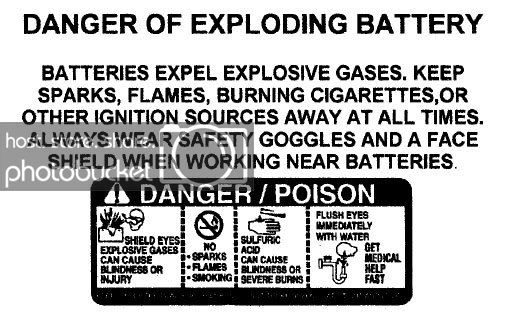
... They also may contain EXPLOSIVE MIXTURES OF HYDROGEN AND OXYGEN GASES in each cell at all times. Therefore, the first section of this manual is devoted to the safety precautions to be followed when working around batteries...
Now I bolded the section above to point out that they do not say only when overcharged or abused. They say at all times. Why would they say such a thing?
And then a little further down the page we see this warning:
Now let's look at East Penn, the worlds largest battery manufacturer (so their site says). They have a very similar warning in their
MSDS:
May form explosive air/gas mixture during charging....
FIRE AND EXPLOSION HAZARDS:
Batteries evolve flammable hydrogen gas during charging and may increase fire risk in poorly ventilated areas near sparks, excessive heat or open flames.
And now we get to your smart *** comment about me quoting a solar website. I know that you would love to use that to refute the knowledge on that site, but your claim has no basis in reality. The fact is that they give general battery knowledge that is very useful in any application. It is not just solar specific.