Intentional Impedance Mismatch..

I have known for some time that maximum power is achieved when the load impedance matches the source impedance but what i have recently learned is that in relation to amplifier and speaker impedance it is best to have slightly higher speaker impedance, something about the complex mechanical nature of the speaker itself..

I was looking real hard at raw 4 ohm drivers but then after looking at the spec sheet almost every single 4 ohm driver has less than 4 ohms dc resistance, usually anywhere from 3.8 to 3.9 ohms.

This prompted me to look at 5 and 6 ohm drivers and i found the Vifa D27TG35-06, it's listed as a 6 ohm driver but measures out at 4.9 ohms, am i on the right track ?

Impedance: 6 ohms

Power Handling: (RMS)100 Watts

Frequency Response: 700-20,000 Hz

Sensitivity: 92.6 dB 1W/1m

Resonant Frequency: (Fs)720 Hz

DC Resistance: (Re)4.90 ohms

 
I think what you're touching on is the impedance magnitude (moreover, the severity of the capacitive and inductive phase angles on either side of driver Fs) and not the fact that impedance is high or low. You can have low impedance drivers with a very low impedance magnitude (less reactive) which will be easy for the amplifier to control (provided the amplifier is up to delivering the current), versus a higher impedance driver with a very high impedance magnitude, making for a very reactive driver that will be very demanding on the amplifier. This can all depend on many different things from driver type, moving mass, driver suspension, electrical damping, etc...

Unless I misinterpreted what you wrote.

 
You're seeing the difference between nominal impedance and DC resistance. Do not confuse the two. Look those terms up on Google.
thank you again, i am eager to learn and there is a bunch of information for me to absorb but it's coming together (slowly)..

 
I think what you're touching on is the impedance magnitude (moreover, the severity of the capacitive and inductive phase angles on either side of driver Fs) and not the fact that impedance is high or low. You can have low impedance drivers with a very low impedance magnitude (less reactive) which will be easy for the amplifier to control (provided the amplifier is up to delivering the current), versus a higher impedance driver with a very high impedance magnitude, making for a very reactive driver that will be very demanding on the amplifier. This can all depend on many different things from driver type, moving mass, driver suspension, electrical damping, etc...
Unless I misinterpreted what you wrote.
For some reason i totally understand what you are saying..

So, would it be correct tn say "it is easier for an amplifier to control a low or equal impedance driver vs a high'er impedance driver" ?

 
For some reason i totally understand what you are saying..So, would it be correct tn say "it is easier for an amplifier to control a low or equal impedance driver vs a high'er impedance driver" ?
I think that would be in the arena of all-too-relied-upon damping factor.
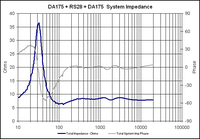
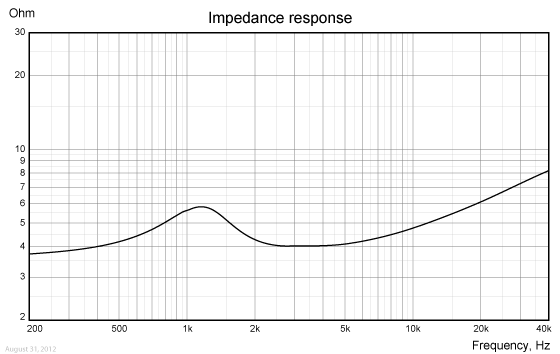
Look at it this way... Compare the following impedance plots. Let's pretend they're both 4ohm drivers but with very different parameters except for maybe Fs, let that be similar (the one plot is actually for a tweeter but just pretend). One has a fairly peaky resonance and one has a more mellow resonance. The more mellow one will be far less demanding on the same amplifier because the phase angles are not as steep on the way up to the top of the peak. Another way to say this is that the peaky one is very reactive and the mellow one is more resistive, which is what you want for predictable power output.

Enclosure will also have a huge impact on this, no matter if it's sealed or vented.

image_preview


TW030Wa02-impedance.png


I think that would be in the arena of all-too-relied-upon damping factor.
Look at it this way... Compare the following impedance plots. Let's pretend they're both 4ohm drivers but with very different parameters except for maybe Fs, let that be similar (the one plot is actually for a tweeter but just pretend). One has a fairly peaky resonance and one has a more mellow resonance. The more mellow one will be far less demanding on the same amplifier because the phase angles are not as steep on the way up to the top of the peak. Another way to say this is that the peaky one is very reactive and the mellow one is more resistive, which is what you want for predictable power output.
Ah, steep phase angle and peaky resonance results from less resistive impedance and the shallow phase angle with mellow resonance results from a more resistive impedance and the latter of the two is more favorable to the amplifier, at last the complex mechanical nature of the loudspeaker is unfolding..

 
There you go. And the enclosure can be designed to tame that peak. If it's vented you could target the peak and you will be left with two smaller, more manageable peaks. Small sealed will drive the peak upward in frequency and minimize the magnitude as well.

All of this is where the term 'rise' comes in when the kids are talking about power being delivered in the real world. Impedance profile really is a big help when factoring in what type of amplifier and how much power will be needed.

 
There you go. And the enclosure can be designed to tame that peak. If it's vented you could target the peak and you will be left with two smaller, more manageable peaks. Small sealed will drive the peak upward in frequency and minimize the magnitude as well.
Too cool, using the enclosure to smooth out the Impedance curve, as frequency rises so does the impedance, i think..

 
Too cool, using the enclosure to smooth out the Impedance curve, as frequency rises so does the impedance, i think..
Yep. And actually, that impedance rise that you see tracking with frequency is due to the voice coil inductance. But that's a different topic, lol. Here's a couple real-world models that may help solidify this for you. The first model (home theater), if you look at the parameters on the left you will see that the Fs is 15.5Hz. The large volume of air space doesn't do much to tame the impedance magnitude but tuning the enclosure to 14Hz splits up and tames the peak (bottom right graph). The second model includes both a sealed and vented curve for driver with an Fs of 24Hz. Notice how the vented enclosure @ 22Hz does the same as the first model, but the sealed curve (red) has driven the peak upwared in frequency and lowered the magnitude of it (middle left graph). In free-air the magnitude would be higher. Anyway, hope that helps.


Activity
No one is currently typing a reply...
Old Thread: Please note, there have been no replies in this thread for over 3 years!
Content in this thread may no longer be relevant.
Perhaps it would be better to start a new thread instead.

About this thread

gstokes

FÜKENGRUVEN
Thread starter
gstokes
Joined
Location
Beaverton, Oregon
Start date
Participants
Who Replied
Replies
9
Views
2,209
Last reply date
Last reply from
ciaonzo
IMG_20260516_193114554_HDR.jpg

sherbanater

    May 16, 2026
  • 0
  • 0
IMG_20260516_192955471_HDR.jpg

sherbanater

    May 16, 2026
  • 0
  • 0

New threads

Top