what are the needs for horns? Is it just to be able to get louder while keeping distortion low, or is there sonic attributes to horns that are superior to say a soft/hard dome tweeter?
Horns have many advantages. Efficiency is their most well-known advantage. This doesn't just mean louder, it means less amplifier needed/used, less distortion, better transients, etc.
Also, horns have directed sound dispersion. this means the horns shape is designed in such a way so that it will distibute a greater amount of sound to the opposide side of the car as it will to the side its mounted on. This helps to minimize the bias you usually experience when listening to a stereo in a car (closer speaker drowns out one on other side of vehicle). This is why horns are notorious for providing a rock solid center image, and very good 'out of the box' imaging in general.
Crossover point. Horns also tend to extend much lower than a standard round tweeter (as low as 1kz usually, in some cases as low as 600hz), where your standard round tweeter will need to be highpassed probably 2 octaves higher than that. Standard comp sets with round tweeters tend to have to have their HP/LP filter in the 'sweet spot' of midrange for human hearing perception. An xover filter, no matter how well designed/built, WILL add some acoustical anomolies to the sound in that region. Be it a slight dip in freq output as the mid drops off and the tweeter picks up, or a spike in output, etc. Therefore, when you have a speaker like a compression horn that will extend down much lower, again to say 1khz, the xover filters are now in a frew range that is not so sensitive to our hearing.
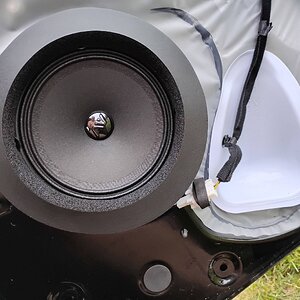
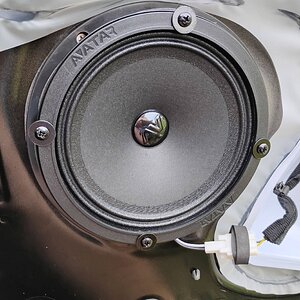
Lastly, the lower freq extension also tends to allow you to run a 2-way configuration and get away withh a larger mid/midbass. For example, JamesBang running a 2-way with IDQ8's and horns... that would be impossible with conventional round tweets. The 8's would never extend anywhere near high enough to where the tweets cut off (3.5-5khz), but they can (pretty much) extend to 800-1khz. Allowing for a larger mid/midbass means, of course, more allowable midbass output.