tglisson
10+ year member
Senior VIP Member
Because woofers are specialized reproducers, their design maximizes their potential for reproducing the lowest frequency. Thus they will have cones that are suspended in such a way as to promote the maximum back and forth motion, called XMAX. Middle frequencies by contrast, have smaller cones and less excursion, or cone travel. Tweeters have cones, domes, or diaphragms that may seem practically motionless. Even so, they can produce sound in their frequency range that is just as powerful (and piercing) as their larger siblings.
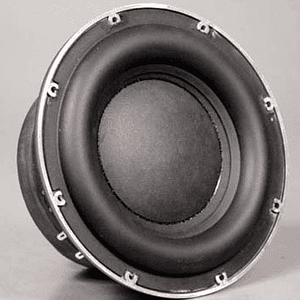
Woofer cones must move in and out with the longest possible extension because sound waves get longer as they get lower in frequency. Current technology provides us with stiff and rigid cone materials such as Polypropylene, Carbon and Polymer Laminates that maintain their shape under stress, resist moisture, and are very light. The cone works as a piston to compress and alternatively evacuate large masses of air. To do this most effectively, the woofer must be connected to an amplifier that produces the high amplitude waveforms that can produce this motion. Because such signals require considerable electrical power behind them to control the cone movement, the highest power available is needed strictly for bass reproduction. Similar levels in the midrange and high frequency areas require comparatively little power for the same apparent loudness, all other things being equal.
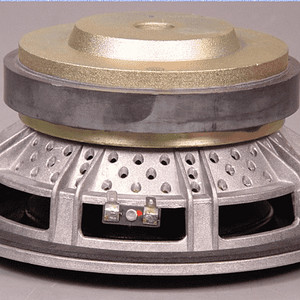
Because of the powerful dynamic motions of the woofer cone, the frame or basket is often cast in a heavy metal to reduce the tendency for the speaker to "ring" at certain resonant frequencies. This arrangement also allows for the most precise alignment of the voice coil within the magnetic field and is particularly useful in speakers at or greater than 15" in diameter. In the larger drivers, after years spent resisting the tug of gravity, there is a tendency for the heavy magnet to be pulled out of alignment on the stamped frames of the larger sizes. This is of little practical concern with 12" and smaller woofers.
Magnetic structure design is fairly standardized with pole pieces constructed to put a concentrated magnetic field around the voice coil. Over the past 30 years, the magnetic materials used have changed considerably to permit ever-larger concentrations of magnetic energy rated in "Gauss" to be created from smaller quantities of lighter compounds. Coupled with the use of Kapton multiwound coils and more powerful amplifiers, speakers - when designed with even a modicum of commitment to high fidelity - can much more easily achieve that end.
For speakers to truly work well and achieve their maximum audio potential, they must be housed in an appropriate enclosure. Indeed without some elementary means of preventing the front radiated wave from interacting with the back wave, no bass would be heard at all. This is simply because the two waves are precisely 180 degrees out of phase with each other and cancel out when they meet.
Woofer cones must move in and out with the longest possible extension because sound waves get longer as they get lower in frequency. Current technology provides us with stiff and rigid cone materials such as Polypropylene, Carbon and Polymer Laminates that maintain their shape under stress, resist moisture, and are very light. The cone works as a piston to compress and alternatively evacuate large masses of air. To do this most effectively, the woofer must be connected to an amplifier that produces the high amplitude waveforms that can produce this motion. Because such signals require considerable electrical power behind them to control the cone movement, the highest power available is needed strictly for bass reproduction. Similar levels in the midrange and high frequency areas require comparatively little power for the same apparent loudness, all other things being equal.
Because of the powerful dynamic motions of the woofer cone, the frame or basket is often cast in a heavy metal to reduce the tendency for the speaker to "ring" at certain resonant frequencies. This arrangement also allows for the most precise alignment of the voice coil within the magnetic field and is particularly useful in speakers at or greater than 15" in diameter. In the larger drivers, after years spent resisting the tug of gravity, there is a tendency for the heavy magnet to be pulled out of alignment on the stamped frames of the larger sizes. This is of little practical concern with 12" and smaller woofers.
Magnetic structure design is fairly standardized with pole pieces constructed to put a concentrated magnetic field around the voice coil. Over the past 30 years, the magnetic materials used have changed considerably to permit ever-larger concentrations of magnetic energy rated in "Gauss" to be created from smaller quantities of lighter compounds. Coupled with the use of Kapton multiwound coils and more powerful amplifiers, speakers - when designed with even a modicum of commitment to high fidelity - can much more easily achieve that end.
For speakers to truly work well and achieve their maximum audio potential, they must be housed in an appropriate enclosure. Indeed without some elementary means of preventing the front radiated wave from interacting with the back wave, no bass would be heard at all. This is simply because the two waves are precisely 180 degrees out of phase with each other and cancel out when they meet.