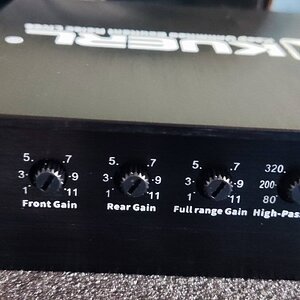
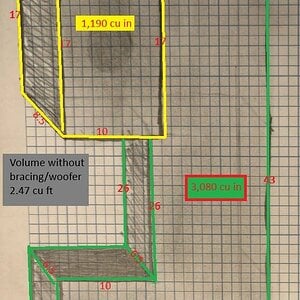
Experts: Please explain this phenomenon

what is not reasonable about that explination ?
Have you even considered that what you experienced could have been 100% placebo effect ????

Because I am quite sure it was..
It would only be the placebo effect if I had a preconceived notion that they would sound a million times better @ 4 ohms, which I didnt.

As I said before, and before and before. I didnt know how different it would sound, if at all, and I said I would probably end up just clipping the amp trying to get the power out of it. My thoughts were "Im just going to try and listen and see what happens."

So, you can put you "placebo-my mind made it up" theory to rest.

 
Less distortion may be it, but this brings me to my next question.

Could the great, boner inducing, highly popular SAZ 3000D have that much distortion?

Doesnt everyone always say you cant hear distortion up to a certain level?

Is the SAZ 3000D that bad?

Im not trying to bash the amp/company. Its an excellent value IMO. Im just raising some more questions!

 
Could the great, boner inducing, highly popular SAZ 3000D have that much distortion?
When you don't know how to set your amp to NOT reproduce a distorted signal, yes. Buy the most expensive, bad *** amp in the world and drive it to it's limits and crank the gain and it will distort, no question about it.

I find it funny how you enlist the help of the "experts" who give you plausible explanations as to what is actually happening and you still argue for an instrument that is easily fooled: your ears. Maybe you should design your own amp???

Btw, when you say you're doing "experimenting," you're not out in your car performing a properly designed scientific experiment, you're just "tryin' things." To argue with the best of what we (scientific community) know and understand about electronic equipment and how it operates makes you look foolish, sorry.

 
The fact is, is you dont know what I hear. You dont know how I listen and how I pick out certain details. Everyone does it differently. Everyone listens in a different way. There will NEVER be a standard, no mater how scientific you get.
You can "listen" however you want.

Simple fact of the matter is, science will tell us what is affecting what you are hearing and what is not. You can use whatever subjective terms you wish to describe a sound and you can use personal preferences to "prefer" one sound over another. But you can not hear something that the laws of physics and physiology do not allow you to hear, or do not even allow to be present. If you can hear it, it will be described by science. Period.

They are assuming that "its all im my head" which is a poor excuse for somebody who cant offer a reasonable explanation.
1) You CAN NOT rule out the possibility that it is in your head. You did not maintain the proper controls or conduct the proper measurements to provide any evidence that it is anywhere other than your head.

2) Read my very first response to this thread. I provided a highly plausible explanation that has nothing to do with the amp or it being in your head. You simply ignored it for god knows what reason.

This thread reminds me I need to buy one of those shirts.......Science. It works, Bitches.

You just can get over the fact that I heard a REAL change in the sound. I tried to explain it the best I could.
You can't get over the fact that you presently can not prove it was a real change in sound //content.invisioncic.com/y282845/emoticons/biggrin.gif.d71a5d36fcbab170f2364c9f2e3946cb.gif

Anyways, I think you're missing the point. You're focusing too much on this "in your head thing". The point is; This thread is pointless. As I've mentioned before, you did not maintain enough controls in your "experiment" for anyone to provide an actual reason. You can neither confirm nor deny any explanation given at this point. You're experiment was far too flawed.

Learn how to listen,
//content.invisioncic.com/y282845/emoticons/laugh.gif.48439b2acf2cfca21620f01e7f77d1e4.gif

I've always those types of responses.

 
I offered anyone to come listen.

I read some actual explanations, but it was always followed by "its in your head" or "you dont know what you're doing".

You dont always need an exact science to tell if something is true or false IMO. I feel I kept enough controls in place to reach my conclusion with a great degree of accuracy.

 
op, if you were to hear a difference (in improvement), i would guess that its either a faulty amp that isn't working properly at 1 ohm or its a perception of difference in sound on your part. that's not to say that the difference wasn't actually there. however, your perception of better sound might be possibly due to something simple like a minor difference in gain, for example. keep in mind, a human's perception of sound IS subjective. though human hearing is very sophisticated and can do things that no test instrument can do, this goes likewise the other way as well. your changing of the wiring and gain and your perception of (or real) difference thereafter is NOT a good scientific way to isolate variables to make the test truly scientific. your ears would not know the exact power the subs got from each setup, nor the distortion level, gain, damping, etc. if the amp is not faulty at 1 ohm, then the cause certainly isn't from things like damping factor, higher distortion, etc. i have tendencies to doubt people (on a scientific basis) who claim things like 'sharper' highs, 'tighter' bass, 'crisper' sound, etc when they talk about a line driver, a class a/b amp vs. a class d amp, silver stranded rca’s, etc. not to necessarily say that the difference wasn’t really there on your part, but perhaps your subjective analysis of the improvement was indeed just that, subjective.

 
I just learned that BOSE makes an electromagnetic suspension for cars...WOW
Well, since are changing subjects....

I went to a local audio shop the other day...just to look. The guy asked what amp Im running. I say Sundown 3000D. He looks confused and then asked to take a look at it, so I show him. I tell him its 3000w @ 1 ohm. Then he said "Yeah if lightning strikes it!"

 
Well, since are changing subjects....
I went to a local audio shop the other day...just to look. The guy asked what amp Im running. I say Sundown 3000D. He looks confused and then asked to take a look at it, so I show him. I tell him its 3000w @ 1 ohm. Then he said "Yeah if lightning strikes it!"

Apparently a retard. Retards can run business's too... just look at me!

LOL. He has probably never heard of or had experience with these amps so as it is unknown to him he degrades it and writes it off as junk. Most people who run stereo shops seem like used car salesmen to me... you get a totally different story about products from one place to the next.

The only mechanical difference in the way it would be working that I can think of, and I am not really an SQ guy, or a physicist (sp?) nor is my IQ over 130, but I know how the amps work, somewhat anyway, as I do work on them every day, is the difference between high voltage going out on the speaker wire vs high current. At regular listening levels (not balls to the walls) with a 4 ohm load you would be getting something like 60-80 volts AC and 15-20 amps AC being sent to and from the subwoofer by the amp (around 900 watts or more), whereas with 1 ohm it would be more like 28.2VAC and 28.2AMPS ( around 800 watts). Maybe it's easier for the subwoofer to be controlled by the higher voltage than by the higher current. Therefore making it sound "crisper".

Again I probably shouldn't even get involved in these things but I couldn't resist at least reading it and posting something.

Also the proper way to read the output to your subwoofer while it is playing tones, put a AC Clamp meter on 1 of the 2 speaker leads (either the + or -, do not put the clamp on both wires) then use another meter set to AC Volts and attach the leads to your amps + and - wires (1 on the + and 1 on the -). Put a tone in crank up the volume, then write down the readings from the meters and use these formulas:

Power in Watts = Voltage x Current

If you got 60volts AC and 15 amps AC then you have 900 watts

Then divide the two numbers to get your actual impedance at that freq:

60/15 = 4 ohms

28.2/28.2 = 1 ohm

The "dipping" of the rail voltage of the amps power supply could have something to do with it not sounding near as good at 1 ohm as it did at 4 ohms. Again this all goes back to control over the subwoofer motor.

I think you will probably find (if you go buy the meters and check it) that the SAZ-3000D will do WAY more watts at 4 ohms than 800....

And as far as some of the comments here... You have to understand something about internet forums. There are a lot of really dumb people here, and really smart people here.... The dumb ones will mislead you, the smart ones will toy with your head, as they enjoy "playing" with you like a child. I have a diverse group of friends, some with sky-high IQ's and some with double digit IQ's (low) and I have found this to be true at least in my experience with it, as IQ goes up common sense goes down, kinda like a see-saw (sp?) effect. And vice-verse, as IQ goes down common sense can actually go up till you reach a point that you are mentally retarded and common sense and "smarts" don't exist, everything seems the same to you and you only know what you see in front of you. Anyway I am rambling, but the point is, don't let them get to you. You are doing the right thing by asking questions and I think there have been some good attempts here at answering them, and my own personal explanation would have to be the high-voltage involved is having better control over the speaker, giving you tighter crisper bass response.

 
i have a whole load of commentary on this. It comes down to engineering, not math. the real question is what you're trying to find out, not some simple measurements.

I find irony in oscope-witnesses and ammetanglists who have such blind faith in oscopes and ammeters to be infallible. They're not bad, but only if you know what you're measuring and what it means.

(on tools)

an oscope is certainly an impressive tool, and worthy of being in any serious hobbyist's toolkit, as is an ammeter (or better yet a current probe for the oscope). Why not add in any DAQ or spectrum analyzer. If you're ambitious and want to learn my advise is to go all out. But use some critical thinking skills -- don't just take the equations at face value but go further -- find out why they apply to your goals. If you are going into science or engineering in college you'll need this -- the equations are easy, but the application is the challenge.

(on the clamp+dmm)

Any time you test with a speaker, you get a measurement of power to your speaker -- relevant for that much -- but not necessarily a measurement of the full capabilities of the amp. When you find your 1kW amp only puts out 250W double check the math to make sure the impedance doesn't come out to 4ohm instead of the 1ohm you were assuming.

(on oscope, goals)

When you insist that an oscope is the only true way to set gains, think about what might happen if the battery voltage changes. (or why the oscope helps everyone achieve whatever goal they might have -- even ones different from your own) Then think about why getting fullscale output would magically blend a system in a way that sounds good.

(on power)

on the issue of clamps and speakers, certainly a valuable tool, but again take it for what it is. Even from a mathematical/physical standpoint it doesn't give actual power, but apparent power. in short, sometime the speaker will not draw current in a nice sine wave, but will distort the current drawn. this current will be measured, but doesn't contribute to actual power. likewise, any current drawn to put energy into the woofer that is later returned, or "reactive power," will be measurable current, but not contribute to real power. But is that even relevant? (depends on what you're goals are)

(on sound)

for SQ, I always put the most stock in EQ and other signal processing settings before the amp. (the speakers and acoustic environment are also very important.) Not by any magical reasons will the DMM method make things sound good. (even JL's guide says/said to adjust the HU ect... to blend the speakers.) If you had better sound by putting less power to the woofer, then go for that (goal is your happiness, not some magic number).

(on reasons)

Many class D amps actually do have a fairly low damping factor with 1ohm loads, so much so that the output often doesn't scale as expected. people like to talk about how damping factor doesn't matter, but then you get an amp with a DF of around 4, and suddenly it becomes a plausible explanation. but only to a point -- the EQ and the HU settings and such can have a HUGE impact on sound -- so check that first.

(on experience)

very relevant here is my own experiences with class D vs class AB, and how I fooled myself. my class D amp failed, so I bought a class AB monster. The sound seemed tighter and was very nice. But it was hell on my electrical system, so I fixed the class D. switching back to the class D, the sound was MUCH tighter and defined. why? because I tuned my system for that. I critically listened using music that had more defined basslines and set up the HU and amp settings to sound good with that music.

(on tuning)

keep in mind that you should be tuning in short intervals. one or two songs per hour or such. when you expose yourself to even moderate SPLs, you end up biasing your hearing. This means you can get good results one day, and then go back the next morning and think your system is terrible.

 
Activity
No one is currently typing a reply...
Old Thread: Please note, there have been no replies in this thread for over 3 years!
Content in this thread may no longer be relevant.
Perhaps it would be better to start a new thread instead.

About this thread

rc10mike

10+ year member
I b sippin on sizzurp
Thread starter
rc10mike
Joined
Location
Jacksonville, Fl
Start date
Participants
Who Replied
Replies
58
Views
2,895
Last reply date
Last reply from
rc10mike
IMG_20260506_140749.jpg

74eldiablo

    May 22, 2026
  • 0
  • 0
design.jpeg

WNCTracker

    May 22, 2026
  • 0
  • 0

New threads

Top