Digital Time Alignment for Clarion

bmwx3

Junior Member
Hello, i have just had a cz702a clarion head unit installed in my bmwx3 and its really good but i don't understand how digital time alignment works, it doesn't explain it in the user manual and the installer didn't know either, can anyone explain how it works?

the measurement system is 0 - 501.4cm per speaker whatever that means.//content.invisioncic.com/y282845/emoticons/confused.gif.e820e0216602db4765798ac39d28caa9.gif

 
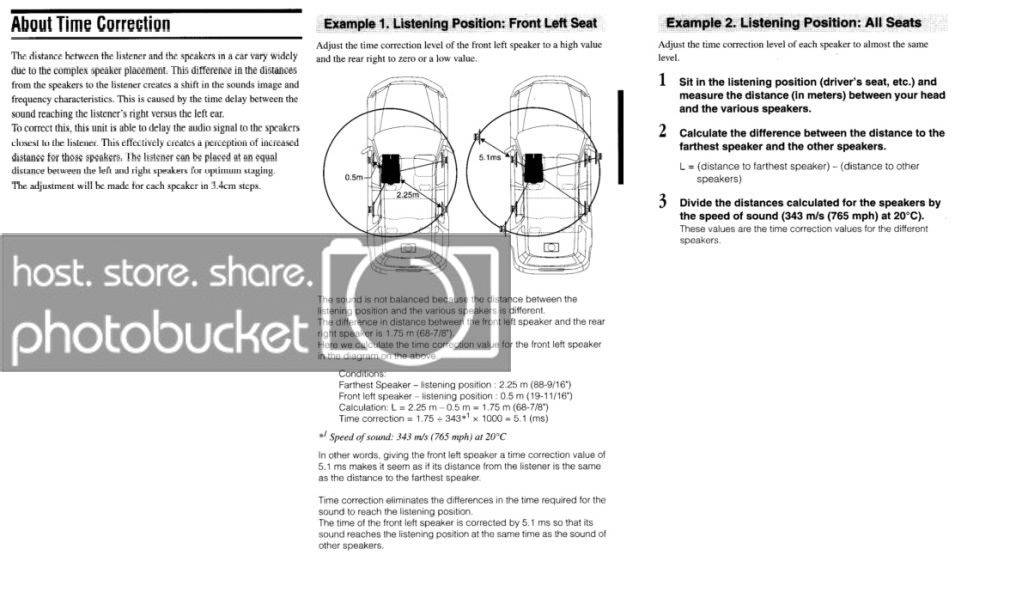
Your furthest speaker should have 0 delay as it will be the last to "hit" your ears. The closest should have the most delay. The object is to have the sound from all speakers arrive at your ears at the same time. I'm limited on time right now to do the search, but google time alignment and you'll find what/how to do the math to get you in the ballpark. the rest is actually how it sounds to your ears.

 
So the moral of the story is the closer the speakers to yourself the more you add delay i take it.

for example i should leave all speakers at 0 and add between 0-501.4 for the drivers speaker.

 
So the moral of the story is the closer the speakers to yourself the more you add delay i take it.
for example i should leave all speakers at 0 and add between 0-501.4 for the drivers speaker.
you front drivers side should have the most delay followed by usually the passenger front then the drivers rear and leave the passenger rear at 0

but its really up to your ears

 
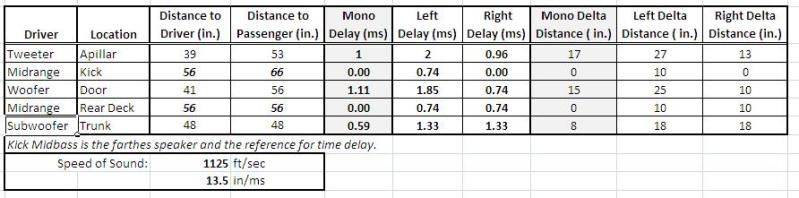
what i do is create an excel table that tells me what the difference in distance is between the closest speaker and every other speaker.

so, for each channel, measure the distance from your head to the speaker voice coil. then figure out the difference between each speaker relative to the shortest distance. that is what you use in the head unit for settings.

after that, you can tweak to shift the sound stage in horizontal and vertical position. this is best done with a test disc, like the IASCA discs. using any random song isn't useful. if you don't have a test disc, you can listen to some select songs on a home reference system, where you can sit perfectly equidistant between some nice monitors. then take notes on the sound stage (instrument placement, singer and backup singer placement, etc). then listen in the car.

i've found it's best to start with measurements, then tweak from there.

 
here is my spreadsheet

timedelaycalcs-1.jpg


"mono" delay is for two seats. equal left and right T/A.

then i tweak from there.

 
things that throw off the sound stage and make the measurement method inaccurate:

*specular reflections off glass

*poor crossover point choices

*inaccurate level setting

*speaker aiming/off-axis response/grill attenuation

*diffraction due to mounting

 
Actually my drivers side rear is located up near the inside top hinge of the door so its actually closer than the drivers front to my head, currently im experimenting. To be honest i have no idea if any of the other stuff you mention is OK or not, the manuals for these are not what i call user freindly, infact i also have no clue how the adjustment of the custom equaliser works but ill leave that for another day i think.

 
Clarion got clever and did their time alignment in in/cm instead of ms, so people don't have to do the conversion. Keep this in mind when following instructions from a different manufacturer.

 
here is my spreadsheet
timedelaycalcs-1.jpg


"mono" delay is for two seats. equal left and right T/A.

then i tweak from there.
Sorry to bring a dead thread back to life... but... what is the formula for mono delay? This would optimize TA for driver and passenger correct?

I download the spreadsheet, but the mono isn't included.

Thanks!

 
Sorry to bring a dead thread back to life... but... what is the formula for mono delay? This would optimize TA for driver and passenger correct?
I download the spreadsheet, but the mono isn't included.

Thanks!
the mono delay is just equal left and right and based on pathlength differences to the driver's side relative to the driver's seat. an alternative method is to base it on pathlength differences of the passenger side relative to the driver's seat. experiment.

 
Activity
No one is currently typing a reply...
Old Thread: Please note, there have been no replies in this thread for over 3 years!
Content in this thread may no longer be relevant.
Perhaps it would be better to start a new thread instead.

About this thread

bmwx3

Junior Member
Thread starter
bmwx3
Joined
Location
Australia
Start date
Participants
Who Replied
Replies
16
Views
10,356
Last reply date
Last reply from
keep_hope_alive
IMG_20260516_193114554_HDR.jpg

sherbanater

    May 16, 2026
  • 0
  • 0
IMG_20260516_192955471_HDR.jpg

sherbanater

    May 16, 2026
  • 0
  • 0

New threads

Top