I am new to this and not an expert by any means but I find his explanation to be a bit simplitic. He kind of goes into the fact that real world gain setting requires some overlap to sound good if you're not running two or three times the rated power to each driver but he doesn't go much further than that.
As an example: I have a 4 volt head unit. I run a pioneer premier shallowmount 10 off a 300 watt Alpine MRP M500. Before I had a 2 volt head unit.
When I had the two volt head unit the DMM method had my gains at slightly further clockwise than the .5 volt marking on the amp. When I switched to my 4 volt head unit I first tried it by ear, listening for distortion at high volumes and for the sub to rise in volume in the same linnear fashion as the rest of the deck. The gain ended up at slightly above the .5 volt mark, and the amount I was off by from setting by ear was negligible. My bass sounds clean to about 80% of max volume.
The voltage markings on alot of amps are not exact and alot of times they aren't even linnear, as in, you may see two notches close together for .2 and .5 volts but then the next one may be 1 volt, and the notches in between may not be marked at all. So good luck setting for your target input sensitivity just by looking at the dial.
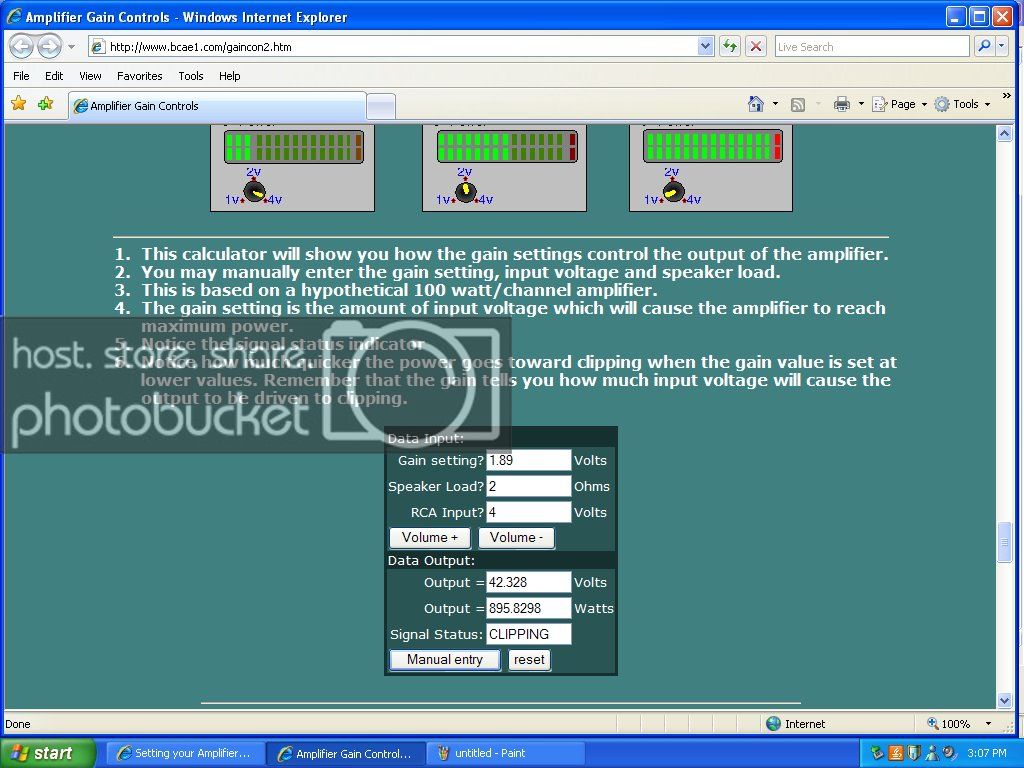
The head unit puts out 4 volts with a test tone at max undistorted volume but if your music ever reaches these levels it will be for fractions of a second. The rest of the time it'll probably be at considerably lower voltage levels, too low to trigger those 900 watts if you try it your way.
At bare minimum use the DMM method and test tones if you're really lookin to get a good starting point. Figure out where your head unit distorts and what's the highest you plan to turn it up then aim for making your target voltage and power output at a notch or two below it. There are better methods but this would be better than trying to figure it out on the amp's gain dial.