amp gain calculations (pic)

Jakeeck
10+ year member

CarAudio.com Elite
gains.jpg


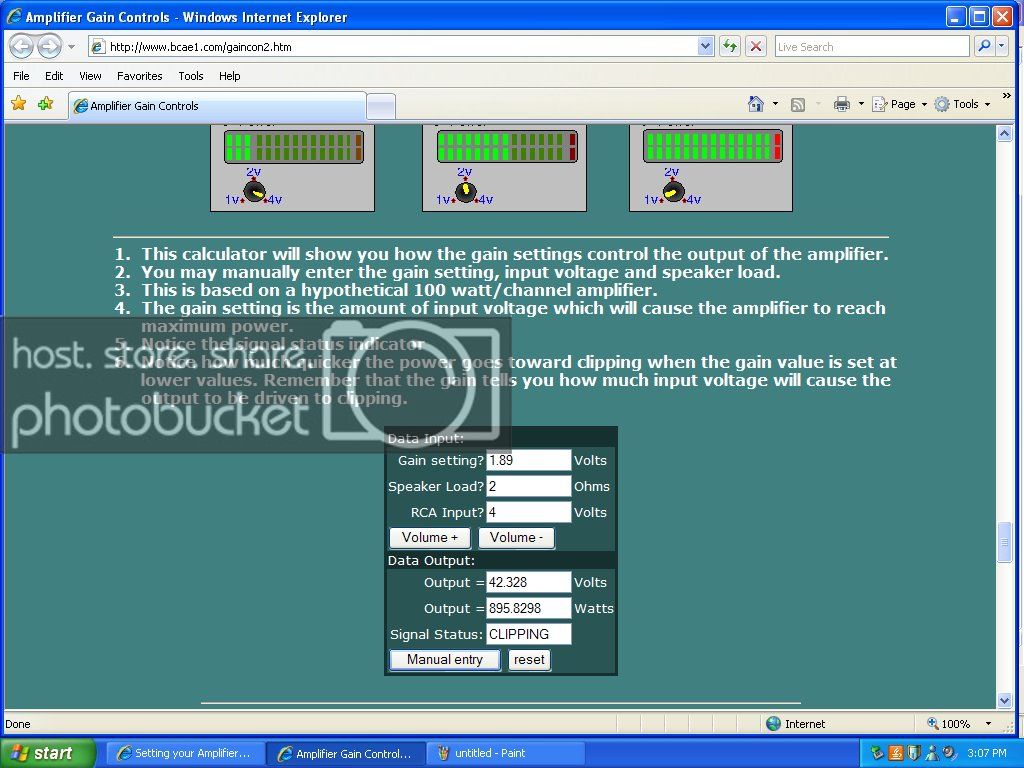
so according to this picture.. with a 4v output deck and a 2ohm load.. i should set my gain to 1.89v correct? my amp is a hifonics 1208d wired at 2 ohms which acquires 900w... which is like setting my gain about 85% of the way

is that correct?

http://www.bcae1.com/gaincon2.htm

calculator is here for anyone who wants to see it.. bottom of page

 
That is just a ball park setting assuming that your Hifonics actually makes RATED power! You need to use your ear to do the rest!

As for the rated power comment.... I watched a Hifonics BXi 1608D start to clip at about 800 watts of output with a 2 ohm reactive resistive load (i.e. the subwoofers) on a 0 dB 50 Hz test tone @ 13.1 volts. Will they ALL make less than rated power? I don't know. But to assume ALL 08 series Hifonics will indeed make rated power is something I would not recommend based on their prior track record of being OVER rated!

 
That is just a ball park setting assuming that your Hifonics actually makes RATED power! You need to use your ear to do the rest!
As for the rated power comment.... I watched a Hifonics BXi 1608D start to clip at about 800 watts of output with a 2 ohm reactive resistive load (i.e. the subwoofers) on a 0 dB 50 Hz test tone @ 13.1 volts. Will they ALL make less than rated power? I don't know. But to assume ALL 08 series Hifonics will indeed make rated power is something I would not recommend based on their prior track record of being OVER rated!
**** clipping at 800 is pretty bad.. so i guess i should just go outside and put in a song with heavy bass, set all my HU settings to 0, and increase the gain until it starts to sound like shit and then turn it back to where it still sounds good?

but say this was a perfect world and my deck put out exactly 4v and my amp did rated power.. would setting the gain at 1.89v be correct?

 
I am new to this and not an expert by any means but IMHO on that website he shouldn't have gone into amp voltage vs. head unit voltage nearly as much as he did. It's enough to give people the impression that you can get an accurate setting this way. He kind of goes into the fact that real world gain setting requires some overlap to sound good if you're not running two or three times the rated power to each driver but he doesn't go much further than that.

As an example: I have a 4 volt head unit. I run a pioneer premier shallowmount 10 off a 300 watt Alpine MRP M500. Before I had a 2 volt head unit.

When I had the two volt head unit the DMM method had my gains at slightly further clockwise than the .5 volt marking on the amp. When I switched to my 4 volt head unit I first tried it by ear, listening for distortion at high volumes and for the sub to rise in volume in the same linnear fashion as the rest of the deck. The gain ended up at slightly above the .5 volt mark, and the amount I was off by from setting by ear was negligible. My bass sounds clean to about 80% of max volume.

On the other hand with my Eclipse EA4200 for my door speakers when I mess with the gain on that using 0DB test tones it seems to end up exactly on the notch that matches the rated voltage output for my HU and everything sounds perfect at that level or maybe with a tiny bit of overlap. Go figure.

The voltage markings on alot of amps are not exact and alot of times they aren't even linnear, as in, you may see two notches close together for .2 and .5 volts but then the next one may be 1 volt, and the notches in between may not be marked at all. So good luck setting for your target input sensitivity just by looking at the dial.

The head unit puts out 4 volts with a test tone at max undistorted volume but if your music ever reaches these levels it will be for fractions of a second. The rest of the time it'll probably be at considerably lower voltage levels, too low to trigger those 900 watts if you try it your way.

At bare minimum use the DMM method and test tones if you're really lookin to get a good starting point. Figure out where your head unit distorts and what's the highest you plan to turn it up then aim for making your target voltage and power output at a notch or two below it. There are better methods but this would be better than trying to figure it out on the amp's gain dial.

 
I am new to this and not an expert by any means but I find his explanation to be a bit simplitic. He kind of goes into the fact that real world gain setting requires some overlap to sound good if you're not running two or three times the rated power to each driver but he doesn't go much further than that.
As an example: I have a 4 volt head unit. I run a pioneer premier shallowmount 10 off a 300 watt Alpine MRP M500. Before I had a 2 volt head unit.

When I had the two volt head unit the DMM method had my gains at slightly further clockwise than the .5 volt marking on the amp. When I switched to my 4 volt head unit I first tried it by ear, listening for distortion at high volumes and for the sub to rise in volume in the same linnear fashion as the rest of the deck. The gain ended up at slightly above the .5 volt mark, and the amount I was off by from setting by ear was negligible. My bass sounds clean to about 80% of max volume.

The voltage markings on alot of amps are not exact and alot of times they aren't even linnear, as in, you may see two notches close together for .2 and .5 volts but then the next one may be 1 volt, and the notches in between may not be marked at all. So good luck setting for your target input sensitivity just by looking at the dial.

The head unit puts out 4 volts with a test tone at max undistorted volume but if your music ever reaches these levels it will be for fractions of a second. The rest of the time it'll probably be at considerably lower voltage levels, too low to trigger those 900 watts if you try it your way.

At bare minimum use the DMM method and test tones if you're really lookin to get a good starting point. Figure out where your head unit distorts and what's the highest you plan to turn it up then aim for making your target voltage and power output at a notch or two below it. There are better methods but this would be better than trying to figure it out on the amp's gain dial.
o ya i know its impossible to get it to exactly 1.89v just looking at the dial.

would u recommend i just go out there and put in a song like put on or white girl or somethin and just increase gain until it starts to distort?

 
If you like. Alot of people, and ALOT of proffessional installers usually do it this way and send people out of the install bay with it tuned like that.

 
just by ear u mean?
Yep. Been to a couple high end shops, a so-so shop, Best Buy, Circuit City. Always seen it done by ear. When Im sitting in the waiting room and I hear my IPOD music blaring from the install bay I know it's almost time to go home and start re-tuning from scratch.

 
Activity
No one is currently typing a reply...
Old Thread: Please note, there have been no replies in this thread for over 3 years!
Content in this thread may no longer be relevant.
Perhaps it would be better to start a new thread instead.

About this thread

Jakeeck

10+ year member
CarAudio.com Elite
Thread starter
Jakeeck
Joined
Location
Eutopia
Start date
Participants
Who Replied
Replies
12
Views
1,317
Last reply date
Last reply from
Mr. Slate
1778578257023.png

Glen Rodgers

    May 12, 2026
  • 0
  • 0
Screenshot_20260511_212804_Amazon Shopping.jpg

Blackout67

    May 11, 2026
  • 0
  • 0

New threads

Top