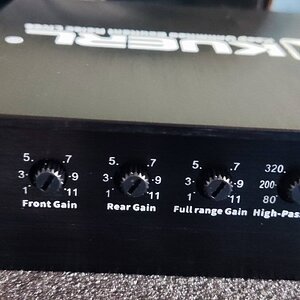
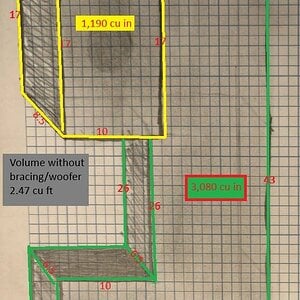
3/4 vs 5/8 grade MDF boxes and L ports.

If one sub blows or just stops playing, there's a good chance the other will suffer mechanical damage due to the sudden strain of being in a box twice the proper size. Another point I think could be an issue with enclosures without individual chambers is that I don't see bass rhythms sent in stereo to the right and left subwoofers alternatively (rhythms specifically meant to hit the left or right woofer and vice versa in stereo)being as clear/clean in sequence.
that would only apply to a sub setup with a 2-channel amp, most large proper setups run mono block and if one goes the other will stop.

 
with common chamber enclosures you have a few challenges (that are usually overlooked).

1. excursion is reduced due to the two subs fighting each other to pressurize the space. separate the airspace and excursion is more (all else equal).

2. common chamber enclosures can be smaller since the sub will "see" more than half of the airspace, but how much requires computer modeling to determine response characteristics. 2/3 is an old rule of thumb.

3. distance from port mouth to each sub can be different, that will result in slightly different tuning for the two and worsen cancellation.

properly designed common chamber enclosures can be great. few people ever "design" they just build.

 
@keep_hope_alive RE ''L'' ports, standard Slot ports and Flared ports. Do you prefer one over the other.

I realize there are other factors which determine the type of port which might suit a certain setup and music type, but it seems too slight too really make a difference with port tuning. Do you prefer one over the other? Perhaps you could offer some insight as to the pros and cons of one over the other. Thank you.
 
[quote name='Jaguar']That 1+ inch front baffle on that box is kind of s.e.x.y.__Did you make that, do you make boxes? I need one made soon.[/QUOTE]

I'll 2nd that, nice work, @goingdef


[quote name='Jaguar']This is an excellent point... I have no idea if the theory on slot ports possibly causing a slight turbulence vs flared ports hold water though. Visually, I can imagine how it could, but then I also think a more curved design inside and out of the box would also be more conducive to the way sound travels as
opposed to rectangular shapes and port walls. Am I wrong?
[/QUOTE]

From my experience, the flared circular port's main advantage is that it reduces port noise vs. a circular port without the flared ends. A slot port with routed edges, IMO, is the way to go. I think it comes down to a matter of personal preference, if the design allows both options.
(seems like I just said this, lol)


[quote name='Jaguar']The only thing I'd be hesitant about with dual subwoofer enclosures without individual chambers is that if one subwoofer blows the other is likely to blow
after and soon . Even if your fortunate enough to notice one is blown without the other being blown, it's like you said the other could end up out of phase.
[/QUOTE]

That makes no sense. when a sub stops working, the effect is reduced output...or depending on the wiring scheme, possibly no output from either driver. But the idea of one sub blowing and causing the other to blow makes no sense..You would have to assume the sub that blew was either drastically overpowered or clipped. Then the possibility of the other sub suffering the same fate is extremely high if it is continued to be used in that same manner.
 
and I could be wrong too looking at the other posts, the idea of one sub being pushed with the same power in a much larger airspace all of a sudden and having ill effects is a possibility as well , thx @Flex68 and @keep_hope_alive

I wasn't thinking about the other sub unloading at a different tune than designed, but this idea is more specific to the sub being used, power used and box design.
 
That makes no sense. when a sub stops working, the effect is reduced output...or depending on the wiring scheme, possibly no output from either driver. But the idea of one sub blowing and causing the other to blow makes no sense..You would have to assume the sub that blew was either drastically overpowered or clipped. Then the possibility of the other sub suffering the same fate is extremely high if it is continued to be used in that same manner.
Could you be wrong or is it possible I have not used words close enough for people to understand. What I wrote has nothing to do with my personal experience, I wrote it because I see people specifically sighting those problems in accordance with dual sub setups in common chambers. Perhaps, what they had written was in theory, but it seemed unlikely since I read of similar issues in several different locations. Re: If one sub blows, the other could blow, or if one sub blown in a common chamber the other sub can suffer mechanical damage due to the sudden strain of being in a box twice the proper size.

 
Actually, I was being facetious regarding what OP wrote ("due to the sudden strain of being in a box twice the proper size").

Is the loss of one sub in a shared enclosure something that could cause issues with the second sub if not addressed? Yes.

Is that second sub suffering a "sudden strain of being in a box twice the proper size?" uhm, maybe upon that initial loading difference...if it is a POS that was being pushed to its max limitations beforehand.

Are most audiophiles going to "miss" the fact that they have lost one of their two subs, and just keep on pounding? Nope, most are going to immediately be like, "WTF?!" and reach to turn down the volume, then continue on to find out what is up before any damage is done to 2nd sub.

Are most systems going to be running a monoblock that will react appropriately before they can even turn down the volume, if there are overloading issues, anyway? I'd hope so.

There's just a heyull of a lot more stuff that I'd be worried about with any system, prior to adding what the OP was professing into the equation...just think there is a miniscule liklihood of it ever happening.

(All this makes me think of holic's sig about not ever blowing a sub by underpowering it, lol)

 
@quackhead Well, it seems to me that it's unlikely a sub to blow because two subs are in a common chamber, that was never my point my friend. I suppose the sooner one would notice a sub was blown in a common chamber the greater chance one would have of saving the other sub from mechanical damage (however slight)or blowing because the one good sub would then be operating in an airspace twice the size it was designed for in a common chamber. The level of risk to the one sub left winds down to timing, still though the risk for two subs being damaged would be because of common chambers. With separate chambers If it's a dual 12" setup, It's hard to pinpoint how similar the damage would be if one sub would blow since the subs are separated, but the amp would still be pushing the one sub left (in it's separate chamber) hard until someone noticed.
 
[quote name='Jaguar']@quackhead Well, it seems to me that it's unlikely a sub to blow because two subs are in a common chamber, that was never my point my friend. I suppose the sooner one would notice a sub was blown in a common chamber the greater chance one would have of saving the other sub from mechanical damage (however slight)or blowing because the one good sub would then be operating in an airspace twice the size it was designed for in a common chamber. The level of risk to the one sub left winds down to timing, still though the risk for two subs being damaged would be because of common chambers. With separate chambers If it's a dual 12" setup, It's hard to pinpoint how similar the damage would be if one sub would blow since the subs are separated, but the amp would still be pushing the one sub left (in it's separate chamber) hard until someone noticed. [/QUOTE]

As it has been said, the outcome would be greatly affected by the subs in question, the amount of power in question and the overall box design...to many variables involved to say yes or no, I did not exclude the possibility, anything is possible in your scenario.
Do I think is is worth the extra expense(subs used, materials, advanced design) to avoid the possibility of sub failure due to sub failure?
No.
Am I wrong?, only if You do not know what you are doing.
 
[quote name='Jaguar']@keep_hope_alive RE ''L'' ports, standard Slot ports and Flared ports. Do you prefer one over the other.

I realize there are other factors which determine the type of port which might suit a certain setup and music type, but it seems too slight too really make a difference with port tuning. Do you prefer one over the other? Perhaps you could offer some insight as to the pros and cons of one over the other. Thank you.
[/QUOTE]

Properly designed slot, individual chambers, maximum rigidity. A good design doesn't need "trial and error"?

If you don't know what you're doing, flare and play with length.

Placement is crucial and depends on application.
 
Activity
No one is currently typing a reply...
Old Thread: Please note, there have been no replies in this thread for over 3 years!
Content in this thread may no longer be relevant.
Perhaps it would be better to start a new thread instead.

About this thread

Jaguar

10+ year member
Senior VIP Member
Thread starter
Jaguar
Joined
Location
GA
Start date
Participants
Who Replied
Replies
43
Views
17,880
Last reply date
Last reply from
keep_hope_alive
IMG_20260506_140749.jpg

74eldiablo

    May 22, 2026
  • 0
  • 0
design.jpeg

WNCTracker

    May 22, 2026
  • 0
  • 0

New threads

Top