alot to read but worth your time
DD ENCLOSURE INFORMATION
Excursion Capability And System Efficiency
The current trend in car audio these days is toward higher output systems. Probably the most crucial element in designing a high output system is the speaker/enclosure combination. The conversion from electrical energy to acoustic energy takes place at the speakers, this is the least efficient link in the chain. Therefore, maximizing speaker/enclosure interface has the most impact on total system performance.
Small Sealed Box = Small Sound
The recent past in car audio saw the growth of the sub in the small sealed box application. This design relies heavily on the transfer function of the cars interior to deliver low frequency output. This application has many practical uses; true high output however, is not one of them. The combination of an inefficient subwoofer in an inefficient enclosure is finding fewer applications in this sheet metal shaking world.
Small sealed boxes are classified as high Q designs. They do not provide adequate damping to the cone and have a corresponding high peak in the response. Increasing the box size will lower the –3dB down point of the system, forcing the speaker to play lower and move further. This is why some manufactures recommend small sealed boxes for their drivers, this type of box limits the low frequency output and becomes a power limiter for the speaker.
Since the small sealed box adds little spring or restoring force to the cone, it allows the cone to get uncontrolled at certain frequencies. This high Q alignment results in a humped output just above the system resonant frequency. This hump can increase output in a narrow range, but not without drawbacks. The hump or peak is followed by severe ripple in the response while the lack of cone damping diminishes the driver’s ability to react quickly, creating a kind of thunder mud bass. I bet that smells funny.
Speaker Design For Small Sealed Boxes
The typical speaker for small box installation would have a very loose suspension, high moving mass and low magnetic drive force (or BL product- this is the voice coil energy multiplied by the magnet system energy). This keeps the –3dB as low as possible in a small box. The low motor force helps get the Qts. up higher in order to get any bass from the acoustic suspension design.
Now you have a weak suspension, a weak motor and high moving mass. Not really a recipe for control. These systems tend to flop around when any real power or EQ is added to the system. What could make things even worse? Use a small sealed box. Now you've got a weak speaker in a weak box, neither the speaker nor the box, have much, if any restoring force to the cone. It'll play fine at lower volumes though, be happy.
Lets Start With A Clean Slate, What Would Work Better?
Misconceptions about vented and sealed box types (called alignments) abound. What is more important than the box type, is the proper application. Most bad experiences are due to poor engineering application than inherent box type characteristics. There are examples of both types in the professional audio and high-end consumer audio representing pinnacle achievements in sound quality. Proper driver selection and enclosure integration is the key to success.
DD drivers are designed to deliver high output in moderate sized enclosures and at the same time, provide a fast transient response (the basis for good sound quality and high efficiency).
The DD Box
In order to get the most performance from these non-optimum applications we have taken a different approach. We keep the moving mass low, energy high and add a suspension with high restoring force to help control cone motion. This means that the subs will not have to rely on the box for their loading.
The vehicle itself will offer some loading to the system, and the transfer function will make the system play an octave lower than the tuning freq. So, if you could find some speakers that could stay in control below the box tuning, subs that are really tuned to the box loading plus the car loading, you could design a system to play low. loud and do it in a relatively small box. That is what we designed and spent many years developing.
The DD box system provides great bass AND high efficiency from small spaces. We wanted to make great bass possible for anyone, even if there wasn't much space available. We set about designing subs to maximize the available airspace.
Each Sub Series we make is designed to work in the DD Boxes. Each size sub in the series is designed for the same response. They all get the same motor, the same spiders, suspension throw and power handling. The 10 inch size will play just like the 15, but do it in a much smaller space.
Which would be louder?
A common question we get (ALL THE TIME) is, "which would be louder?" Lets say that you have a 1.5 cubic foot box and 300 watts of power. Is the top of the line 18" woofer going to outperform the little 10" woofer? Doubtful.. Like we said, the speaker is the least efficient part of the system. So why not make the small box more efficient by not cramming a humongo woofer in it. The big woofer will essentially suffocate in that small box. With the 10" woofer in its properly fitted box, it will perform how it was designed to. And along with your great sounding woofer, you wont get made fun of in the forums. Installing a subwoofer system takes some planning. Before you buy anything, you should decide how much space in your vehicle you are willing to give up. Once you've figured out what size box you want to use, check out the list below to see what combination of woofer(s) will fit. So fit the box to the vehicle and then fit the subs to the box.
Match The Right Sub(s) To the Space
Here is the method for matching the subs to the space:
8" woofer- .7 - 1.0 Cubic Feet
10" woofer- 1.2 - 1.5 Cubic Feet
12" woofer- 1.7 - 2.5 Cubic Feet
15" woofer- 3.0 - 4.5 Cubic Feet
THE DD PORT
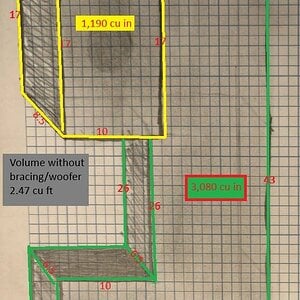
The port formula for the above box sizes is as follows: 15-16 square inches of port area per cubic foot of box volume, make the port 16 inches deep. The port is tuned to the box volume, not the subs.
Once you determine how much space you have available, divide the sub(s) into that space. Don't cram the space, its better to error on the big side than the small side. A 10" sub will outperform a 12" sub if the space isn't big enough.
The proper combination of a vented enclosure coupled to a driver that is suited for this application can give a substantial increase in output for a given input power and yield outstanding SQ. A vented enclosure has increased output due to the fact that it has an increased effective radiating area.