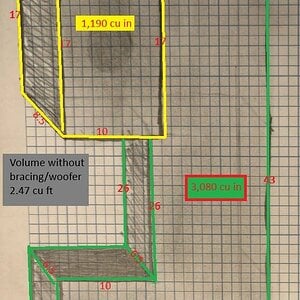
xmax......Box.....Efficiency....
That's pretty much what it comes down to. No replacement for displacement, and the type of box/install for the equipment.
If you compare a subwoofer to a piston engine's bore and stroke, you get a good idea of how it relates. The bore (piston size) would be your cone area, the stroke is the Xmax. If you want to displace a lot of air, you either need more cone area, lots of xmax or a combination of both.
These are not exact numbers, but here is the relation:
1) One 10" sub with an xmax of 15mm = ~One 12" sub with an xmax of around 8mm.
2) One 10" sub with an xmax of 30mm = ~One 12" sub with an xmax of 15mm
These are approximates to show the relation of xmax verses cone area.
For all out SPL applications, port effects (tuning, velocity, direction and type), box type, position of the box in the cab, frequency played at - all give an extra edge when comparing 2 systems with the exact same equipment (subs, amps).
Efficiency. The more efficient the sub, the less power it takes to move the same amount of xmax as another sub. A 97db @ 1W, 1M is going to be a lot more sensitive and take a lot less power than a sub that is 80db @ 1W, 1M. This is how you can take 8 "cheap" subs with higher sensitivity and make them out perform 2 - 4 subs with less sensitivity, AS LONG AS the xmax of both subs is pretty similar at max output. If you have 1 sub putting out 15mm xmax and another one at 50mm, that is an unfair advantage of the higher xmax sub.
That being said, there is a lot of ways to reach over 150db with a Single 12" sub and moderate amount of power, but many fail to see how this is possible. //content.invisioncic.com/y282845/emoticons/wink.gif.608e3ea05f1a9f98611af0861652f8fb.gif 90% install, 10% equipment is the key to this equation.....