Ok Buddy, it sounds like you need School on the BASIC principles of audio reproduction.
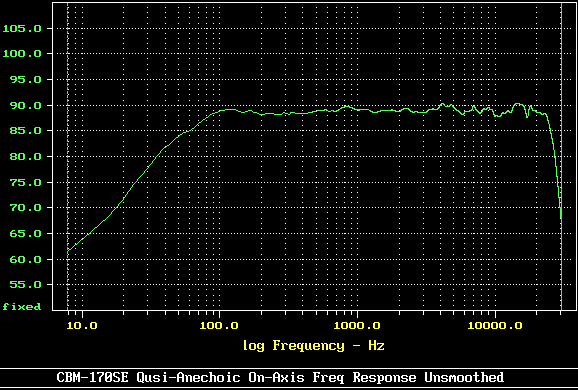
Lemme leech a response graph from Ascend Acoustics, since I love that company so much:
Now, Wattage is SECONDARY to how loud a speaker can go. WATTS DO NOT DIRECTLY EQUAL VOLUME. Watts CERTAINLY have nothing to do with quality, either. I would much rather have a system with a smooth Frequency Response across the board instead of a system that can play, say, 45hz at 100 SPL all day long.
Which brings me to SPL. SPL is "Sound Pressure Level", and this is what most people interpret as 'loudness' or 'volume'. That's the actually air pressure created to make your sound wave.
On the graph, to the left is the SPL as indicated in dB, or Decibels. This graph was taken (as it say on the top) at 1 meter away from the speakers (home theatre speakers by the way, car audio only differs when you get into the on/off axis response, which we'll get to). As you can see, these speakers produce a whopping 90 decibels of response on a single watt with the microphone sitting 1 meter away. You're not going to be sitting a meter away from car speakers...
On the bottom of the graph it says 'frequency'. It is what it says, frequency measured in Hz. Now, the limit for a person to be able to not easily hear a dip in SPL (or volume) is 3 dB. To get the most accurate sound possible, a speaker shouldn't go below 3dB in its intended range of audio reproduction. I've seen some speakers with even tighter tolerances - +/- 2dB!
With Car Audio things are different, mostly the install location of the components, the Tweeter especially. High frequencies are WAY more dependant on placement than lower frequencies. The lower you go in frequency, the less placement matters. The generally understood bottom limit is 80 hz, where actual placement doesn't matter...I'm picky, and I prefer below 50hz. It's at this point where things are completely omnidirectional, meaning that no matter where your sub goes (you will be using a sub for these low frequencies) you'll hear those bass notes as if they're coming from your front speakers, if your subwoofer is properly installed. In order to make up for placement issues, the crossovers are very important...and that's about the limit to my knowledge.
In short, watts almost don't matter at all. You shouldn't be looking at wattage - it's just how much power the speaker can take before it fries...and you also need to actually consider the QUALITY of the watts you're getting as well. I've seen 5, yes FIVE watt amplifiers that blow away 100 watt amplifiers (the five watt amp is a Tripath-based T-Amp, btw).
Take the speakers you 'see' in the graph above. At 1 meter away, the SPL is still at about 90 decibels powered on a single watt. These are 150 watt RMS speakers.
Edit: Now let's talk about STEREO!
Stereophonic (or Stereo for short) speakers were introduced to more accurately reproduce sound. The logic is that because we have two ears, two speakers angled towards our heads SHOULD in theory produce a '3D' sound. This '3D' sound is what is known as the 'Stereo Image'. Now, in practice it falls a little short (thus more speakers in a home theatre setup), but with a really good setup (such as mine) it can come pretty **** close to creating an 'image' that makes you feel like you're 'in' the sound, as opposed to just percieving sound coming out of speakers. This is one reason why your headrest install is a horrible idea.
Now, since it's hard to create a good stereo image in the car audio environment, the best installs use component tweeters. This is because, as I mentioned previously, the higher the audio frequency is, the more directional the sound becomes. This means that placement becomes more and more important. Component tweeters allow you to install the tweeters in a position that actually points towards your head. There are also optional 'imaging kits' that you can buy to add an additional set of tweeters. This allows your 'main' tweeters to be configured to produce the sound, and the 'image' tweeters to actually create the stereo image effect.