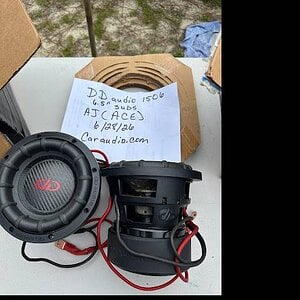
voice coils

generally a subwoofer comes with one coil. sometimes its offered in a secondary impedance for more amplifier options. for example, you might be able to get one subwoofer in a 2 ohm or a 4 ohm. Those are different gauge voice coils. One coil is actually thicker than the other, but genearlly only very slightly. The steel gap plate is also compensated for the difference in coil thickness so that the usually the thiele small parameters are very similar for both impedances. Sometimes you'll see dual or even quad voice coils. These are identical to single voice coils except the coil is cut in half and then you have the options of connecting back in series or parallel. The advantage here is that you can connect it back in parallel and reduce the resistance further to draw more current from the amplifier at the same voltage. This of course puts most amplifiers at higher risk because they are producing more power and generating more heat.
If you are talking about different coils for different subwofoers, well I can assure you that you need not worry so much about that. There are literally hundrends of numbers when it comes to designing a voice coil and most of them you'll never need to know. Even more complex is the theory of linear drivers and then understanding how voice coils behave in a 2D non-linear magnetic flux field. Trust me, its not worth getting into unless you plan on designing your own.

One of the many myths about coils is that the better coils take more power. This is really not what you're after. What you're after is SPL and unfortunately there are no voice coils for speakers that can avoid heating up because they generally use metals like aluminum or copper. All too often people consider how many "watts" a driver (subwoofer) can take but rarely plot or calculate the actual response in a system which will tell you much more. For example, there is no point in putting 1000 watts on a driver if you blow past xmax in your passband. Likewise, there is no point in getting a low sensitivity woofer that has very high xmax and then not being able to use it all because you dont have the power.

The major differences between aluminum and copper are mass. Copper has triple the mass of aluminum, but at the same time it cools better and conducts better. So the copper coil will be able to handle more current and provide more BL product for a normalized resistive load. But the mass differences actually make aluminum more ideal is most circumstances therefore most voice coils are aluminum.

What he said.

 
generally a subwoofer comes with one coil. sometimes its offered in a secondary impedance for more amplifier options. for example, you might be able to get one subwoofer in a 2 ohm or a 4 ohm. Those are different gauge voice coils. One coil is actually thicker than the other, but genearlly only very slightly. The steel gap plate is also compensated for the difference in coil thickness so that the usually the thiele small parameters are very similar for both impedances. Sometimes you'll see dual or even quad voice coils. These are identical to single voice coils except the coil is cut in half and then you have the options of connecting back in series or parallel. The advantage here is that you can connect it back in parallel and reduce the resistance further to draw more current from the amplifier at the same voltage. This of course puts most amplifiers at higher risk because they are producing more power and generating more heat.
If you are talking about different coils for different subwofoers, well I can assure you that you need not worry so much about that. There are literally hundrends of numbers when it comes to designing a voice coil and most of them you'll never need to know. Even more complex is the theory of linear drivers and then understanding how voice coils behave in a 2D non-linear magnetic flux field. Trust me, its not worth getting into unless you plan on designing your own.

One of the many myths about coils is that the better coils take more power. This is really not what you're after. What you're after is SPL and unfortunately there are no voice coils for speakers that can avoid heating up because they generally use metals like aluminum or copper. All too often people consider how many "watts" a driver (subwoofer) can take but rarely plot or calculate the actual response in a system which will tell you much more. For example, there is no point in putting 1000 watts on a driver if you blow past xmax in your passband. Likewise, there is no point in getting a low sensitivity woofer that has very high xmax and then not being able to use it all because you dont have the power.

The major differences between aluminum and copper are mass. Copper has triple the mass of aluminum, but at the same time it cools better and conducts better. So the copper coil will be able to handle more current and provide more BL product for a normalized resistive load. But the mass differences actually make aluminum more ideal is most circumstances therefore most voice coils are aluminum.
excellent info thanks man and thanks to all for the info to.
 
one more thing are kapton voice coils and Basv voice coils like some boss subs and poweracoustik sub have are thay the same as aluminum or copper i was just asking because i had a friend that burned 6 per of 15'' boss subs up and thay were under powered and then he tryed poweracoustik subs and burned 4 of those subs up so whats up with that type of voice coil because he now has a per of kicker 15s and thay have aluminum coils and he has had those kicker subs for 4 years and never burned a sub and thay are over powered why is this when thay have the same voice coil as thay say.

 
one more thing are kapton voice coils and Basv voice coils like some boss subs and poweracoustik sub have are thay the same as aluminum or copper i was just asking because i had a friend that burned 6 per of 15'' boss subs up and thay were under powered and then he tryed poweracoustik subs and burned 4 of those subs up so whats up with that type of voice coil because he now has a per of kicker 15s and thay have aluminum coils and he has had those kicker subs for 4 years and never burned a sub and thay are over powered why is this when thay have the same voice coil as thay say.
kapton is the former material, not the coil itself. The coils are wound around a former and that material can be a number of different things. Kapton has the advantage of being non conductive so when it comes into the scope of a moving magnetic field, eddy currents can not occur which cause aberrations and distortions that can be remarkably audible. Kapton is disadvantaged from metal formers in terms of stiffness and durable and also it can not conduct heat very well so it does not assist in cooling the coil itself.

 
Nothing wrong with kapton formers.. but they are generally used because they are light weight.. an aluminum former (like a basv) will add thermal mass and cooling to the coil at the cost of weight.. (not really a concearn for a subwoofer IMO)

You can also find fomer materials made of nomex, fiberglass, and a few other composites.. and no doubt some other materials I'm not thinking of right now..

 
kapton is the former material, not the coil itself. The coils are wound around a former and that material can be a number of different things. Kapton has the advantage of being non conductive so when it comes into the scope of a moving magnetic field, eddy currents can not occur which cause aberrations and distortions that can be remarkably audible. Kapton is disadvantaged from metal formers in terms of stiffness and durable and also it can not conduct heat very well so it does not assist in cooling the coil itself.
so if a poweracoustik sub or a boss sub with aluminum voice coils are like a aluminum voice coil in a kicker l7 15 why do the boss and the poweracoustik burn up so fast and the kicker l7 15 keeps on going and thay both have the same voice coils.//content.invisioncic.com/y282845/emoticons/smile.gif.1ebc41e1811405b213edfc4622c41e27.gif

 
so if a poweracoustik sub or a boss sub with aluminum voice coils are like a aluminum voice coil in a kicker l7 15 why do the boss and the poweracoustik burn up so fast and the kicker l7 15 keeps on going and thay both have the same voice coils.//content.invisioncic.com/y282845/emoticons/smile.gif.1ebc41e1811405b213edfc4622c41e27.gif
not all coils are made the same

i'm sure the Oklahoma boys know better and get good coils.

 
why don't more SPL subs have quad V.C;s
when I took apart my 15" Type R.. I just saw one big copper coil... is there really 2 in there, but you just can't see the seperation??
//content.invisioncic.com/y282845/emoticons/laugh.gif.48439b2acf2cfca21620f01e7f77d1e4.gif...

nG

 
generally a subwoofer comes with one coil. sometimes its offered in a secondary impedance for more amplifier options. for example, you might be able to get one subwoofer in a 2 ohm or a 4 ohm. Those are different gauge voice coils. One coil is actually thicker than the other, but genearlly only very slightly. The steel gap plate is also compensated for the difference in coil thickness so that the usually the thiele small parameters are very similar for both impedances. Sometimes you'll see dual or even quad voice coils. These are identical to single voice coils except the coil is cut in half and then you have the options of connecting back in series or parallel. The advantage here is that you can connect it back in parallel and reduce the resistance further to draw more current from the amplifier at the same voltage. This of course puts most amplifiers at higher risk because they are producing more power and generating more heat.
If you are talking about different coils for different subwofoers, well I can assure you that you need not worry so much about that. There are literally hundrends of numbers when it comes to designing a voice coil and most of them you'll never need to know. Even more complex is the theory of linear drivers and then understanding how voice coils behave in a 2D non-linear magnetic flux field. Trust me, its not worth getting into unless you plan on designing your own.

One of the many myths about coils is that the better coils take more power. This is really not what you're after. What you're after is SPL and unfortunately there are no voice coils for speakers that can avoid heating up because they generally use metals like aluminum or copper. All too often people consider how many "watts" a driver (subwoofer) can take but rarely plot or calculate the actual response in a system which will tell you much more. For example, there is no point in putting 1000 watts on a driver if you blow past xmax in your passband. Likewise, there is no point in getting a low sensitivity woofer that has very high xmax and then not being able to use it all because you dont have the power.

The major differences between aluminum and copper are mass. Copper has triple the mass of aluminum, but at the same time it cools better and conducts better. So the copper coil will be able to handle more current and provide more BL product for a normalized resistive load. But the mass differences actually make aluminum more ideal is most circumstances therefore most voice coils are aluminum.
//content.invisioncic.com/y282845/emoticons/applause.gif.bb805d8088f72dbc2fe808c29e85fb4c.gif People are taking time to help others on ca.com......we should all buy a bomb shelter.

 
Activity
No one is currently typing a reply...
Old Thread: Please note, there have been no replies in this thread for over 3 years!
Content in this thread may no longer be relevant.
Perhaps it would be better to start a new thread instead.

About this thread

Burp09

10+ year member
Senior VIP Member
Thread starter
Burp09
Joined
Location
meridian, ms
Start date
Participants
Who Replied
Replies
50
Views
2,886
Last reply date
Last reply from
Ed Lester
IMG_20260513_214311575.jpg

ThxOne

    May 13, 2026
  • 0
  • 0
IMG_20260513_213956814.jpg

ThxOne

    May 13, 2026
  • 0
  • 0

New threads

Top