Tuning an Amp with a DMM?

The moral of all of this is that the only really good way of setting gains is with an oscilloscope. Find someone with one with one that will do it for you or let you use one. You don't need anything special. Pretty much any working oscilloscope will do. Though I don't know if I would buy it, it looks like the steve meade distortion detector works just fine. (for that money I would order a crappy oscope, like this DealExcel: US$169.99 - Uni-T UT81B Oscilloscope 8MHz w/ USB vivid and LCD [18481]) You can measure each signal device for clipping as you set them up.
Unless your amplifier has a regulated power supply you will want to do all measurements with the load you are planning on running, i.e. with the speakers hooked up. Obviously you can do some damage to your mids/highs this way if they are not rated to handle that much power so I use a resistor at this point. However most people never come close to maxing their mids/highs so just measure this without a load knowing that they will never achieve a square wave/clipping.

I would highly recommend measuring any unregulated amplifier for subs with the subs connected however or a dummy load as your output voltage can change drastically with load. My subwoofer amplifier outputs 18 volts more at the same gain setting when the subwoofer is connected...
If a person were to only play 1 frequency, then by all means setting the gain your way would be best. Since they won't, the impedence will be all over the place. This is why you set the gain with no speakers hooked up. Geez. I swear. Why do people LOVE to talk about things they don't fully understand? If you simply kept your mouth shut and listened you would never look foolish and you might learn something.

 
yeah I always buy amps with a remote gain it's really a nice feature. Bass boost remotes fail
I usually set my amp with the remote gain all the way down and only use it if a song has really soft bass and I need extra power. I like my remote because it has a clipping light on it.

 
Someone can chime in and correct me if im wrong but I believe this is how you would do it. First, you will need a 50hz test note. You will want to find the voltage you need to set the gains at with the equation volts = sprt(wattsxohms). Unplug the subwoofers from the amp and put your dmm in the terminals. Keep the RCA's plugged in. turn the subsonic filter off. Then on your deck set all your eq settings to zero or flat. You will want your deck on the highest volume you listen to it at or some say 3/4 of the way up and make sure your bass knob to your amp is at max if you have one. Put the 50hz note on repeat and you should get a reading on the dmm. Turn the gain tell you reach the voltage you found in the equation. Example of equation would be sprt(1500x1ohm) so sqrt(1500) = 38.73 So you would turn the gain up or down tell you reached 38.73. Then reconnect your subs to the amp and you should be set. If doing it with a 4 chanell i believe evertything is the same but you will use a 1khz test note instead.
Ok so my amp is 2200 watts but idk if my subs can take all of that I've heard they can but I don't think I want to use all of that what would you guys recommend I use for watts?

 
The moral of all of this is that the only really good way of setting gains is with an oscilloscope. Find someone with one with one that will do it for you or let you use one. You don't need anything special. Pretty much any working oscilloscope will do. Though I don't know if I would buy it, it looks like the steve meade distortion detector works just fine. (for that money I would order a crappy oscope, like this DealExcel: US$169.99 - Uni-T UT81B Oscilloscope 8MHz w/ USB vivid and LCD [18481]) You can measure each signal device for clipping as you set them up.
Unless your amplifier has a regulated power supply you will want to do all measurements with the load you are planning on running, i.e. with the speakers hooked up. Obviously you can do some damage to your mids/highs this way if they are not rated to handle that much power so I use a resistor at this point. However most people never come close to maxing their mids/highs so just measure this without a load knowing that they will never achieve a square wave/clipping.

I would highly recommend measuring any unregulated amplifier for subs with the subs connected however or a dummy load as your output voltage can change drastically with load. My subwoofer amplifier outputs 18 volts more at the same gain setting when the subwoofer is connected...
used it and it worked great well worth the price and much easier to use than a oscop

 
If a person were to only play 1 frequency, then by all means setting the gain your way would be best. Since they won't, the impedence will be all over the place. This is why you set the gain with no speakers hooked up. Geez. I swear. Why do people LOVE to talk about things they don't fully understand? If you simply kept your mouth shut and listened you would never look foolish and you might learn something.
\
So instead of having the mean average as a representation of your speakers load, you would prefer no load when setting gains?

I will try to be nice at this point (even though it seems your a giant **** from most of your posts) and assume you have no knowledge of electronic circuits and have only ever used JL audio amps or another tightly regulated amplifier when setting gains.

If someone with an unregulated amplifier sets gains with no load they will push there amplifier into clipping once they have hooked up a subwoofer to it.

So anyone that uses an amp like say... an AudioQue AQ2200D(the amp in the op's sig) which is NOT tightly regulated (like 80% of car amplifiers) will be distorting like crazy at what they think is a safe volume. Especially in a more extreme case like the OP's with a 1 ohm load.

Also since the whole idea of properly setting amp gains is to make sure that we don't induce distortion or clipping lets see how well my method of using a resistor works in the ops case.


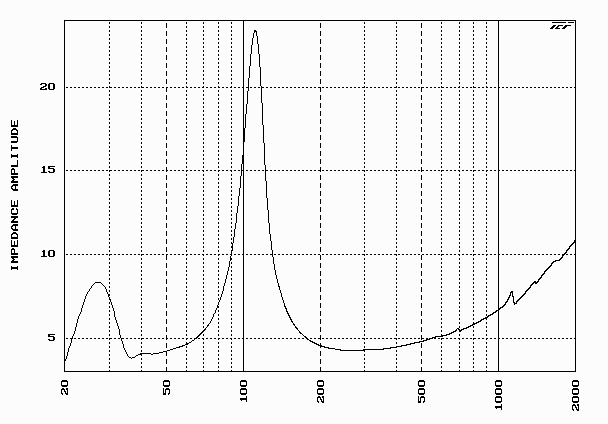
Here is the impedence curve with box rise of the ops subs modeled in Sundowns recommended ported enclosure. Seems like a 1 or 2 ohm resistor would have covered all of his bases for distortion wouldn't it?

 
\
So instead of having the mean average as a representation of your speakers load, you would prefer no load when setting gains?

I will try to be nice at this point (even though it seems your a giant **** from most of your posts) and assume you have no knowledge of electronic circuits and have only ever used JL audio amps or another tightly regulated amplifier when setting gains.

If someone with an unregulated amplifier sets gains with no load they will push there amplifier into clipping once they have hooked up a subwoofer to it.

So anyone that uses an amp like say... an AudioQue AQ2200D(the amp in the op's sig) which is NOT tightly regulated (like 80% of car amplifiers) will be distorting like crazy at what they think is a safe volume. Especially in a more extreme case like the OP's with a 1 ohm load.

Also since the whole idea of properly setting amp gains is to make sure that we don't induce distortion or clipping lets see how well my method of using a resistor works in the ops case.


Here is the impedence curve with box rise of the ops subs modeled in Sundowns recommended ported enclosure. Seems like a 1 or 2 ohm resistor would have covered all of his bases for distortion wouldn't it?
I can tell from your posts that you have no clue what you're talking about and now want to try to save some face. That is no impedence plot because it never shows the impedence dropping below nominal (anyone with any knowledge of transducers knows the impedence drops WELL below nominal at certain frequencies and is jagged and all over the place. )
zplot.gif
is an actual plot of an 8 ohm driver. Now, regulated doesn't matter much if at all because the amps you are talking about are regulated between 1.5 and 4 ohms. As we can all see, the speaker aka transducer has a MUCH wider range of impedences it goes through while playing than just those. As we can also see, the impedence DROPS BELOW NOMINAL frequently. This means setting the gain with a speaker connected will cause the impedence to rise and you set your gain too high. Then when it reaches nominal impedence or lower (it will... constantly) you clip the hell out of it. It's better to set it for nominal because it's much safer on your equipment.

Here is an 8 ohm speaker
IMAGE2%202.GIF
http://www.churchsoundcheck.com/imp1.html

 
LOL! " It's better to set it for nominal because it's much safer on your equipment." Well you got that part right. Thanks for agreeing with me that you were wrong earlier. Yes please set your amp up with the nominal load, NOT with no load...

"The amps you are talking about are regulated between 1.5 and 4 ohms" ROFL Anyone that reads this is just laughing at your right now.

Also as I said above that impedance curve was with box rise and was also simulating voice coil inductance.

Please show me a tested speaker impedance graph in a ported box that goes below nominal on any frequency you would actually play with it. Any video of an actual test that we can watch would suffice as your are obviously pulling crap out of your butt to save your internet epeen.

 
LOL! " It's better to set it for nominal because it's much safer on your equipment." Well you got that part right. Thanks for agreeing with me that you were wrong earlier. Yes please set your amp up with the nominal load, NOT with no load...
Nobody EVER said no load. You know you're wrong so you're now lying about it.

"The amps you are talking about are regulated between 1.5 and 4 ohms" ROFL Anyone that reads this is just laughing at your right now.
Prove me wrong. JL amps claim the same regulated output between those frequencies. If what I said is wrong prove it. Otherwise you admit you're lying and wrong.

Also as I said above that impedance curve was with box rise and was also simulating voice coil inductance.
It was just pure bs. It never showed impedence going below nominal, which anyone who knows anything knows loudspeaker impedence does... it drops as well as rises.

Please show me a tested speaker impedance graph in a ported box that goes below nominal on any frequency you would actually play with it. Any video of an actual test that we can watch would suffice as your are obviously pulling crap out of your butt to save your internet epeen.
So you're saying that impedence ONLY rises in a ported box? Make this statement clear before I post my evidence.
 
I don't even know if your trolling this is so funny.

"This means setting the gain with a speaker connected will cause the impedence to rise and you set your gain too high"

Rising impedance=less voltage=less clipping

 
"Prove me wrong. JL amps claim the same regulated output between those frequencies."

Hmm seems if you actually read that I specified JL audio as one of the very few amplifier manufacturers that make stiffly regulated amplifiers. The ones that you don't need to worry about load on...

Why are half your posts Trolls? Is this a welcoming Troll? Do I get a prize for playing with you?


I don't even know if your trolling this is so funny.
"This means setting the gain with a speaker connected will cause the impedence to rise and you set your gain too high"

Rising impedance=less voltage=less clipping
You're an idiot. You're SETTING your gain. Higher impedence means you need MORE voltage to get desireable output thus you set your gain too high. **** you're an idiot. Stop talking.

 
"Prove me wrong. JL amps claim the same regulated output between those frequencies."
Hmm seems if you actually read that I specified JL audio as one of the very few amplifier manufacturers that make stiffly regulated amplifiers. The ones that you don't need to worry about load on...

Why are half your posts Trolls? Is this a welcoming Troll? Do I get a prize for playing with you?

So you're saying you're playing now? Lol!!! You know you're wrong now so you're now "playing". What a tard.

 
In case anyone starts to believe this idiot, have a read of what Jacob from Sundown had to say on the topic: http://www.caraudio.com/forums/amplifiers/383344-why-daily-systems-should-not-count-impedance-rise.html

The graphs and links are dead, but you can tell from his context and especially this sentence: "This proves to be very important, since a loudspeaker with a nominal impedance of 4 ohms will sometimes have an actual impedance of 1 ohm or less."

This is why you unhook any load from the amplifier when setting your gain. You should have already done the formula for the nominal load you will be presenting your amplifier and set the voltage accordingly. NOT with some reactive load attached that will vary with frequency as vector has suggested. This will throw your gain setting WAY off. Don't do it. You will damage your equipment.

 
I tested my deck RCA voltage with an Oscope. I found that at full volume, my deck does not clip. I backed it down to 35 out of 40 and checked it again with the settings I normally run and the oscope showed that that was at the threshold of clipping. which is what I wanted to know. THen I clamped set the gain on the four channel with a 60hz test tone. with the deck at 35 out of 40. and I set the sub amp with a test tone of 47hz = car peak fq.

THe difference with setting gains with the subs on or off is impedance rise. It is a litle harder to see the voltage when the meter is jumping all over the place. That is why people disconnect the subs. So as of right now I have 3600watts @ 1.5 = 73.8 volts. unclipped per sub.

 
Activity
No one is currently typing a reply...
Old Thread: Please note, there have been no replies in this thread for over 3 years!
Content in this thread may no longer be relevant.
Perhaps it would be better to start a new thread instead.

About this thread

Ninesvnsicks

10+ year member
CarAudio.com Elite
Thread starter
Ninesvnsicks
Joined
Location
Rochester, NY
Start date
Participants
Who Replied
Replies
59
Views
15,944
Last reply date
Last reply from
subzero
IMG_20260516_193114554_HDR.jpg

sherbanater

    May 16, 2026
  • 0
  • 0
IMG_20260516_192955471_HDR.jpg

sherbanater

    May 16, 2026
  • 0
  • 0

New threads

Top