

sundownz
Pro Seller
Supporting Vendor
Pulling this from my other forums... a good read for those that want to learn more :
People ask me this alot... the short answer is that they make the speaker better. The long answer can be shown on some graphs.
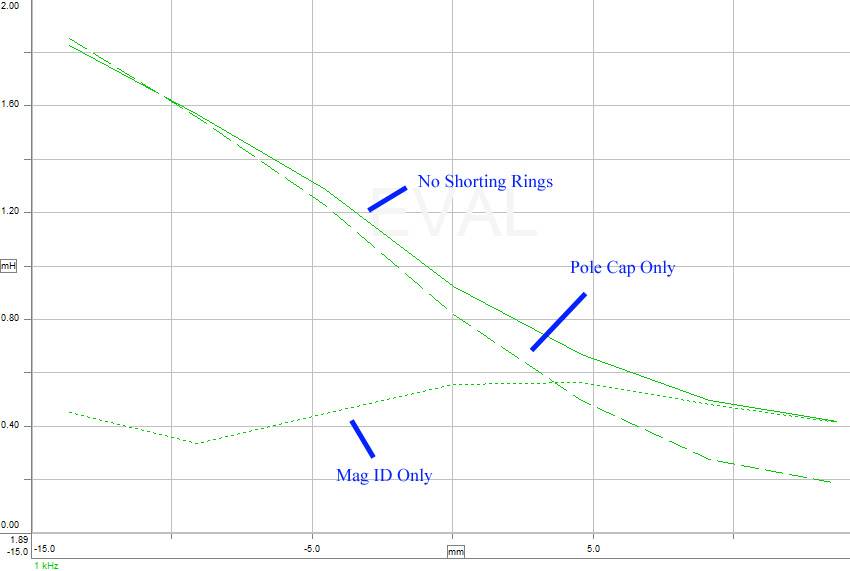
This graph shows inductance over excursion for a basic motor design. The center is at rest, left is rear stroke, and right is forward stroke.
Why is the graph shaped this way ?
Have you ever looked at inductors for a crossover ? You can get a high value in a small package with an iron core. So... what is a speaker motor ? A partially iron core inductor!
As the coil moves back it gets more iron in the core! So the inductance rises. As it moves forward it gets more air in the core so it drops. Pretty cool, huh ?
Now... the field can be absorbed by a conductive material in or around the coil -- so shorting rings come into play.
One approach, which we use on the SA series, Z v.3 series, and NS v.2 series, is a pole cap shorting ring -- note how it reduces forward inductance and at rest inductance. But not much in the way of rearward...
Well the SA Line, the NS v.2/v.3 and Z v.2/v.3 both have a large magnet ID ring -- notice the huge effect on rearward inductance and at-rest inductance ?
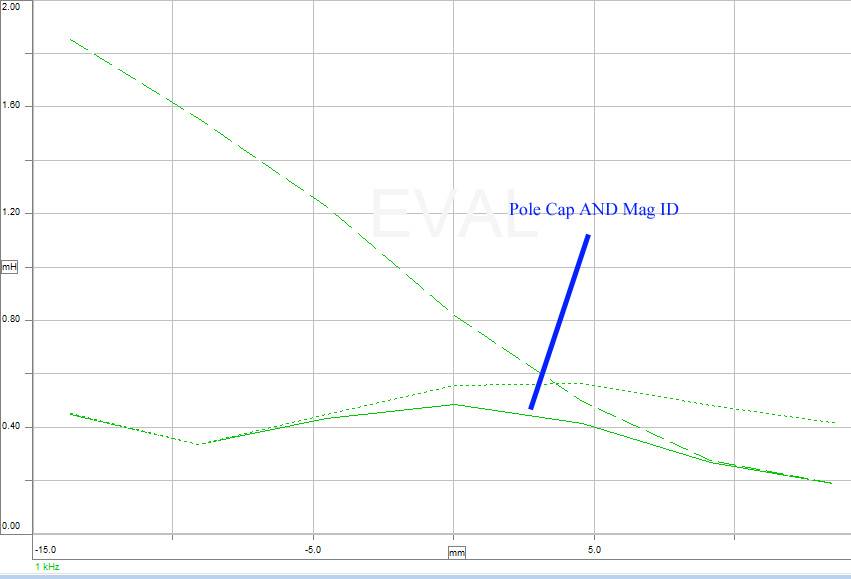
Now... having BOTH rings like the SA Line, the NS v.2/v.3 and Z v.3 has a huge effect across the board! Not only is the inductance more linear but it is much much lower.
Why is this good ?
1) More power delivery to the coil as inductance causes "rise"
2) Less distortion -- inductive distortion is odd order and unpleasant; although a fairly small part of total distortion.
3) More high-end extension as inductance is a 6dB per octave low-pass crossover.
4) These rings also act as heat-sinks; although this effect is not a large reason to use them in and of itself.
Can a speaker sound good without them ? Sure! Many great sounding speakers don't use them and they are pretty expensive too so don't always represent a good price to performance ratio. I do not plan to use magnet ID rings on lines less expensive than the SA series, for example, as the ring represents such a high % of the total cost of the speaker at that point (large chunk of aluminum, copper, or brass).
But they do have benefits and I figured some of you might like to know what those are.
-----
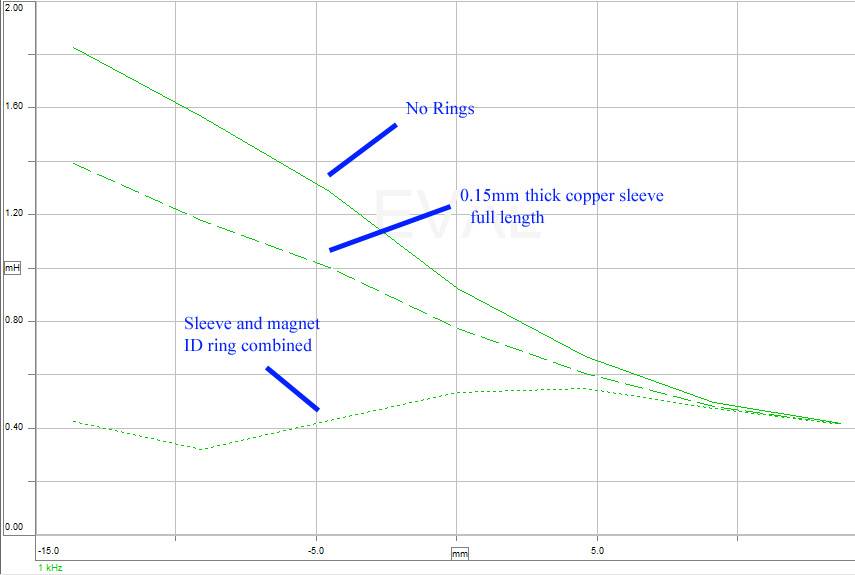
This thin sleeve has a nice effect at rest and on rear-ward -- seems to lose effect combined with the magnet ID ring, though, as that is equal to the magnet ID ring only.
-----
So now lets do a thick sleeve :
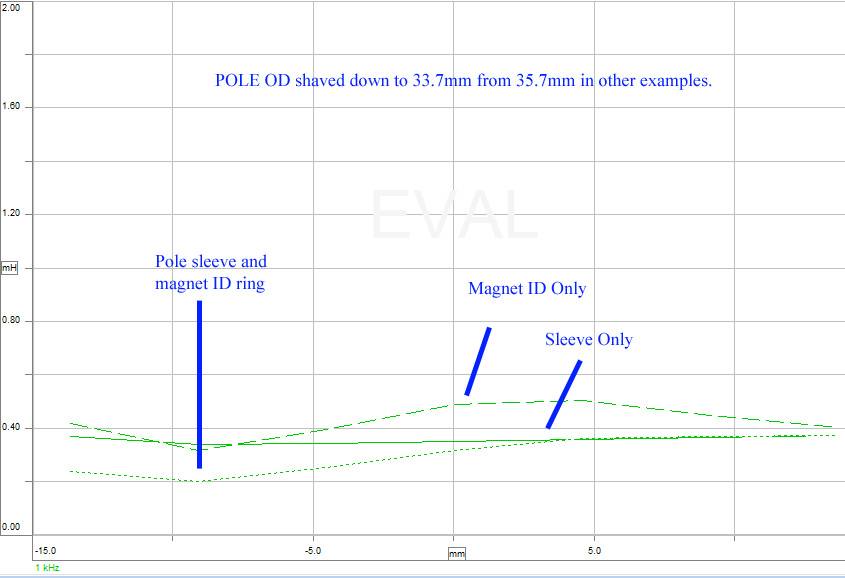
Full 1.0mm thick -- and the effect is MUCH better and also alleviates the issue of being cancelled out by the magnet ID ring.
The only problem is you need to add more motor to compensate for this type of sleeve as it widens the gap a good bit -- for this example the pole had to go down from 35.7mm OD to 33.7mm OD to fit this sleeve.
If the design budget allows for this then no problem -- the issue you end up with is spending more money on the motor by adding magnet to it.
The benefit is that the sleeve is the most linear method simulated -- the Le curve is completely flat in this case.
In most cases price to performance the magnet ID ring would be a better selection unless you are going for ultimate reference level.
-----
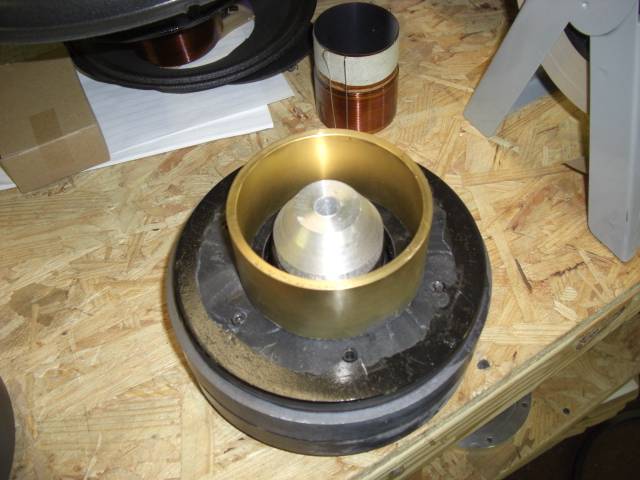
* SA motor -- the top aluminum piece acts as a pole cap ring.
* The brass piece is an example magnet ID ring from a Z v.2 motor. This goes around the inside of the magnets below the top plate / above the back plate.
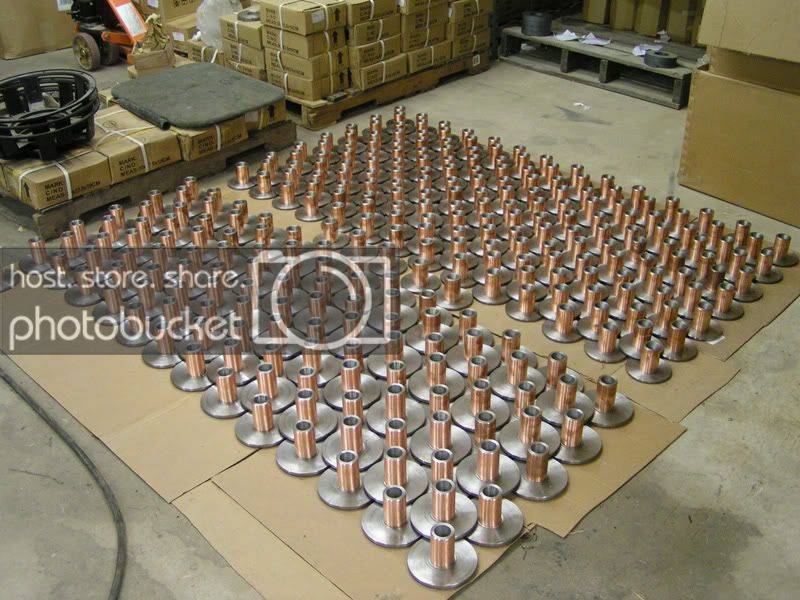
* Acoustic Elegance drivers with pole sleeve shorting rings
-----
We used a pretty small motor for this discussion... 120mm OD magnet utilized.
When I made enough room for the sleeve we dropped off 34% of the motor force factor (BL^2/RE) -- in order to get this back the magnet had to go all the way up to 150mm OD and in turn the back and top plate OD both had to expand as well. So much more steel and much more magnet.
634g magnet to a 1109g magnet -- we had to gain 75% magnet mass.
Total motor went from 1890g to 3112g -- so a 65% gain overall in mass not counting mass added by the sleeve.
So it is fairly significant in terms of cost to get a highly functional sleeve and to "gain back" the desired motor force lost by making room for it. And again, if this pans out for the target cost of the driver these thick sleeves do work great.
People ask me this alot... the short answer is that they make the speaker better. The long answer can be shown on some graphs.
This graph shows inductance over excursion for a basic motor design. The center is at rest, left is rear stroke, and right is forward stroke.
Why is the graph shaped this way ?
Have you ever looked at inductors for a crossover ? You can get a high value in a small package with an iron core. So... what is a speaker motor ? A partially iron core inductor!
As the coil moves back it gets more iron in the core! So the inductance rises. As it moves forward it gets more air in the core so it drops. Pretty cool, huh ?
Now... the field can be absorbed by a conductive material in or around the coil -- so shorting rings come into play.
One approach, which we use on the SA series, Z v.3 series, and NS v.2 series, is a pole cap shorting ring -- note how it reduces forward inductance and at rest inductance. But not much in the way of rearward...
Well the SA Line, the NS v.2/v.3 and Z v.2/v.3 both have a large magnet ID ring -- notice the huge effect on rearward inductance and at-rest inductance ?
Now... having BOTH rings like the SA Line, the NS v.2/v.3 and Z v.3 has a huge effect across the board! Not only is the inductance more linear but it is much much lower.
Why is this good ?
1) More power delivery to the coil as inductance causes "rise"
2) Less distortion -- inductive distortion is odd order and unpleasant; although a fairly small part of total distortion.
3) More high-end extension as inductance is a 6dB per octave low-pass crossover.
4) These rings also act as heat-sinks; although this effect is not a large reason to use them in and of itself.
Can a speaker sound good without them ? Sure! Many great sounding speakers don't use them and they are pretty expensive too so don't always represent a good price to performance ratio. I do not plan to use magnet ID rings on lines less expensive than the SA series, for example, as the ring represents such a high % of the total cost of the speaker at that point (large chunk of aluminum, copper, or brass).
But they do have benefits and I figured some of you might like to know what those are.
-----
This thin sleeve has a nice effect at rest and on rear-ward -- seems to lose effect combined with the magnet ID ring, though, as that is equal to the magnet ID ring only.
-----
So now lets do a thick sleeve :
Full 1.0mm thick -- and the effect is MUCH better and also alleviates the issue of being cancelled out by the magnet ID ring.
The only problem is you need to add more motor to compensate for this type of sleeve as it widens the gap a good bit -- for this example the pole had to go down from 35.7mm OD to 33.7mm OD to fit this sleeve.
If the design budget allows for this then no problem -- the issue you end up with is spending more money on the motor by adding magnet to it.
The benefit is that the sleeve is the most linear method simulated -- the Le curve is completely flat in this case.
In most cases price to performance the magnet ID ring would be a better selection unless you are going for ultimate reference level.
-----
* SA motor -- the top aluminum piece acts as a pole cap ring.
* The brass piece is an example magnet ID ring from a Z v.2 motor. This goes around the inside of the magnets below the top plate / above the back plate.
* Acoustic Elegance drivers with pole sleeve shorting rings
-----
We used a pretty small motor for this discussion... 120mm OD magnet utilized.
When I made enough room for the sleeve we dropped off 34% of the motor force factor (BL^2/RE) -- in order to get this back the magnet had to go all the way up to 150mm OD and in turn the back and top plate OD both had to expand as well. So much more steel and much more magnet.
634g magnet to a 1109g magnet -- we had to gain 75% magnet mass.
Total motor went from 1890g to 3112g -- so a 65% gain overall in mass not counting mass added by the sleeve.
So it is fairly significant in terms of cost to get a highly functional sleeve and to "gain back" the desired motor force lost by making room for it. And again, if this pans out for the target cost of the driver these thick sleeves do work great.









