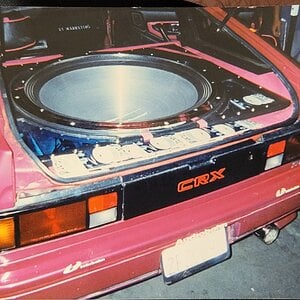
Sure is mate //content.invisioncic.com/y282845/emoticons/smile.gif.1ebc41e1811405b213edfc4622c41e27.giftoyota mr2 mkii
haha in that case I can see where you were coming from. I'll check out the size of the factory wiring tomorrow or something, been so cold lately it's hard to force myself outside, and if it is a large gauge then I will definitely just run off the alt.I missed the mid-engined part. my bad.
The alternator powers the vehicle once the engine is running. Battery acts as a load until it gets recharged after starting. In fact once the engine is running, you can (theoretically) disconnect the battery.Whenever the car is running, the car's charging system is going to be 13.6-14.4, your car doesn't just run at 12.6v if the alternator is not outputting the bulk of its current output. The battery itself acts as a load on the charging system until the alternator cannot adequately supply the current draw of the vehicle and its accessories. You want the battery there to be able to handle the flux in current demand not the alternator itself.
That's rediculous. The battery and alt are THE SAME POINT, connected by a fat wire.Running the power wire to the alternator itself will subject the alternator and voltage regulator to voltage spikes that will harm and drastically diminish the life of the alternator.
If that was true your lights would dim at idle.Factory alternators rarely, if ever, supply meaningful current at idle. Factory alternators are 1. designed to run at about 80% of its charging capacity (i.e. if you have a 100a alternator, it was designed to have 20 amps of buffer after running ALL accessories in the car), and 2. don't produce meaningful current til => 2kRPM.
Riiight... And where do you suppose that 14V comes from?Yes, the voltage will be ~14v but voltage is only part of the equation and not necessarily the important part.
I suggest you follow your own advice.Please read how alternators, batteries, and the overall charging system in your car works first.
.....You're right, that's what I said. The battery acts as a load on the charging system. If there is a drastic spike and the voltage regulator doesn't react quick enough, what's picking up the slack? The battery.The alternator powers the vehicle once the engine is running. Battery acts as a load until it gets recharged after starting. In fact once the engine is running, you can (theoretically) disconnect the battery.
You neglect to actually read things, or you simply ignore words. I did not say the alternator didn't produce ANY current, I said MEANINGFUL current. As in the 100A alternator is not going to be able to produce 100A at 800 engine RPM. The alternator still has the ability to supply current at idle, but it's not going to supply all of the current required to run all accessories in the vehicle, and any additional that the car wasn't designed for.If that was true your lights would dim at idle.
I don't get the point of this comment. The alternator is running and supply the charging system when the vehicle is running, I never said it wasn't. When the vehicle is running the alternator pulling is rotating, thus it's on and supplying 13.6-14.4v.Riiight... And where do you suppose that 14V comes from?
We agree on something then. And that's why I said you can "theoretically" remove the battery once the engine is running. In practice that's a bad idea because the battery absorbs transients......You're right, that's what I said. The battery acts as a load on the charging system. If there is a drastic spike and the voltage regulator doesn't react quick enough, what's picking up the slack? The battery.
That was true in the old days. Under heavy load at idle the battery would supply some current because the alternator couldn't keep up. Voltage would drop to 12.5V. But modern charging systems do indeed have the ability to supply almost full rated current at idle speeds. Put an amp clamp on your alt wire sometime and see for yourself. Look at it this way - if the voltage is above 12.6V then the alt must be supplying all of the current.You neglect to actually read things, or you simply ignore words. I did not say the alternator didn't produce ANY current, I said MEANINGFUL current. As in the 100A alternator is not going to be able to produce 100A at 800 engine RPM. The alternator still has the ability to supply current at idle, but it's not going to supply all of the current required to run all accessories in the vehicle, and any additional that the car wasn't designed for.
There's where we disagree. My point is that the alternator and battery are electrically the same, separated by a length of wire. In the OP's case the wire is just longer than usual. But the voltage source is the alternator as long as the engine is running. It makes no difference which end of the wire you connect to. With engine off, that long wire would be significant but no different than running a wire from battery to the trunk in a "normal" install.CAN you run it off the alternator, theoretically yes. Would I ever do it, no.
You sir, are retarded. You need a better understanding of fundamental electronics.alts are to float your batteries not provide a constant charge, you want to burn it up go a head and run it off the alt.
Just wanted to quote this so maybe some of you will soak it in.if the voltage is above 12.6V then the alt must be supplying all of the current.