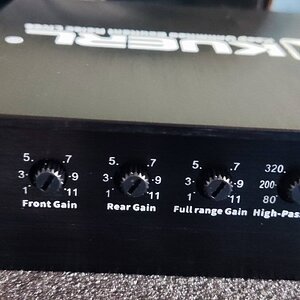
the wiring, as you list it, is known as paralleling amplifiers and is one of the most difficult wiring options. for example, I know of only one non-DIY amplifier that lists this as a feature, and only as a feature for the two channels on the same amplifier. this is the class-i monster from crown/jbl. That amplifier is particularly suited for such operation.
this topology is similar to adding additional output devices, which is done to improve current handling. the idea being that each amplifier will supply half the current. thus a 2ohm speaker would be as easy to drive as a 4ohm speaker would for each amplifier. if a single amplifier can provide full power to the 4ohm speaker there would be no (or little) benefit to adding the second amplifier in parallel.
bridging/strapping are concerned with wiring amplifiers in series. in this case the output voltages sum, allowing for significantly more power, but also making the speaker as difficult to drive as a lower impedance speaker would be, for each amplifier.
in theory, amplifiers can be built to be run in series indefinately, eg, 4 amplifiers "bridged" to quadruple output voltage. of course this causes 4x current to flow through each amplifier, so the load must have an impedance 4x that of what a single channel can handle. this sounds more like what you want to do -- bridge the channels on each amplifier, then strap these two amplifiers. in such a configuration, a typical amplifier designed for 2ohm/channel would require an 8ohm speaker as a load.
refer to the wiring diagram of the kx amplifier for more details on strapping.