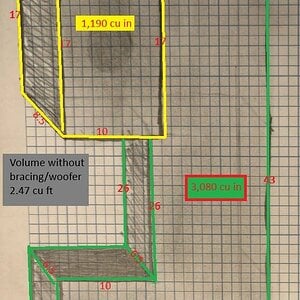
wow thats a big *** enclosure for 2 15'sAnd my SS 1-2 car with 2 15s worked best with a 24 cubic foot enclosure.
that actually made senseWhen the size of the box starts to match or be bigger than the size of the effective cabin, it is in many ways like you are reversing the two, and the cabin becomes the enclosure, as it will dampen and load the cone(s) more than the box will. Have you ever tried sticking a meter in a port or inside a box?
Granted, your actual box is alot more air tight and better built to generate acoustic energy than any part of your cabin is, but you get the idea.
Sounds like you studied fluid dynamics.Simple physics. Take a bowl and fill it with water. Stick your hand in flat towards teh bottom and watch the water rise. By decreasing the volume where the water stands it rises. If the water had no where to go and poked a hole in the bowl, the water would squirt out at a higher pressure than if not compressed.
The same goes with air. Decrease the space for which it has to move/escape and seal it with nowhere to go and pressure will rise as soundwaves increase. The air wants to move and spread and dissapate but the walls/windows of the vehicle won't allow it. Thus...pressure builds
Now.....as with everything....it's not that simple. If it where, then the best SPL vehicles would consistantly be really small cars. There is a threshold, and fine line of balance between the maximum amount of pressure relating to cabin size. Depending on where the mic is going, what size subwoofer/s you have, how much power is going through it, what type of enclosure the subs are in, and how those subwoofers are positioned in relation to the interior design and volume of the cabin....will determine the optimal size cabin for the given set-up. For that, you need to bust out some Algebra.
But as a general rule of thumb, yes, the better sealed and smaller the cabin area, the higher pressure readings one would get.

Really? I thought we were kinda expected to have realized that by like 8th grade? Is this not common knowledge?Sounds like you studied fluid dynamics.
You also touched on something we call power compression.
This is where pressure builds on the cones of the subs and limits how much they can move. So you can add more amplifier power, but your SPL will no longer increase, but will infact decrease due to the extra strain on the electrical system.
correct me if im wrong but im assuming "power compression" based on your description would be when the pressure on the exterior portion of the cone is greater than the pressure inside the enclosure?Sounds like you studied fluid dynamics.
You also touched on something we call power compression.
This is where pressure builds on the cones of the subs and limits how much they can move. So you can add more amplifier power, but your SPL will no longer increase, but will infact decrease due to the extra strain on the electrical system.
Could be behind or in front of the driver.correct me if im wrong but im assuming "power compression" based on your description would be when the pressure on the exterior portion of the cone is greater than the pressure inside the enclosure?
Power compression essentially involves the law of diminishing return. The more you do something the less marginal benefit there is for doing more of it. If you increase power from 100 watts to 1000 watts, you will get MUCH louder. Increase again by 1000 watts and you will get a little louder. Again by 1000 and you will get even less gain from it, and so on. Not only does this happen with laws of energy, but with laws of pressure, heat, etc which all are effecting the output of a sub as wellcorrect me if im wrong but im assuming "power compression" based on your description would be when the pressure on the exterior portion of the cone is greater than the pressure inside the enclosure?