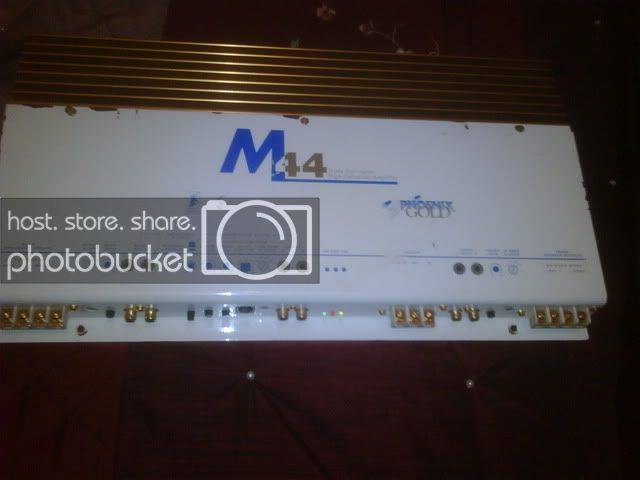
Well, you have to compare apples to apples for this to be valid. I mean, comparing a nice old school amp like an Orion, or PPI or ZED to something shitty today is not a fair comparison as the old school stuff will definitely be better, just like you can't compare the great stuff today like Brax, Helix etc. to the shitty old stuff, again, not a fair comparison. Also, what we have to remember is the old school stuff that is remembered was the best of the best at teh time, the old shitty stuff is forgotten, just like what will happen to today's great and shitty amps.
As for you other statements, there has been huge improvements in process technologies even in the last 10 years let alone the last 20. Transistors now are of a higher quality and can withstand higher temperatires and greater currents. Soldering technology has even improved greatly to allow the boards to be soldered better. Also, keep in mind that computer processing power has increased more than 10X in the last 10 years allowing better simulations and analysis to be done on designs, and with that better QC can be done because it is quicker to test more points on a board. Everfything in the manufacturing process has improved in 10 years, it is simply technology marching forward, somewhat like Moore's Law.
The only thing that has changed since the 80s is the ability to mass produce amps faster and cheaper since machines place the components on the circuit board and they are wave soldered into place. Is the soldering better? Not really. I am sure that there are a lot of Memphis 4KW owners who will disagree with you on being soldered better!
Also, some of these new designs are next to impossible to repair due to proprietary components. Sadly, as a result, we have transitioned into a disposable society. I know some techs that will flat out refuse to work on certain models of Alpine amplifiers because of the level of difficulty to perform the repair correctly.
Getting to amp design, what has really changed since the first class A/B amp was invented some time ago? How many modern day amplifiers are still based on Robert Zeff's original 12 volt designs? Sure, transistors, resistors, capacitors have higher tolerances and better specs than some years ago, but does that alone make an amplifier better?
Don't get me wrong, Class D was a decent innovation, but it had its drawbacks when it was first released to the masses in the 90s. I knew many dealerships, some that are still in business, that stated that Class D was garbage in the 90s. Now they push it as the holy grail whether it be for Sound Quality or SPL

Class D for everyone, for everything, yoo friggin who!//content.invisioncic.com/y282845/emoticons/rolleyes.gif.c1fef805e9d1464d377451cd5bc18bfb.gif
The main thing that has changed in this industry is that no one is passion driven like they used to be. Jim Fosgate, Richard LeMay, and Robert Zeff all stressed using the best of the best to make their products at once upon a time. It is kind of sad to see how some companies are just names slapped on your typical, run of the mill, Asian built amplifiers!
Prime examples of names that are not what they used to be would include, but are not limited to, the following: Orion, PPI, Hifonics, MB Quart, Autotek, Phoenix Gold, Soundstream, and I could go on for a while...