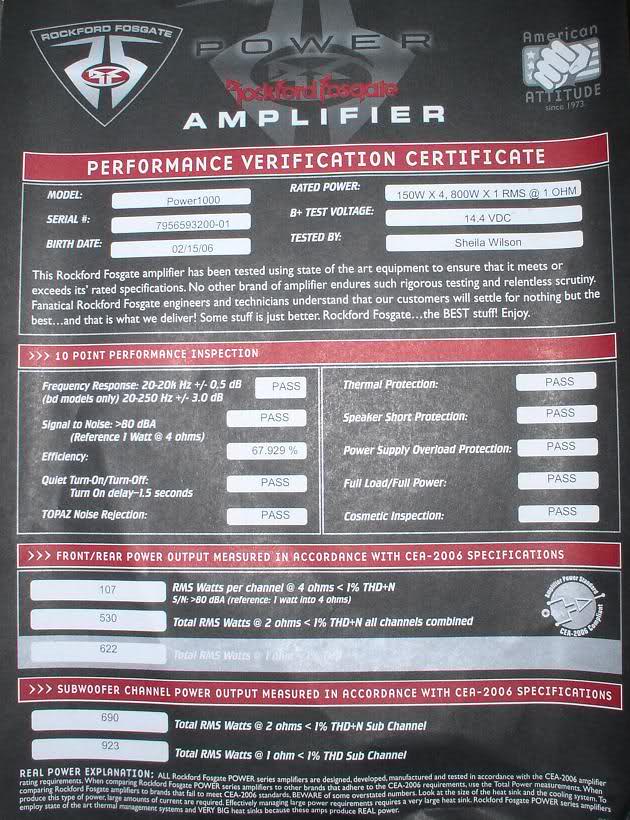
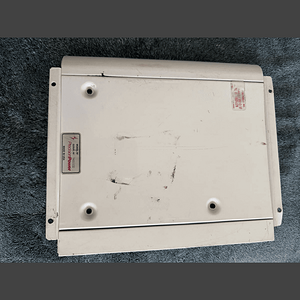
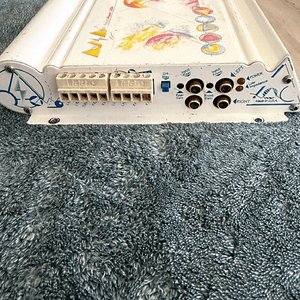
It is a nice touch that Fosgate puts the serial number on the Birth sheet too isn't it?How do i know that a birthsheet didn't get mixed up. Yeah you're right, i'm a noob, been in car audio since 1987 and had the original punch 45 when they came out. I have no idea what i'm saying.//content.invisioncic.com/y282845/emoticons/rolleyes.gif.c1fef805e9d1464d377451cd5bc18bfb.gif
I know fosgate puts serial number on their birthsheets, just saying don't expect the power it shows all the time. **** impressive list there my friend. I had the punch 45 once but i was more of a fan of my hifonics Thor vii. Can't say i have as much experience as you with fosgate, thats for sure. What are you going to do with all those amps.It is a nice touch that Fosgate puts the serial number on the Birth sheet too isn't it?
Anyways, Like old school Fosgate? Stop on in to the Vintage forum at rockfordfosgate.com I have a nice collection of old school Fosgate gear but mine is just a drop in the bucket compared to some of the other collectors on there!
As it sits I have 80-82 model Punch 100 and 40 (slider EQ's not the knobs and NOT DSM's)
2 Punch 150 (1st series with the round heat sinks)
2 Punch 150 (Pre HD)
1 Punch 150HD
1 Punch 45 (and another on the way)
1 Punch 45HD
1 Punch 75
1 Power 100
1 Power 300
1 25 to life 45, 75, 150 and the Power 1000 is on its way to me now
My Pride and joy is a Power 360 4 channel (Bipolar)
Any time you want to talk old school Fosgate let me know!
David
***you're the idiot. I know fosgate amps are underated, just like many other amps. Does that mean that the birthsheet is completely accurate. Again dumbass, i have seen and had friends test amps that put out more than what the birthsheet says, therefore birthsheets are overated. You need to learn about car audio idiot, then you would undersatnd where i'm coming from. So if you take his amp and switch it for another amp with same model number, you're telling me he will hear a difference in amps if one has a higher birthsheet. Answer that smart ***. I can't believe you're that dumb. So go by what the birthseets read cause god knows there so **** accurate.gtdo and learn about how amps are measured and that what they measure on a factory will and can differ from what you get in a car. Since he doesn't have a sheet i was telling him to go by the specs and buy his equipment with those specs in mind. So STFU and GTFO
edit: to the op, just because a birthseet may show what the amp is capable of, doesn't mean you will see that power. Buy your equipment based on factory specs.

im not gonna get to into this too much but going by a clamp and dmm isnt giving you real results either. its just giving you apparent power. and its gets worse at higher impedances.So one should go by the birthsheet over rated power? I guess they rate amps just for the joke of it. I go by actual tests, using dmm and/or clamps to see actual power. How do i know that a birthsheet didn't get mixed up. Yeah you're right, i'm a noob, been in car audio since 1987 and had the original punch 45 when they came out. I have no idea what i'm saying.//content.invisioncic.com/y282845/emoticons/rolleyes.gif.c1fef805e9d1464d377451cd5bc18bfb.gif
Getting power using that method only applied to purely resistive circuits (DC circuits). When you're dealing with AC circuits that have inductance and capacitance (which is what you will have when dealing with speakers), you will have an imaginary part of the impedance that will affect the actual power measured in watts. By imaginary, it like the sqrt(-1) like you have heard of in algebra.
In AC circuits, power in watts is measured by:
Current(rms)*Voltage(rms)*Power Factor = Power (in watts).
If you leave off the power factor, you just have volt amps.
i hear ya. I just wanted to let the OP know that you may not see what the birthsheet shows at all times, seeing how they are tested in a different environment than a car. I guess i don't know the reason he wanted the birthsheet anyways.im not gonna get to into this too much but going by a clamp and dmm isnt giving you real results either. its just giving you apparent power. and its gets worse at higher impedances.
you need to use the "power factor" to find out real world wattages.
heres a little bit from immacomputer about it