Need help repairing an amplifier

Patthehat033
10+ year member

Senior VIP Member
Okay, so I have a PA4002 MOSFET 2 OHM Stable Amplifier that needs repairing. It was in my buddies car. First he was getting the protect light on the amp, so we check all his connections and it ran back to his main fuse being blown at the power wire. So I replaced the fuse with another fuse, and the second I put back the battery terminals the fuse blew again. So that led me to think that there was a problem with the power wire since the fuses on the amp had not blown. So I checked the power wire and there was nothing being grounded. I also tried putting another fuse in and putting the terminals back on while the power wire and the ground wire were no longer attached to the amplifier, and the fuse did not break. Leading me to think that the wire was not getting grounded out anywhere.

So I took the amplifier and tried it on my car, and (don't shun me for this, but I did have the battery still connected) and I put in the power wire in the amp, and then put the ground in and the ground just kept sparking. Now you would think that is normal, but unfortunately I did not have a remote wire hooked up or anything, so that leads me to think that there is a short between the ground and power circuit somewhere internally in the amp. Any ideas on how to fix this or what I should check in the amp. I have the amplifier open right now, it smelled like something was burning previously but there is nothing that looks burn't inside.

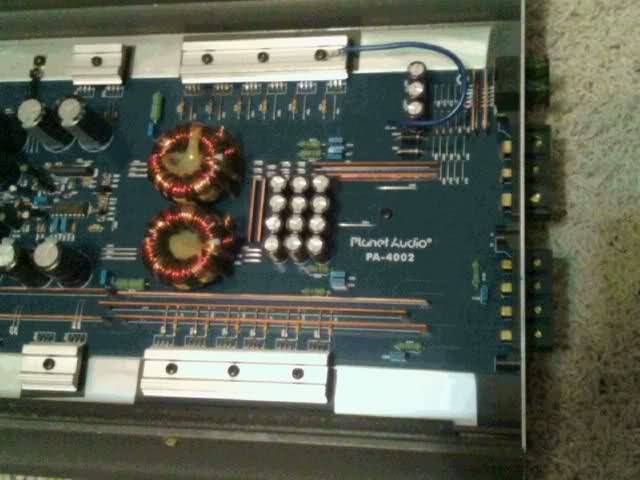
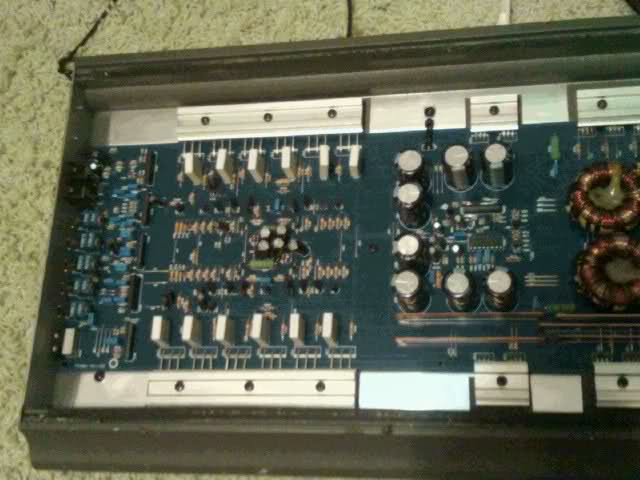
Heres the amp.. the last picture is a picture of a resistor that has some burned insulation I thought could be a problem.
23qx5wx.jpg


13zv1ig.jpg


j7cgf9.jpg


105ch7s.jpg


Last edited by a moderator:
i can tell you now that you have shorted power supply fets. that looks to be a nicely built and underrated amp, so you might want to have someone fix it for you. if you look under that clamp bar with the blue wire screwed to it, you should find the last 2 or 3 on the left cooked, if i see it correctly. if that's the case, the whole bank and the resistors connected to them would need to be replaced at the least. you will need an ohm meter to start inital testing. none of the legs should read zero resistance, or even close. only the 2 pairs on either side, which are actually rectifier diodes. when a power supply fails like that, it can 50% also mean that the output section has failed, which then made the power supply section fail, and many times, the drive circuits are also damaged from the shorted fets. so, you can give it a try if you are decent at soldering, but that's up to you to spend the money that might not fix it

 
Good call I just did an OHM's test and here is what I came up with. In the first picture the last three transistors on the left under the first clamp bar were all reading approximately 5 OHMS, the transistors on the opposite side of the amp that were also under the first bar clamp, and on the left in the first picture were reading about 136 OHMS instead of nearly 1000 OHMS. The two transistors to the side of the first bar clamp on both sides of the amp were reading 5 OHMS as well. So I guess there are 8 transistors that were fried. All the other transistors were fine.

Is there any resistors I should try doing an OHMS test on, and how much would they be putting out?

 
Google resistor color code chart, it tells you how to read what the resistors are supposed to be. regardless, you need to replace the full section of transistors matched, and the resistors attached to them, if even 1 is bad. as i mentioned, the 2 paired up parts in their own 2 clamps are diodes, and will read pretty much zero, depending on what orientation you have the leads on them. should be signified with a d, i.e. "d42;d43;d56;d57" the transistors are signified with a "q".... here is what you do, the transistors that are shorted should be cut free of the circuit. as long as there is one on each side still good. verify that there is no short between the power terminals (a climbing resistance is ok) and if it checks out, hook 12v power to it, but run it through a light bulb, like a spare headlamp or something that will limit the current.install a 5-10a fuse and see if it blows, or lights the bulb up good. if not, then you are good to see if it will power on with the remote wire. make sure that you have the transistors clamped, or they could very easily blow quickly. if, then it does power up and idle fine, then put your meter on dc voltage and see if you have any coming from the speaker terminals. you should not, save for some under 1v. if you have none, then play a test tone to it through the rcas, like from an mp3 player, and see if you are getting good ac voltage. if you are real careful with the leads, you can test the rail voltage first, for something to compare to. should be over 20v feeding the output transistors, when compared to 2 of the speaker output terminals, and nothing on the other 2. both sides even, or real close. only hook the meter to it, no speaker load. this is not guaranteed to tell you it will work, but can give you an idea before buying new fets. i order mine from digikey, but you can get them many places. just stay away from intersil, nte, and like brands, and order a minimum of 10 so that they match. if you cannot get it to work like this, then you should definitely send it out for repair, and i hope that you are good with soldering before touching that board with an iron. oh, and that one resistor you took a pic of should be replaced. likely had to do with what happened when the amp failed, but is not the real problem. it's on the speaker outputs. you can go a little higher on the wattage, not lower, but you have to orient them a little different to make them fit. disclaimer: you may take this advise at your own risk. no guarantee granted. it's just advise.

 
Power supply is definitely shot. All power supply fets must be replaced to insure future reliability even if only one were actually shorted.They all saw the same stress that destroyed those few so they are all most likely on their last leg. I'd also check out the gate resistors,power supply driver transistors,and the pwm IC. To do this right you really need an oscilloscope so that you can verify that the power supply drive waveform looks as it should. You may also be looking at some blown/shorted outputs too(whether they look "blown" or not) . Many times a failure in the power supply comes after a failure/short/blowout in the output section but not always.

 
Activity
No one is currently typing a reply...
Old Thread: Please note, there have been no replies in this thread for over 3 years!
Content in this thread may no longer be relevant.
Perhaps it would be better to start a new thread instead.

About this thread

Patthehat033

10+ year member
Senior VIP Member
Thread starter
Patthehat033
Joined
Location
Missouri
Start date
Participants
Who Replied
Replies
7
Views
860
Last reply date
Last reply from
Spooney
IMG_20260516_193114554_HDR.jpg

sherbanater

    May 16, 2026
  • 0
  • 0
IMG_20260516_192955471_HDR.jpg

sherbanater

    May 16, 2026
  • 0
  • 0

New threads

Top