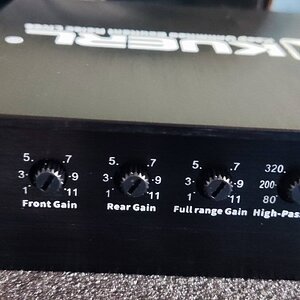
Not sure what your "friend in the business" was talking about. But a mono amp, is an amp with 1 channel. Most tend to be Class D. And most modern ones tend to be 1 ohm stable. It's all stated in the specs. Was there something you had a question about specifically?
Thanks. I decided to re-word the original post more carefully in hopes it might help anyone who may find this thread in the future understand the question
originally posed. The issue has been cleared. I believe there was some confusion on my part believing that a mono-block had to be 1 ohm stable in order
for optimal performance, but it was more likely in reference to the particular class d mono-block he was suggesting I need... Whether some mono-block
amps are better or ''work out'' the operation of single channel processing more efficiently than others, I'm going to have to assume he meant that in
reference to higher grade models on the same token as to avoid lesser grade ''questionable'' less expensive models. Thanks again everyone.
He may have been referring to amps, such as the MRX-M100 which states that it is 1 ohm stable, but only produces 500w @ 1ohm where at 2 ohms it produces 1000w. I don't know, all i know is that mono block = 1 channel.
well, ive been doing some research and have not seen many of these amps you speak of with less than .1 thd and before the class d most amps were .05 or less . again its just a simple comparison and not saying newer amps are not as good. for example my audiosystem amp is considered a higher quality amp and its @1. thd so go figure .
Why does amplifier distortion matter since on average most speakers have 3%, or more, distortion due to their design? 1% is a CEA standard designed to level the playing field whereas .00000001% THD+N is a marketing standard designed to sell amplifiers.
What next, are we going to start an argument about damping factor?
[quote name='NFrazier']He may have been referring to amps, such as the MRX-M100 which states that it is 1 ohm stable, but only produces 500w @ 1ohm where at 2 ohms it produces 1000w. I don't know, all i know is that mono block = 1 channel.[/QUOTE]
Why does amplifier distortion matter since on average most speakers have 3%, or more, distortion due to their design? 1% is a CEA standard designed to level the playing field whereas .00000001% THD+N is a marketing standard designed to sell amplifiers.
What next, are we going to start an argument about damping factor?
we have not even began discussing 4ohm THD vs 1 ohm thc, i mean d. IIRC, industry standard measurements stop at 2ohms due to the levels of distortion present at low power levels at 1 ohm. I read someplace where a common class D monoblock can produce 25+% THD at 1 ohm power I am asking, as not spread dis info, but to know if anyone has benched and can confirm.
Mono=single channel.(does not require a certain ohm, even if it has multiple + and - outputs it is still 1 channel)
There are several variations of them from Class A/B to D to X. Each has their own pros and cons.
Different manufacturers build their amps to be "safe" at different ohms. Some will be 4, others are 2, others are 1, and companies like MMats have some rated for .5 ohm.
Their topology and materials/parts used will influence the amount of efficiency they have at any given voltage or ohm.
@ewadz3006 , did you understand the original question in this thread?
Most cats do run the show, from my experience...kinda like a woman. When you pet them, they can be purring one minute and bite you the next.
[quote name='quackhead']@ewadz3006 , did you understand the original question in this thread?
Most cats do run the show, from my experience...kinda like a woman. When you pet them, they can be purring one minute and bite you the next.[/QUOTE]
Quackie I don't know if op had a question, a statement, or a relapse. Fact is i cant make heads or tails from any of it, like i said in the other thread i feel dumber after reading it.
As far as women go, i dont usally get them to purr i just get bit. But i guess i like it.lol