is there a way to tell if im clipping?

its a big artificial boost, no where near the affects of a normal gain raise. It throws everything off balance and the whole audio track is way more susceptible to clipping and distortion. Big reason why we never touch bass boosts on amps nor bass EQ, its pretty common knowledge there.
Basically anything past those limits is clipping when you skew the response slightly with a bass boost, even when you lower the overall amplitude aka gain, you will still have clipping with any kind of bass boost put onto it this is the example here.
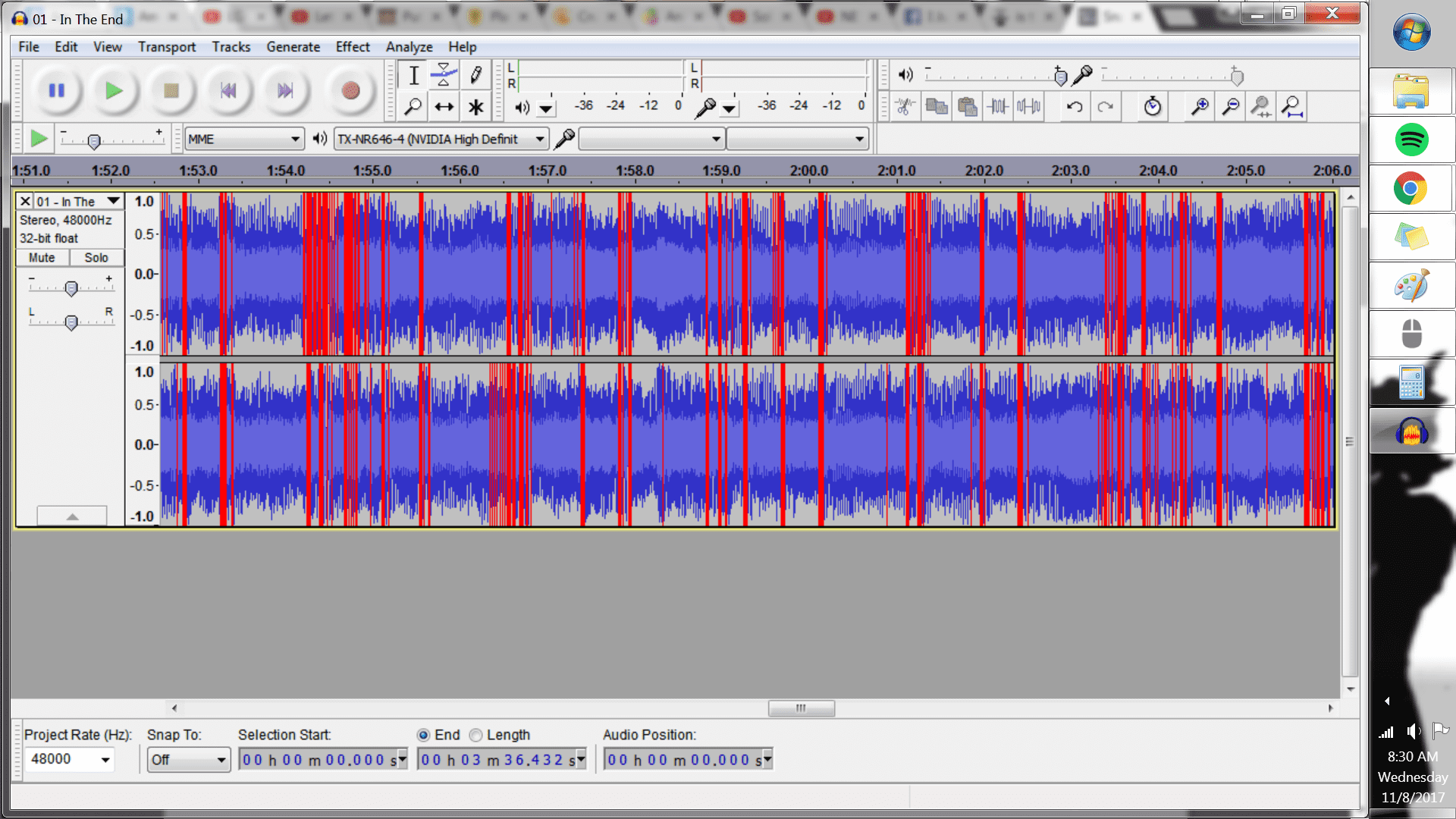
Se2TCg.jpg


TLDR, any kind of bass boost is bad... the only thing you would want to do bass EQ wise is to cut if you want a flat bass response if your bass is response is peaky.
I think I see what you're saying now. The source unit has some max voltage it can output, and at high volume settings, it's getting close to that max. Any amplification of that signal beyond that point and its output signal clips.

Then what I said before is essentially true as long as you're sure your volume setting isn't so high that EQ settings can't reasonably be applied. You can turn up gain or EQ or both so long as nothing clips and you get the same output voltage. (Since the original question was whether it's better to use EQ or gain if your bass signal is too low at lower volume levels).

 
My question is, what is clipping? You have a program there and it has limits as to the largest amplitude signal it can output, I assume. So you have turned the signal up to the point where it clips in your program.
Is that the same thing as an EQ? The source (ie head unit) reads whatever signal is on the file or disc. In your example the original source is clipped in the sense that it has flat top signals. The head unit then applies an EQ, which I am currently assuming to be basically selective amplification, and as long as the output voltage of that signal does not exceed the head units amplifier's max voltage, it hasn't clipped. That signal goes the sub amp, it applies amplification, and again if the output voltage isn't above its maximum, it hasn't "clipped" either, even if the input signal is clipped.

I guess I'm asking if head unit EQ application really is the same thing as whatever you're doing in your program there.
I actually havent turned anything up, if anything i lowered the amplitude in my previous post just to make a point that even if you lower the gain in your actual setup and add bass EQ, you'll still completely fk things over.

Refer to Post 28 the original picture is how the song originally looks coming off a Lossless Rip, no modifications added. A Good song file is always a strong unclipped clean source from the start. This program is just to prove what happens when you even introduce a little bass boost/EQ and how it affects your music. It throws your music off balance straight into clipping levels. So yes it applies when it comes to the bass boost part completely.

When you bass boost the signal and its clipped like that, signal will travel to the amp already clipped like that and get amplified. Even though you have your gain down, you are still amplifying a dirty signal but you aren't immediately killing your subs because you have the gain down but it causes certain and eventual damage to your coils because the coils are moving in an irregular pattern generating a lot more heat than normal even at lower volumes because the signal is clipped from the start. IF you use the amp bass boost as well, thats a certain death sentence.

 
I actually havent turned anything up, if anything i lowered the amplitude in my previous post just to make a point that even if you lower the gain in your actual setup and add bass EQ, you'll still completely fk things over.
Refer to Post 28 the original picture is how the song originally looks coming off a Lossless Rip, no modifications added. A Good song file is always a strong unclipped clean source from the start. This program is just to prove what happens when you even introduce a little bass boost/EQ and how it affects your music. It throws your music off balance straight into clipping levels. So yes it applies when it comes to the bass boost part completely.

When you bass boost the signal and its clipped like that, signal will travel to the amp already clipped like that and get amplified. Even though you have your gain down, you are still amplifying a dirty signal but you aren't immediately killing your subs because you have the gain down but it causes certain and eventual damage to your coils because the coils are moving in an irregular pattern generating a lot more heat than normal even at lower volumes because the signal is clipped from the start. IF you use the amp bass boost as well, thats a certain death sentence.
I have a bad habit of editing my posts. See the new model above (my apologies).

Recall the original question: If your song has bass that's EQ'd back, there are two ways to make that signal stronger. One is EQ, the other is gain. You recommend gain, which will certainly work. But if the bass is EQ'd back "at the factory", so to speak, then you should be able to apply positive gain to it at moderate listening levels without the clipping you showed as example.

Edit: I should add that normal volume levels are significant reductions in db, correct? So like volume 5/40 will be a significant negative gain to the source signal. What are we EQing on our head units? The source signal, or the post-volume level signal?

 
I can see now that I have some deep ignorance about how this whole thing works. There's a source signal with some kind of inherent level, and a head unit amp / pre-amp. Somewhere in there is an EQ. I need some reading material to educate myself.

 
I have a bad habit of editing my posts. See the new model above (my apologies).
Recall the original question: If your song has bass that's EQ'd back, there are two ways to make that signal stronger. One is EQ, the other is gain. You recommend gain, which will certainly work. But if the bass is EQ'd back "at the factory", so to speak, then you should be able to apply positive gain to it at moderate listening levels without the clipping you showed as example.

Edit: I should add that normal volume levels are significant reductions in db, correct? So like volume 5/40 will be a significant negative gain to the source signal. What are we EQing on our head units? The source signal, or the post-volume level signal?
its not prevelant at low volumes but when you start pushing the amp to 80% of its capabilities, things can get pretty nasty on the oscope.

Thing is, when you try to modify the original source file through sound manipulations, you are already causing distortion in the signal from the start.

Refer back to audacity. That is basically the whole signal that will be sent to the amplifier to be amplified. However when you add just a little bit of bass EQ, that signal there is already clipped. Whatever amp settings or gain settings you do wont change the fact that the signal being sent to the amp is already clipped. All the amp is doing is amplifying the clipped signal. All the modifications i made was just to show you what kind of effect Bass EQ boosts can have on the source file straight from the source aka head unit.

 
Activity
No one is currently typing a reply...
Old Thread: Please note, there have been no replies in this thread for over 3 years!
Content in this thread may no longer be relevant.
Perhaps it would be better to start a new thread instead.

About this thread

ekah

Senior VIP Member
Thread starter
ekah
Joined
Location
hawaii
Start date
Participants
Who Replied
Replies
34
Views
3,784
Last reply date
Last reply from
Jeffdachef
design.jpeg

WNCTracker

    May 22, 2026
  • 0
  • 0
IMG_2118.jpeg

WNCTracker

    May 22, 2026
  • 0
  • 0

New threads

Top