is there a way to tell if im clipping?

what he said he just agreed and don't see what u think is wrong with it ? using meter to set it with tone only works at that freq not on real music.. some tracks maybe louder or lower or lots less bass so then u could set it higher or lower easily we all have remote volume controls..

Come feel my amps and tell me when i'm clipping or not from the heat. LMAO! Stop repeating every little thing you read without understanding.

I have a DD1 and O scope. Or just buy Taramps, Soundqubed, or any other amp with clipping indicators. Or if you want to be cheap get a Piezo tweeter and do Taylor fades buzzer trick.

 
Your first option is an oscilloscope. That will show you when you're clipping with 100% certainty.
Another way to check your gains is to use a digital multi-meter (DMM). It's easier for you to just Google how this is done than it is for me to try to explain it. It would be a lot of typing. Long story short, power dissipated through a resister is V^2/R where V is the voltage and R is the resistance. Since power has units of Watts, basically you solve for V since you know the Watts and resistance, then set your amp gain so that you don't exceed that maximum voltage value. There's more to it, but you should read up on it for yourself.

This link looks correct, at a glance.

Edit: And now I feel a need to type more. Clipping is what happens when the amplified signal voltage reaches the maximum voltage the amplifier can supply. Link to some literature on the topic here. By setting our gains via DMM we ensure that that the maximum signal voltage, post-amplification, never equals that maximum number.
the flaw about the multi-meter method is, you are using a 40/50 hz sine wave at whatever db level... When you play music, the recording levels in music range from -15 to -10 with some rock and classical, -10 to -5 with mainstream, pop, edm and rap and -5 to 0 db with rebassed music. If you use a -5 db test tone to set gains then play a rock music, your output will be extremely weak and you are way undergained. If you play rebassed music that goes up to a -1 db level of bass, that means you are well beyond clipping. If you set your gains at 0 db test tones and just leave it at that one volume setting, that means you just are fking yourself over completely with your output.

People really need to know the relationship between the recording levels in music and how it affects your head unit pre-out voltage which directly affects your amplifier power output rather than blindly choosing a test tone to set gains with and not knowing how your setup really works. Another issue is if the amp is OVERRATED as fk and you do that same power equation. For example an amp that claims 2000 rms but only does 1200 real rms. If you set the gain for 2000 rms, you are already way overdriving your amp way past distortion levels. When you are fully aware of your max level out output aka when you turn it up and it stops getting louder, and closely monitor output levels, and voltages for every song you play and adjust sub level accordingly which involves always rolling up on the volume knob from a lower volume level until you reach your max safe output, thats when you run your gear the safest, its called active gain setting. The typical multimeter method of tuning at 23/30 volume, sub level max, tune with a 40 hz test tone then leave it alone and always turn up to that exact volume at 23 is called passive gain setting which is basically sh*t IMO.

There is no one setting fits all, the multi-meter method only gets you to a certain ballpark, the rest needs active maintenance and monitoring. Clipping does not directly kill equipment, clipping generates heat a lot faster. heat is the actual culprit that kills amps and subs other than mechanical failure.

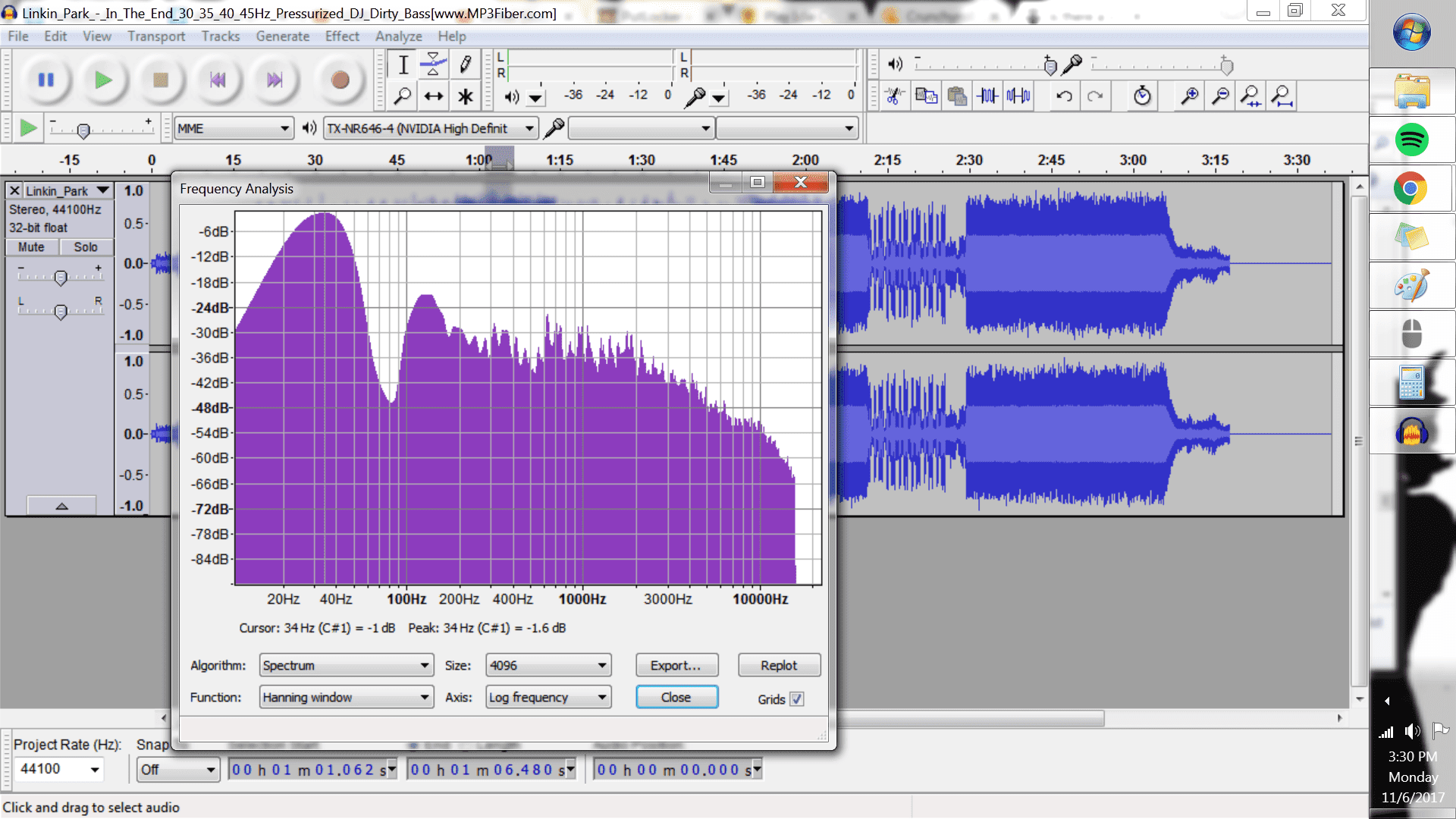
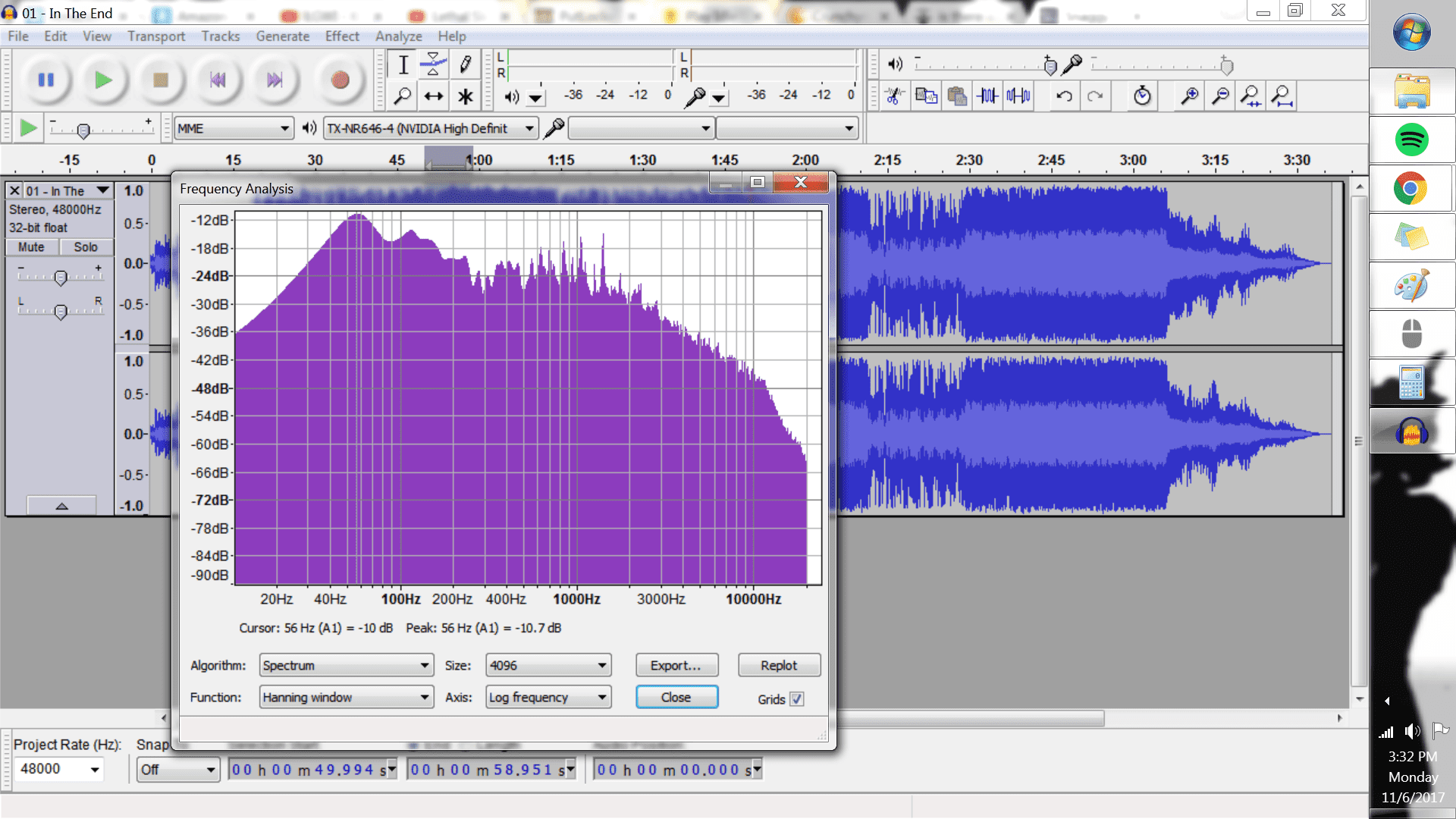
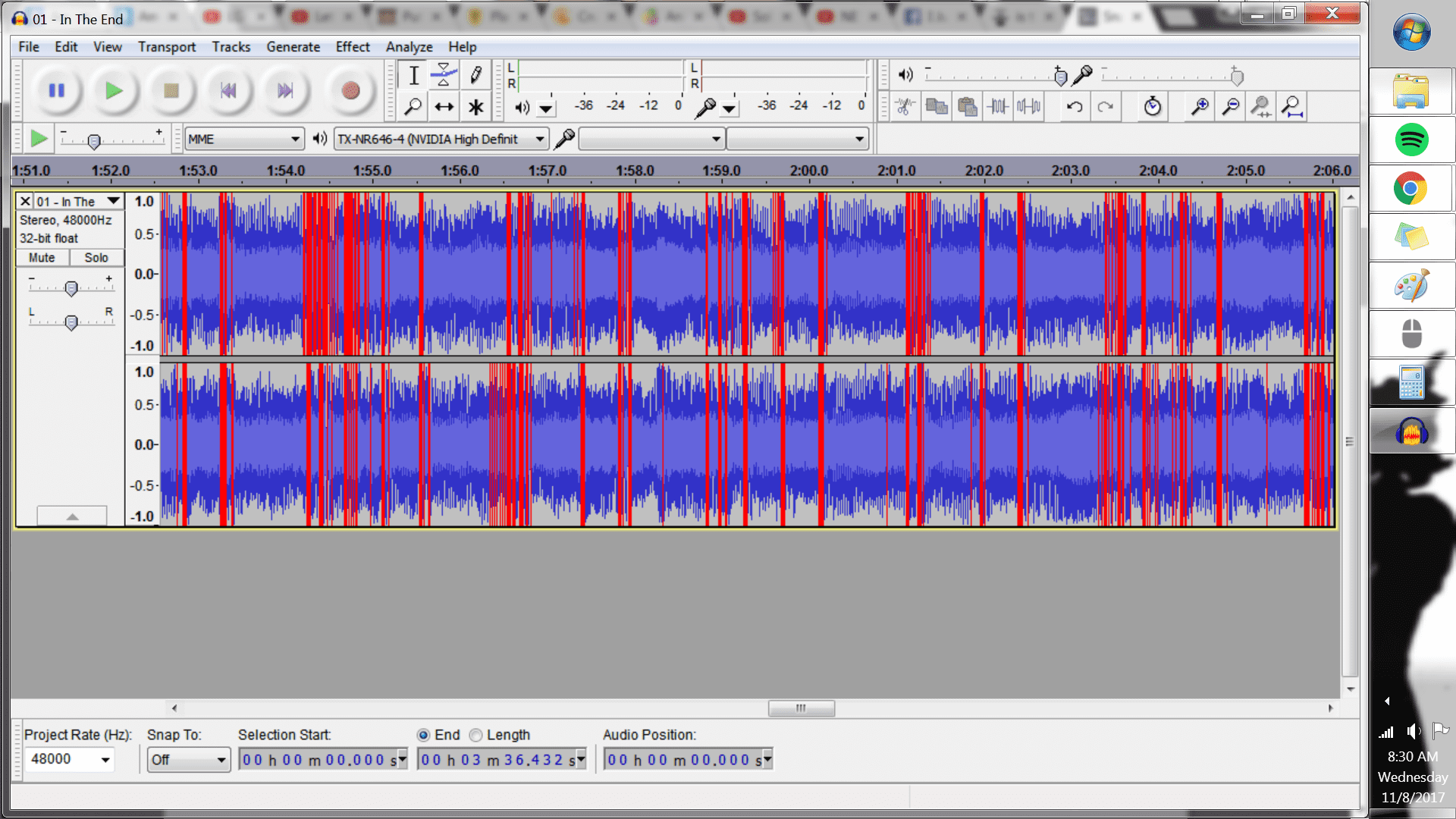
I'd recommend everyone getting audacity audacity and checking their music with the spectrum anaylzer and seeing the bass recording levels and get an understanding of whats inside their music and how it translate to their setups.

 
Difference between a rebassed linkin park vs the normal linkin park

xsfwOJ.jpg


ofNy7E.jpg


Dd1 distortion detector

O-scope

Buy an amp with a clipping light.....

3 good ways.

Subs when they move a lot also raise ohms......so it's always better to over power a speaker with clean power than to clip with under rated power.

 
the flaw about the multi-meter method is, you are using a 40/50 hz sine wave at whatever db level... When you play music, the recording levels in music range from -15 to -10 with some rock and classical, -10 to -5 with mainstream, pop, edm and rap and -5 to 0 db with rebassed music. If you use a -5 db test tone to set gains then play a rock music, your output will be extremely weak and you are way undergained. If you play rebassed music that goes up to a -1 db level of bass, that means you are well beyond clipping. If you set your gains at 0 db test tones and just leave it at that one volume setting, that means you just are fking yourself over completely with your output.
People really need to know the relationship between the recording levels in music and how it affects your head unit pre-out voltage which directly affects your amplifier power output rather than blindly choosing a test tone to set gains with and not knowing how your setup really works. Another issue is if the amp is OVERRATED as fk and you do that same power equation. For example an amp that claims 2000 rms but only does 1200 real rms. If you set the gain for 2000 rms, you are already way overdriving your amp way past distortion levels. When you are fully aware of your max level out output aka when you turn it up and it stops getting louder, and closely monitor output levels, and voltages for every song you play and adjust sub level accordingly which involves always rolling up on the volume knob from a lower volume level until you reach your max safe output, thats when you run your gear the safest, its called active gain setting. The typical multimeter method of tuning at 23/30 volume, sub level max, tune with a 40 hz test tone then leave it alone and always turn up to that exact volume at 23 is called passive gain setting which is basically sh*t IMO.

There is no one setting fits all, the multi-meter method only gets you to a certain ballpark, the rest needs active maintenance and monitoring. Clipping does not directly kill equipment, clipping generates heat a lot faster. heat is the actual culprit that kills amps and subs other than mechanical failure.

I'd recommend everyone getting audacity audacity and checking their music with the spectrum anaylzer and seeing the bass recording levels and get an understanding of whats inside their music and how it translate to their setups.
Interesting info. What I really need to know is the level of my test tone in relation to the music I normally listen to. The upshot is that if the test tone is at 0 db and most normal music is at negative EQ then setting via multimeter is safe, albeit might under perform. I'm OK with that. I'd rather under perform than fry my equipment.

I don't see the evil in just using EQ to up the voltage on bass signals at normal listening volume. I understand the difference between that and gain - in the case of gain, every signal coming into the sub amp is...well...amplified, whereas with EQ it's something like a Gaussian spread. Some signals are boosted more than others. But that doesn't really bother me, and seems safer than messing with gain in the absence of a remote gain knob.

Wow. I think I just realized why a remote gain knob is useful. Ya learn something new every day.

 
Interesting info. What I really need to know is the level of my test tone in relation to the music I normally listen to. The upshot is that if the test tone is at 0 db and most normal music is at negative EQ then setting via multimeter is safe, albeit might under perform. I'm OK with that. I'd rather under perform than fry my equipment.
I don't see the evil in just using EQ to up the voltage on bass signals at normal listening volume. I understand the difference between that and gain - in the case of gain, every signal coming into the sub amp is...well...amplified, whereas with EQ it's something like a Gaussian spread. Some signals are boosted more than others. But that doesn't really bother me, and seems safer than messing with gain in the absence of a remote gain knob.

Wow. I think I just realized why a remote gain knob is useful. Ya learn something new every day.
If the test tone is 0db then you would be over setting the gain as going from negative to 0 is + gain not minus.
Sent from my Moto G (4) using Tapatalk

 
All one has to do to avoid an underperforming sub system when setting gains using a DMM is to purchase an amplifier that is say 125% more powerful than what the subwoofer needs to perform at its best, which is typically the top of its RMS range. Set the gain using the DMM method set to the voltage that the sub can take, not the max power of the amplifier, which is basically what 90% of the people out there have access to. Doing it this way you’ll get decent high quality output and will be less likely to clip the signal or fry an amplifier.

There are basically three camps out there which are the regular joe who just wants their music to sound good, the Sound Qaulity camp who push the sound quality to higher levels with DSP’s and active high quality components, and then the all out SPL people who run big power pushing multiple speakers with high current electrical systems. The first two camps would be just fine using an amplifier that is more powerful and the basic DMM method. Some of the really serious SQ camps and definitely the high dollar SPL camps will want to push everything to its absolute maximum limits using oscilloscopes, distortion detectors, or other more scientific methods.

So depending on where you fall into one of these three basic catigories here will sort of depend on which method you really need to use. The guy with basic coaxial speakers and a small subwoofer doesn’t need to get an occiloscope and the all out SPL competitor isn’t going to get that last 5-10% using just a DMM and 60 hz test tone.

 
If the test tone is 0db then you would be over setting the gain as going from negative to 0 is + gain not minus.
Sent from my Moto G (4) using Tapatalk
Indeed.

All one has to do to avoid an underperforming sub system when setting gains using a DMM is to purchase an amplifier that is say 125% more powerful than what the subwoofer needs to perform at its best, which is typically the top of its RMS range. Set the gain using the DMM method set to the voltage that the sub can take, not the max power of the amplifier, which is basically what 90% of the people out there have access to. Doing it this way you’ll get decent high quality output and will be less likely to clip the signal or fry an amplifier.
There are basically three camps out there which are the regular joe who just wants their music to sound good, the Sound Qaulity camp who push the sound quality to higher levels with DSP’s and active high quality components, and then the all out SPL people who run big power pushing multiple speakers with high current electrical systems. The first two camps would be just fine using an amplifier that is more powerful and the basic DMM method. Some of the really serious SQ camps and definitely the high dollar SPL camps will want to push everything to its absolute maximum limits using oscilloscopes, distortion detectors, or other more scientific methods.

So depending on where you fall into one of these three basic catigories here will sort of depend on which method you really need to use. The guy with basic coaxial speakers and a small subwoofer doesn’t need to get an occiloscope and the all out SPL competitor isn’t going to get that last 5-10% using just a DMM and 60 hz test tone.
Interesting, and believable.

 
Interesting info. What I really need to know is the level of my test tone in relation to the music I normally listen to. The upshot is that if the test tone is at 0 db and most normal music is at negative EQ then setting via multimeter is safe, albeit might under perform. I'm OK with that. I'd rather under perform than fry my equipment.
I don't see the evil in just using EQ to up the voltage on bass signals at normal listening volume. I understand the difference between that and gain - in the case of gain, every signal coming into the sub amp is...well...amplified, whereas with EQ it's something like a Gaussian spread. Some signals are boosted more than others. But that doesn't really bother me, and seems safer than messing with gain in the absence of a remote gain knob.

Wow. I think I just realized why a remote gain knob is useful. Ya learn something new every day.
You wouldn't believe the amount of people that come on this forum and complain that their amp or sub is junk because its weak and they claim they set their gains right via the multimeter method. Then when they tried what i said, they literally jumped 5 to tenfold in output.

Being complacent is no excuse for not knowing what your actual system limits are.

Your comment about seeing no evil in using the eq to boost up is extremely worrying. In music there is a clean level of bass output and information. Boosts on the EQ is trying to add bass thats not there in the first place. If you actually mix audio, you'll see the direct effect of this which is massive clipping and distortion. There's a reason why eq boosts are frowned upon.

 
You wouldn't believe the amount of people that come on this forum and complain that their amp or sub is junk because its weak and they claim they set their gains right via the multimeter method. Then when they tried what i said, they literally jumped 5 to tenfold in output.
Being complacent is no excuse for not knowing what your actual system limits are.

Your comment about seeing no evil in using the eq to boost up is extremely worrying. In music there is a clean level of bass output and information. Boosts on the EQ is trying to add bass thats not there in the first place. If you actually mix audio, you'll see the direct effect of this which is massive clipping and distortion. There's a reason why eq boosts are frowned upon.
I believe you on the first point. I set the gain on my sub amp by ear the first time I did it, with factory HU wired up using high level input signal. The gain setting was indeed slightly higher than the current setting, but only slightly. (For reference, both methods put me at about 3/4 gain).

As to the second, I guess I still don't understand. Method 1: bass signals in song were EQ'd back. At normal volume, you get (just to make up a #) a 3 volt bass signal. Set gains so that it becomes 21 volts on the sub. Method 2: Set your EQ so that 3 volts becomes 4 volts. Set gains so that becomes 21 volts on the sub.

What's the difference? (Other than the EQ not amplifying every bass signal equally, of course).

 
I believe you on the first point. I set the gain on my sub amp by ear the first time I did it, with factory HU wired up using high level input signal. The gain setting was indeed slightly higher than the current setting, but only slightly. (For reference, both methods put me at about 3/4 gain).
As to the second, I guess I still don't understand. Method 1: bass signals in song were EQ'd back. At normal volume, you get (just to make up a #) a 3 volt bass signal. Set gains so that it becomes 21 volts on the sub. Method 2: Set your EQ so that 3 volts becomes 4 volts. Set gains so that becomes 21 volts on the sub.

What's the difference? (Other than the EQ not amplifying every bass signal equally, of course).
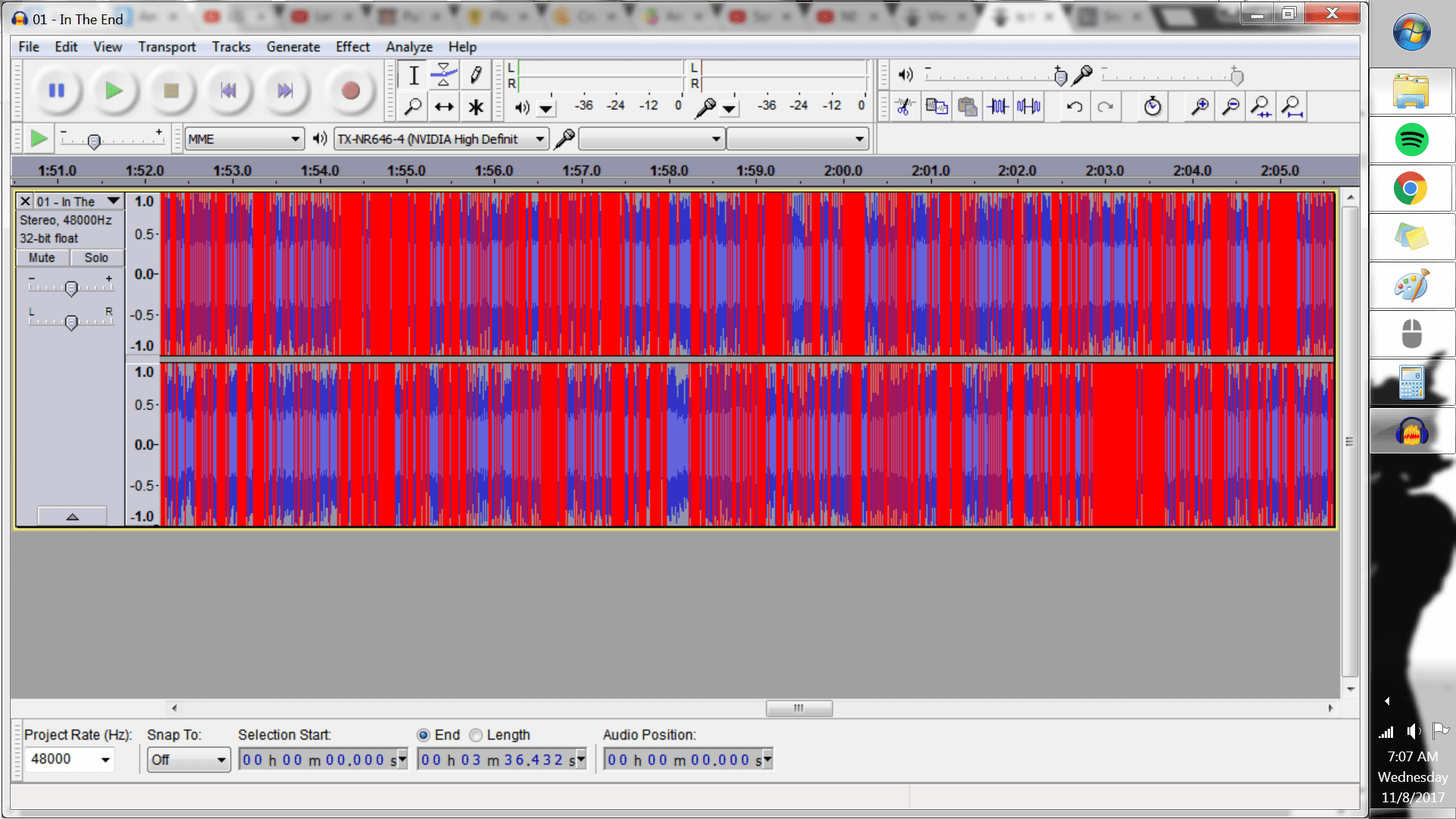
normally bass boost/ bass EQ is centered around a certain frequency aka 45hz. If a song doesnt have any 45hz information, well now its forced to have it in there magically. You are basically trying to add musical information that is not there in the first place.

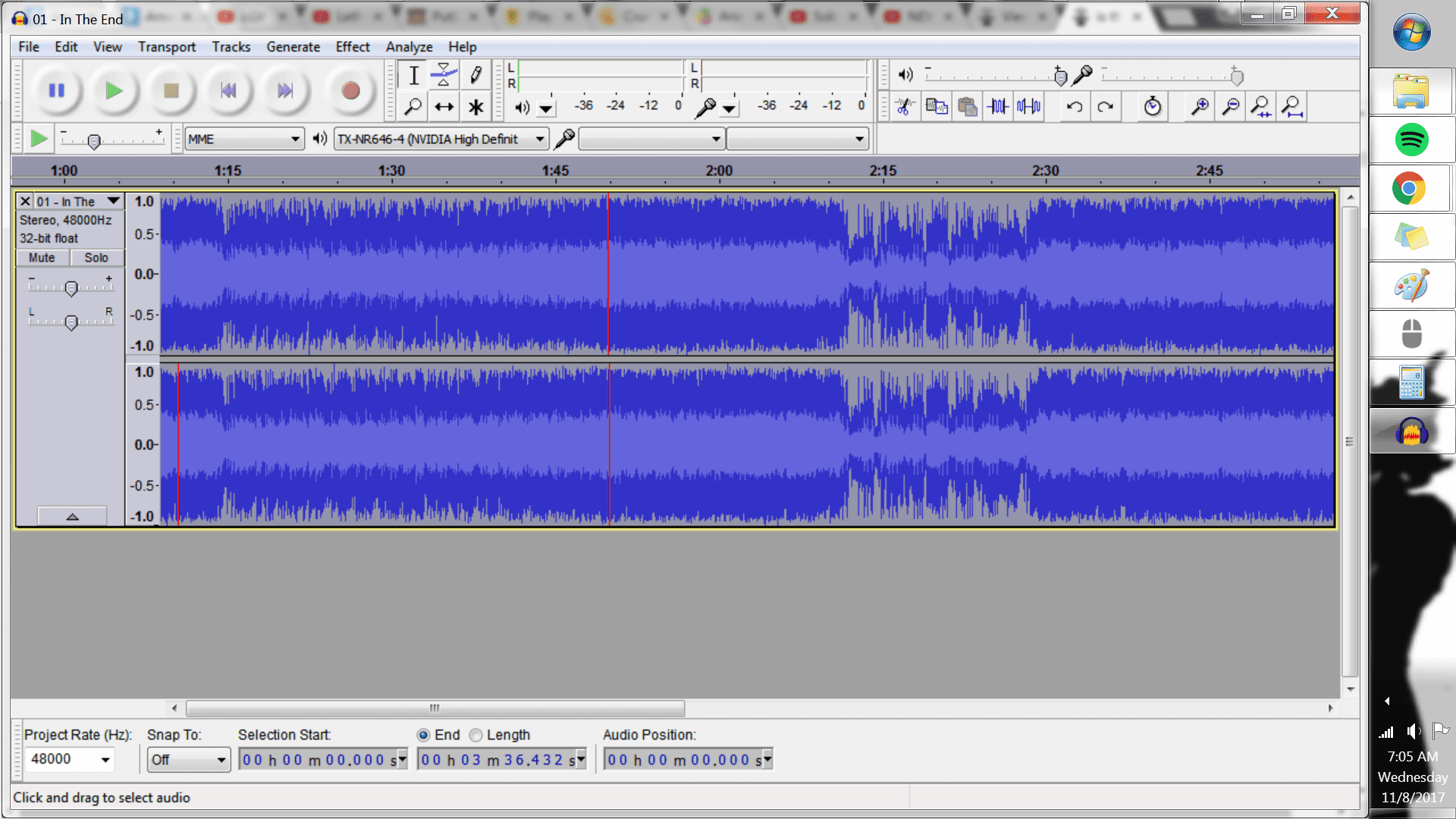
This is a basic simulation of what happens

clean unmodified file.

bjL9MB.jpg


and here's a a tiny bit of 45 hz bass EQ added onto the mix. Red lines are clipping and distortion

rSIq0i.jpg


normally bass boost/ bass EQ is centered around a certain frequency aka 45hz. If a song doesnt have any 45hz information, well now its forced to have it in there magically. You are basically trying to add musical information that is not there in the first place.

This is a basic simulation of what happens

clean unmodified file.

bjL9MB.jpg


and here's a a tiny bit of 45 hz bass EQ added onto the mix. Red lines are clipping and distortion

rSIq0i.jpg
Bass boost or EQ doesn't create signal, it only amplifies existing signal in a certain range. As far as I understand it, you would get the same effect in your example if you had your sub amp gain turned way on up.

I must reveal my ignorance here: What are the upper and lower limits (+1 and -1) in your program supposed to indicate?

 
Bass boost or EQ doesn't create signal, it only amplifies existing signal in a certain range. As far as I understand it, you would get the same effect in your example if you had your sub amp gain turned way on up.
I must reveal my ignorance here: What are the upper and lower limits (+1 and -1) in your program supposed to indicate?
its a big artificial boost, no where near the affects of a normal gain raise. It throws everything off balance and the whole audio track is way more susceptible to clipping and distortion. Big reason why we never touch bass boosts on amps nor bass EQ, its pretty common knowledge there.

Basically anything past those limits is clipping when you skew the response slightly with a bass boost, even when you lower the overall amplitude aka gain, you will still have clipping with any kind of bass boost put onto it this is the example here.

Se2TCg.jpg


TLDR, any kind of bass boost is bad... the only thing you would want to do bass EQ wise is to cut if you want a flat bass response if your bass is response is peaky.

 
Activity
No one is currently typing a reply...
Old Thread: Please note, there have been no replies in this thread for over 3 years!
Content in this thread may no longer be relevant.
Perhaps it would be better to start a new thread instead.

About this thread

ekah

Senior VIP Member
Thread starter
ekah
Joined
Location
hawaii
Start date
Participants
Who Replied
Replies
34
Views
3,776
Last reply date
Last reply from
Jeffdachef
IMG_20260516_193114554_HDR.jpg

sherbanater

    May 16, 2026
  • 0
  • 0
IMG_20260516_192955471_HDR.jpg

sherbanater

    May 16, 2026
  • 0
  • 0

New threads

Top