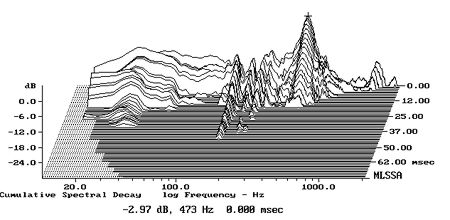
how to make sense of these types of graphs

nauc
10+ year member

CarAudio.com Veteran
D25fig3.jpg
 
Its a waterfall or decay plot. It shows resonances in the speaker itself. Basically it tells you how long after the speaker stops getting a signal that it quite making sound. That particular graph shows a pretty big resonance at 150Hz (not at all uncommon) another one in the 30-40 Hz range (again pretty common) and a huge response peak in the 500Hz range. The 150hz and 500Hz res are products of cone breakup and will get killed by the lowpass crossover.

 
what i find interesting is that i have those two peaks (150 and 500 hz) set to like negative 12 db on my eq.. i do this to achieve a flat RTA response.. can someone go further in details.. should i deaden to rid of this??

 
Originally Posted by DanWiggins

2. Transient response IS frequency response. The two are the same thing. Take the transient response, run it through the Fourier transform, and you get frequency response. Take frequency response, run it through the inverse Fourier transform, you get transient response. You cannot talk about one without implicitly talking about the other!

---------------

if thats true, why does the signal drop off a lot faster at around 500hz compared to around 150hz that almost goes to 50msec

 
Activity
No one is currently typing a reply...
Old Thread: Please note, there have been no replies in this thread for over 3 years!
Content in this thread may no longer be relevant.
Perhaps it would be better to start a new thread instead.

About this thread

nauc

10+ year member
CarAudio.com Veteran
Thread starter
nauc
Joined
Location
USA
Start date
Participants
Who Replied
Replies
8
Views
451
Last reply date
Last reply from
helotaxi
IMG_20260516_193114554_HDR.jpg

sherbanater

    May 16, 2026
  • 0
  • 0
IMG_20260516_192955471_HDR.jpg

sherbanater

    May 16, 2026
  • 0
  • 0

New threads

Top