All the other companies and products tested against it huh?none...only thing i would get is audio technix....it has been test proven on several levels to out perform the other companies and even has been acoustically tested to out perform as well! only other company that is comparable is second skin...they are on par with eachother but audio tecnix is cheaper and has a more agressive adheisive...will stand up to the hottest day and not come off.
No that proves the guy that tested the products was biased towards AT. AT paid him to do the testing not SS.
There is TOOO MUCH **** LOGIC in your post.Yes it does. Thats why I read unbiased reviews from people who have used the product and have experience with other products rather than asking the vendor about their own product.
I try to use enough material to cover 25% of the panel, spread out over the central 40-50%. Here's the theoretical ideal on an open panel like a roof:does anyone have pics they would be willing to share of a 25% installation in their vehicle? i am having a hard time getting my head around where the 25% should be applied. seems like i have always seen the whole door covered and the middle third of the trunk. i was thinking of doing the roof and floors as well, especially in my truck since i am pulling the whole interior including the dash for glassing and flocking.
I try to use enough material to cover 25% of the panel, spread out over the central 40-50%. Here's the theoretical ideal on an open panel like a roof:![]()
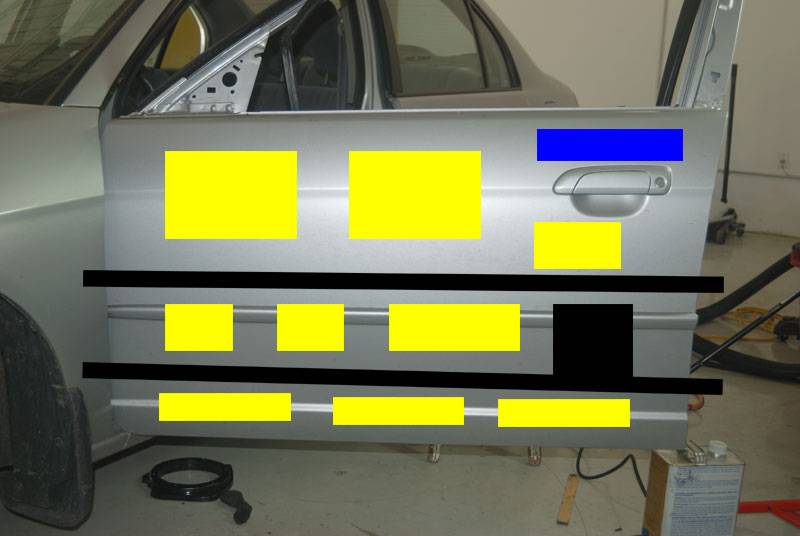
Doors get a little more complicated (in theory):
![]()
The blue rectangle is the stock material.
The black horizontal bars are the side impact beams.
The Black square is a steel structural element attached to the outer skin.
The yellow rectangles are vibration damper.
The key concept here is that the side impact beams are bonded to the outer skin. They are that way from the factory in this Civic. I fill the gap on cars where they aren't connected.
The side impact beams effectively divide the outer skin into 3 "virtual" panels. Target the centers of each one.
Treating the roof with vibration damper is almost always a good idea. Floors usually need no or very little supplemental damping. They are reinforced at many points and usually have a lot of material installed at the factory. You really need to add a barrier for noise reduction on the floor.

Try clearing your cookies, or using a different browser to view the pics. Or you can try putting the link to the pics directly in your address bar and viewing them that way.Thank you for the information. I can't seem to see your photos for some reason. not sure why. i would really like to see them. did you host them somewhere?