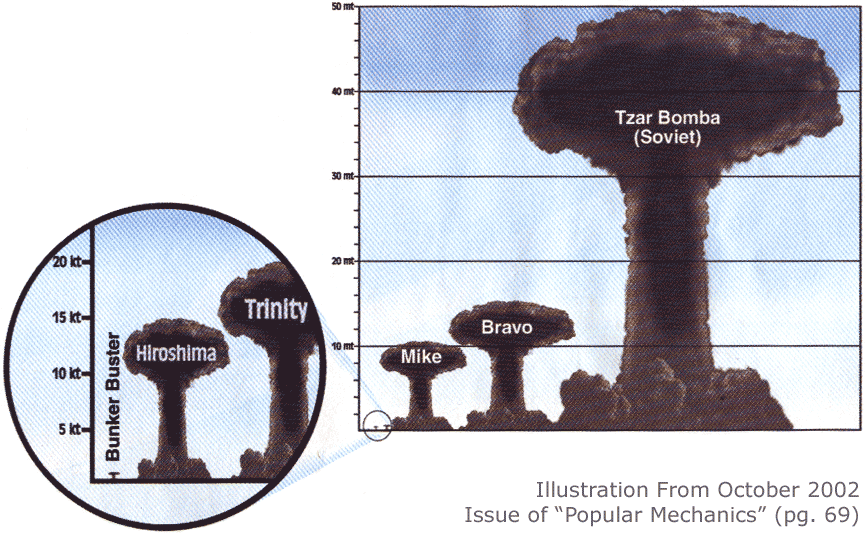
The original U.S. estimate of the yield was 57 Mt, but since 1991 all Russian sources have stated its yield as 50 Mt. Nonetheless, Khrushchev warned in a filmed speech to the Communist parliament of the existence of a 100 Mt bomb (technically the design was capable of this yield). The fireball touched the ground, reached nearly as high as the altitude of the release plane, and was seen and felt 1,000 km away. The heat from the explosion could have caused third degree burns 100 km away from ground zero. The subsequent mushroom cloud was about 60 km high (nearly seven times higher than Mount Everest) and 30–40 km wide. The explosion could be seen and felt in Finland, even breaking windows there [4]. Atmospheric focusing caused blast damage up to 1,000 km away. The seismic shock created by the detonation was measurable even on its third passage around the Earth. Its Richter magnitude was about 5 to 5.25[4]
Since 50 Mt is 2.1×10¹⁷ joules, the average power produced during the entire fission-fusion process, lasting around 39 nanoseconds [citation needed], was a power of about 5.4×1024 watts or 5.4 yottawatts. This is equivalent to approximately 1% of the power output of the Sun. The detonation of Tsar Bomba therefore qualifies as being the single most powerful device ever utilized throughout the history of humanity.