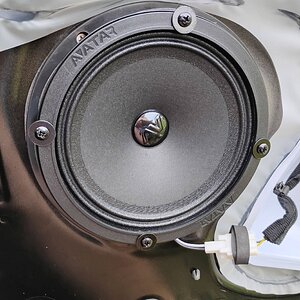
Budget component setup

The MRV-F345 is a flexible amplifier.
CH 1&2 crossover switch: Select high-pass, low-pass, or full-range operation for the CH 1&2 speaker outputs

CH 1&2 frequency control: Rotary control adjusts the crossover frequency from 30Hz-400Hz or 600Hz-8kHz (depending on frequency multiplication switch)

CH 1&2 frequency multiplication switch: Select "x1" for frequency band 30Hz-400Hz or "x20" for frequency band of 600Hz-8kHz

CH 3&4 crossover switch: Select high-pass, low-pass, or full-range operation for the CH 3&4 speaker outputs

CH 3&4 frequency control: Rotary control adjusts the crossover frequency from 30Hz-400Hz or 600Hz-8kHz (depending on frequency multiplication switch)

CH 3&4 frequency multiplication switch: Select "x1" for frequency band 30Hz-400Hz or "x20" for frequency band of 600Hz-8kHz

Input channel selector switch: Select between 1/2, 3/4, and 1+3/2+4

That means you can use the amp LPF set around 2kHz-4kHz depending on the woofer's off-axis performance and low frequency performance of the tweeters.

Since the amp doesn't feature a bandpass crossover feature, you will need some sort of high-pass filter on the woofers. what frequency depends on what other woofers are in the system. luckily, you can easily adjust the crossover frequency between woofers and tweeters as needed once you pick your tweeters. no passive crossovers are needed, but a single small non-polarized capacitor in series with each tweeter will offer extra protection if you accidentally change the frequency multiplier.
another question.

Ive been consistently stumbling across the terms 2nd, 3rd and 4th order crossovers

do I need to concern myself with this aspect of component systems?

e/

referring to the application i am building that is

 
another question.
Ive been consistently stumbling across the terms 2nd, 3rd and 4th order crossovers

do I need to concern myself with this aspect of component systems?

e/

referring to the application i am building that is
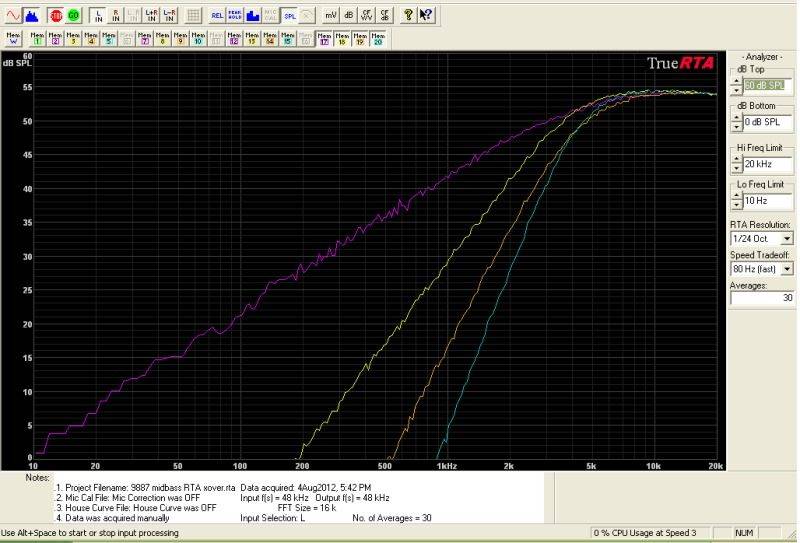
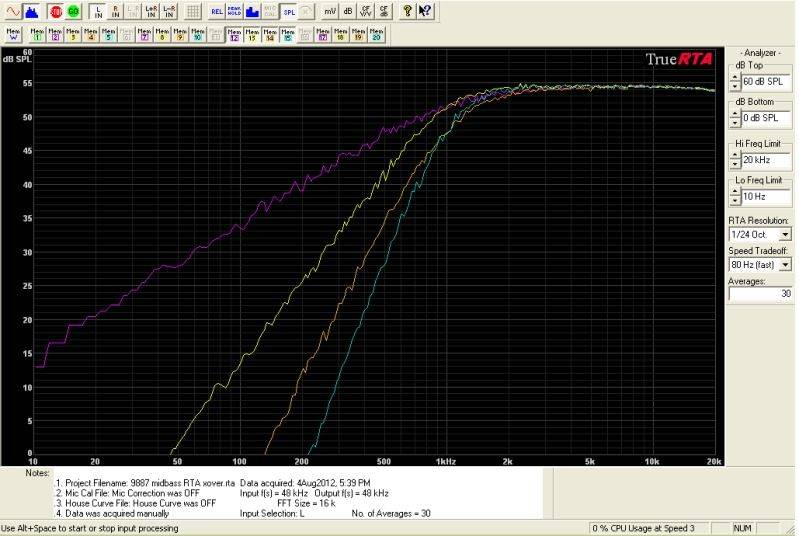
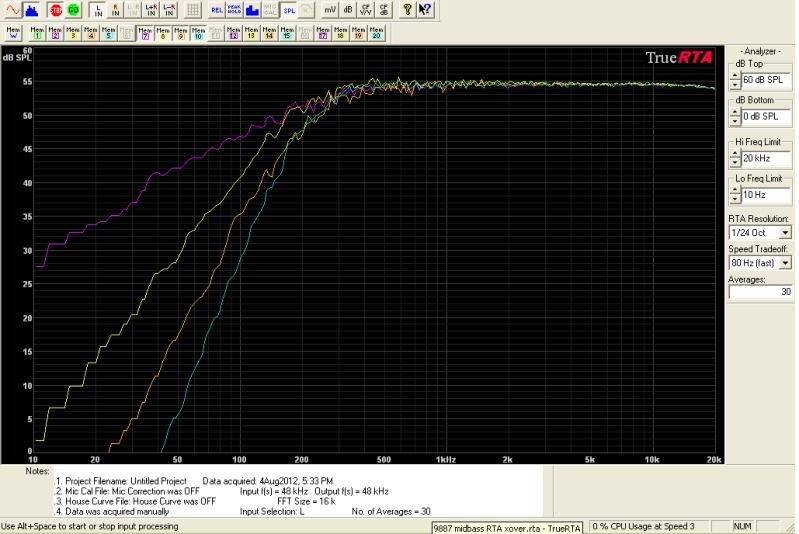
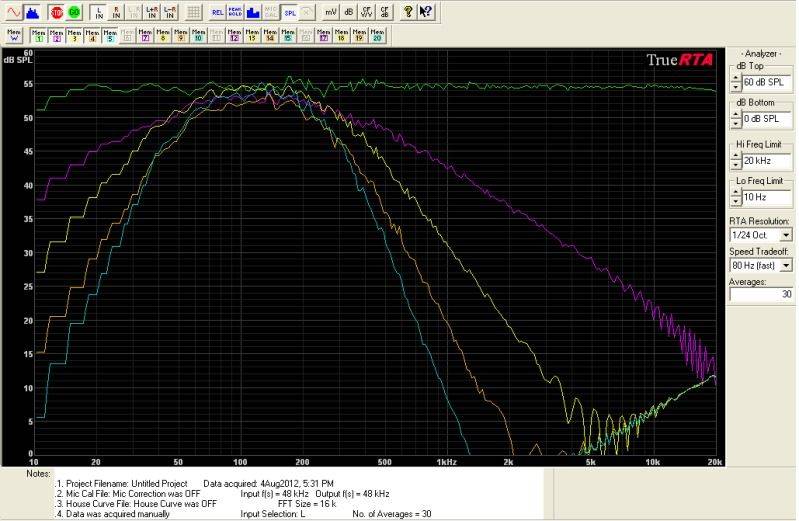
Data was taken by using the SoundDevices USBPre line level rca input from the Alpine CDA-9887 output directly. Levels are relative. Autosound 2000 Track 18 (un-correlated pink noise) was used as the source.

I am using the Alpine DRE-A200 as a crossover between my tweets and mids off the Front outputs on the 9887. you can see the 12dB/oct slope of that crossover.

There is the same consistent drop at the crossover frequency (6 and 12 are the same, 18 and 24 are the same at the xover point). Certainly, when choosing crossover slopes and points, the drop at the crossover point should be taken into consideration - resulting in some overlap with the crossover points.

4kHz crossover point, slope varies 6 to 24dB/oct. Front output of 9887

9887_4kHz_HPF.jpg


1kHz crossover point, slope varies 6 to 24dB/oct. Front output of 9887

9887_1kHz_HPF.jpg


200Hz crossover point, slope varies 6 to 24dB/oct. Rear output of 9887

9887_200Hz_HPF.jpg


50Hz HPF, 250Hz LPF, slope varies from Full to 6, 12, 18 & 24dB/oct. Rear output of 9887

9887_50Hz_250Hz_BPF-1.jpg


the other item to keep track of is phase. each time you increase crossover slope (or order) you shift phase by 90 deg. that means 12dB/oct (2nd order) has a 180 deg. phase shift. you keep track of this because it has the effect of reversing polarity. keeping crossover points the same between drivers can alleviate some of these concerns.

 
Activity
No one is currently typing a reply...
Old Thread: Please note, there have been no replies in this thread for over 3 years!
Content in this thread may no longer be relevant.
Perhaps it would be better to start a new thread instead.

About this thread

tylerj

10+ year member
Senior VIP Member
Thread starter
tylerj
Joined
Location
NE
Start date
Participants
Who Replied
Replies
17
Views
1,983
Last reply date
Last reply from
keep_hope_alive
IMG_20260516_193114554_HDR.jpg

sherbanater

    May 16, 2026
  • 0
  • 0
IMG_20260516_192955471_HDR.jpg

sherbanater

    May 16, 2026
  • 0
  • 0

New threads

Top