I said earlier it depends (there are way too many variables not specified), but maybe I should have said all the above.
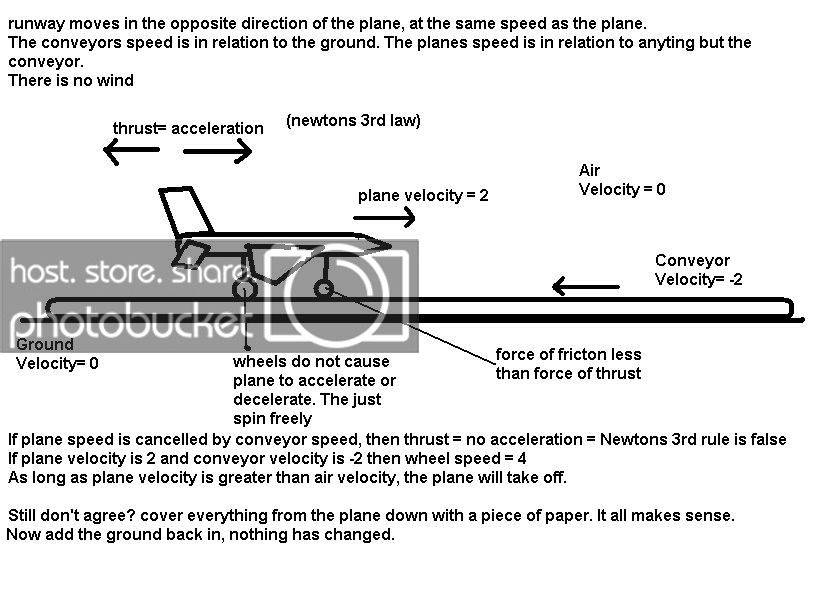
However, to prop up those who voted no, consider the following: The problem as stated specifies speed not velocity, hence there need be no forward velocity (read the belt is dragging the plane back at the same rate the plane is attempting forward progress). No movement of the airplane relative to fixed ground - no lift, no flight.
For the "it will fly" crowd, if you assume low friction between belt and aircraft body, i.e., wheels with good bearings, a reasonable assumption, and equate speed with velocity (not scientifically true, but then I'm a physicist and so...); then the aircraft's wheels will be rotating at a rate that is approximately equivalent to that at twice take-off velocity - the plane's speed in one direction, the belt's in the other - but there's still enough forward progress to take off & fly normally.
And finally, for those who somehow fell in-between (or couldn't make up their mind) assume the coefficient of friction between the belt and aircraft body was sufficiently high (the problem doesn't specify wheels with good bearings anywhere that I read) such that the velocity was low, then the plane could lift and fall back down due to stall speed considerations.
BTW, I have a low post count because I mostly lurk - and this is one of two audio forums I visit to learn.
Finally, the argument rages among scientific types, but I think the general consensus is that the air flow over and under the wing with pressure differential causes lift is old thinking. Lift (vertical thrust) IMO has as it's primary source a rotational torque applied to the wings. Why? Look at pics of contrails coming off a wing, or think about how a sailing boat with a rotating cylinder (and no sails) is able to move.