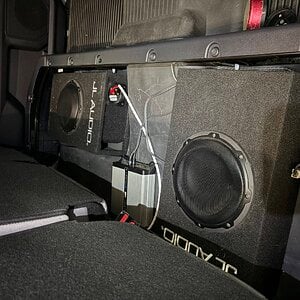
anybody ever ran their plate amp at 2ohms?

I ran my 70 watt PE one at two ohms for about a month before it....did nothing at all haha. It just got hot, but didn't fail or distort compared to 4 or 8 ohm operation.

 
I am sure it is distorting a lot more at 2 ohms than at 4 or 8. You just can't hear it.

Also, 70 Watts is a completely different story than 100 Watts or 500 Watts. //content.invisioncic.com/y282845/emoticons/fyi.gif.9f1f679348da7204ce960cfc74bca8e0.gif

I am sure you could get away with doing it, but I wouldn't run the risk of damaging equipment or causing a major meltdown.

 
I am sure it is distorting a lot more at 2 ohms than at 4 or 8. You just can't hear it.
Also, 70 Watts is a completely different story than 100 Watts or 500 Watts. //content.invisioncic.com/y282845/emoticons/fyi.gif.9f1f679348da7204ce960cfc74bca8e0.gif

I am sure you could get away with doing it, but I wouldn't run the risk of damaging equipment or causing a major meltdown.
Yeah I know, I just didn't feel like buying two more drivers to bring the load up to 4 ohms //content.invisioncic.com/y282845/emoticons/crazy.gif.c13912c32de98515d3142759a824dae7.gif
 
$5 says that amplifier if really pushed gets HOT...
Yeah it would, but it was on party duty for 3 hours and it never skipped a beat //content.invisioncic.com/y282845/emoticons/eek.gif.771b7a90cf45cabdc554ff1121c21c4a.gif
 
Its just like car audio, depends on how box rise, etc plays a role on the system, as well as how accurately the manufactures rate their product. IE can it REALLY provide rated rms at rated impediance for extended periods of time...otherwise power and distortion ratings are irrelevant, which in many cases they are //content.invisioncic.com/y282845/emoticons/frown.gif.a3531fa0534503350665a1e957861287.gif

Only testing with your specific system and equipment will give you a real answer. Otherwise, generalizations like these...

I am sure it is distorting a lot more at 2 ohms than at 4 or 8. You just can't hear it.
are not valid //content.invisioncic.com/y282845/emoticons/wink.gif.608e3ea05f1a9f98611af0861652f8fb.gif
 
Earthquake Supernova MK-V plate amp in a custom box with two SVC 4 ohm DBXis and its at 2 ohms //content.invisioncic.com/y282845/emoticons/biggrin.gif.d71a5d36fcbab170f2364c9f2e3946cb.gif

 
Its just like car audio, depends on how box rise, etc plays a role on the system, as well as how accurately the manufactures rate their product. IE can it REALLY provide rated rms at rated impediance for extended periods of time...otherwise power and distortion ratings are irrelevant, which in many cases they are //content.invisioncic.com/y282845/emoticons/frown.gif.a3531fa0534503350665a1e957861287.gif
Only testing with your specific system and equipment will give you a real answer. Otherwise, generalizations like these...

are not valid //content.invisioncic.com/y282845/emoticons/wink.gif.608e3ea05f1a9f98611af0861652f8fb.gif
are not valid?

The problem is he is wanting to run a 4 ohm rated plate amplifier at 2 ohms. So he is not running it in where it is rated.

Anyone who thinks that running a amplifier below rated impedance is a good idea and just fine, is just an idiot.

Yea, there are some amplifiers that can do it and not even flinch, but the amplifiers usually don't have the heat dissipation capabilities to run this low. So even if they don't melt down right away, eventually the extra heat will seriously diminish the life of the system.

Also, the distortion and THD+N goes up when you run higher current (or lower impedance), especially if the amplifier isn't made to run at that current level.

Moral of the story, buy things that fit the project. If you want to run subwoofers that come out at 2 ohms, buy and amplifier that is rated and can handle it. If you have an option and SQ is of any importance go with the higher impedance.

 
are not valid?
The problem is he is wanting to run a 4 ohm rated plate amplifier at 2 ohms. So he is not running it in where it is rated.

Anyone who thinks that running a amplifier below rated impedance is a good idea and just fine, is just an idiot.

Yea, there are some amplifiers that can do it and not even flinch, but the amplifiers usually don't have the heat dissipation capabilities to run this low. So even if they don't melt down right away, eventually the extra heat will seriously diminish the life of the system.

Also, the distortion and THD+N goes up when you run higher current (or lower impedance), especially if the amplifier isn't made to run at that current level.

Moral of the story, buy things that fit the project. If you want to run subwoofers that come out at 2 ohms, buy and amplifier that is rated and can handle it. If you have an option and SQ is of any importance go with the higher impedance.
Umm did you NOT read what I said? Have you measured his specific equipment and concluded that it is in fact BELOW 4 ohms nominal? No you have not.
I love how people make assumptions of how equipment works, the amplifier will NOT see a constant rated impediance for a given system. Various factors can easily push the nominal impediance well above 4 ohms, including the box its in. Not to mention a speaker does not have the same load throughout the frequency range, and can peak as high as 10 times its load value...but you should know that right?

I used to think you were knowledgeable, but it seems all you do is look up theories and buy commercially made equipment //content.invisioncic.com/y282845/emoticons/rolleyes.gif.c1fef805e9d1464d377451cd5bc18bfb.gif

Im not saying that it will work all the time, and I'm not saying that it will not, all depends on the situation. Don't go around spreading generalizations (look it up if you need to) with a setup that you haven't even seen, let alone tested...

 
Umm did you NOT read what I said? Have you measured his specific equipment and concluded that it is in fact BELOW 4 ohms nominal? No you have not.
No, I did read what you said. However, I am trying to remember the last time I sweeped the impedance of a 2 ohm driver and had 4 ohms any where other than at the Fs or the tuning of the box. Usually in fact if you sweep a driver you are going to get A LOT of the usable audio range below the nominal. I have seen 2 ohm drivers read less than 1 ohm at points, weirdest one is an 8 ohm speaker at just a touch above 3 ohms. I haven't measured his specific equipment because for one he has never said what is equipment his and two he is almost going to certain have points where his driver impedance drops pretty low.

Here is the idea, lets even say that he is going to have considerable impedance rise. But, lets talk about .5 ohms vs 1 ohm. According to your idea I should be able to run my subwoofer at .5 ohms in a 1 ohm setup.

Hmmm.... Something doesn't seem right about this, maybe it is the copious amount of heat generated by my amplifiers before they go into protect. Or maybe it is the massive amount of amperage that I have to feed them so they don't shut off. Or maybe it is the clicking sound of transistors splitting because I have seriously damaged them.

I love how people make assumptions of how equipment works, the amplifier will NOT see a constant rated impediance for a given system. Various factors can easily push the nominal impediance well above 4 ohms, including the box its in. Not to mention a speaker does not have the same load throughout the frequency range, and can peak as high as 10 times its load value...but you should know that right?

Maybe we are talking about something different because I have no idea what impediance is.

The dictionary doesn't either...

http://www.merriam-webster.com/dictionary/impediance

Anyway, if you are talking about impedance, you are 100% correct, BUT this is a PEAK of 10 times. There is a considerable amount of the area below and above the peak point which can be below the rated nominal impedance.

I used to think you were knowledgeable, but it seems all you do is look up theories and buy commercially made equipment //content.invisioncic.com/y282845/emoticons/rolleyes.gif.c1fef805e9d1464d377451cd5bc18bfb.gif
//content.invisioncic.com/y282845/emoticons/laugh.gif.48439b2acf2cfca21620f01e7f77d1e4.gif One, 99.999% of everything that I comment on I either have direct experience with or have seen or know people who have had direct experience with the subject.

Two, what is wrong with commercial made equipment? Seriously? It shows a lot about a person when they think that they know more than everyone else. It gets annoying that people say this, just because I use a little sense and say "oh if I need 1000 watts at 4 ohms I better get an amplifier that does that" vs "oh if I need 1000 watts at 4 ohms I'll use the 500 watt at 4 ohm amplifier and run it at 2 ohms to get the 1000 out of it".

Just out of curiosity, don't you buy commercially made speakers? Don't you own commercially made amplifiers? What have the commercial world done to hurt some of you guys feelings so bad?

Im not saying that it will work all the time, and I'm not saying that it will not, all depends on the situation. Don't go around spreading generalizations (look it up if you need to) with a setup that you haven't even seen, let alone tested...
I'm not saying that it won't work all the time, you might be able to pull it off a couple times but I still wouldn't do it. I am just saying from my personal experience and from testing that I have done it is NOT a good idea to run something below its rated impedance. It increases distortion, decreases overhead, increases heat, decreases efficiency, and unless the transistors were designed to output that sort of current it is NOT a smart thing to do.

Anyway, how can you criticize me if you haven't tested his setup either?

SO STFU! Also, learn to spell "impedance"... K THnkx

//content.invisioncic.com/y282845/emoticons/wink.gif.608e3ea05f1a9f98611af0861652f8fb.gif

 
No, I did read what you said. However, I am trying to remember the last time I sweeped the impedance of a 2 ohm driver and had 4 ohms any where other than at the Fs or the tuning of the box. Usually in fact if you sweep a driver you are going to get A LOT of the usable audio range below the nominal. I have seen 2 ohm drivers read less than 1 ohm at points, weirdest one is an 8 ohm speaker at just a touch above 3 ohms. I haven't measured his specific equipment because for one he has never said what is equipment his and two he is almost going to certain have points where his driver impedance drops pretty low.
Bravo, you have proved me wrong with ONE case! Have a cookie…lets look at another example. I am going to make some generalizations (gasp!) about one driver, in this case, the Dayton HO 12 inch driver.

1.) In this case, we will deal with the driver without a box, no effects of box rise or shift whatsoever.

2.) We will supply a lowpass at 50hz, since this is a subwoofer, its assumed that it will play sub-bass frequencies.

3.) The amplifier will have a selectable subsonic filter, let’s set it at 10 Hz to be modest, to remove strain on the amplifier.

They all seem reasonable right? Let’s continue…

Case A: http://www.partsexpress.com/pdf/295-466g.pdf

Note that the FS is ~27 Hz, where we have the highest visible peak. Now take note of the shape of the peak, notice it is not completely vertical, it has some width to it ( a Q factor if you will), with a decreasing instantaneous slope as you move down the graph.

What does that do to our lowest points on the graph? Since are usable range is between 10 hz and 50 hz, let’s trace upwards from those points to the graph for simplicity. Notice for 10 and 50 hz, we have a resistance value of ~ 7 and 8 ohms respectively.

Take note also that our lowest point, which approaches 4 ohms, is ~ 90hz, out of the range of our subwoofer. At around 75hz, or half an octave away from our low pass, the slope of the graph begins to approach 0, the minimum of our graph. With a conservative 12db/octave lowpass, that point will be 6db down; at 90hz around 10db down.

Once the subwoofer is in an environment, the graph will be shifted up depending on the complexity of the box. Generally, the more complexity, the more the box’s rise becomes a factor. Of course, the graph can be shifted to the left or right, depending on box type, which will have to be measured to confirm that these shifts are not detrimental to the system.

So in this case, if our amp was rated at 8 ohms, should we run the subwoofer? An educated guess would say yes, since most sane and intelligent individuals:

A.) Do not play the subwoofer at full volume 24/7

B.) Play MUSIC and not test tones, music is dynamic, generally (unless its rap, which I am sure you will approve to leave it out //content.invisioncic.com/y282845/emoticons/smile.gif.1ebc41e1811405b213edfc4622c41e27.gif ) will not hover at the lowest and highest points of our system for extended periods of time. Even if they do, they are generally not played at 0db levels. With the gains set correctly, even rap is safe.

In any system you run the risk of damaging your equipment: Inaccurate manufacture ratings, clipped music recordings, etc. However, if you asked yourself “What if?” all the time, you will never enjoy what the equipment was made for; music!

Just to beat a dead horse:

Case B: http://www.partsexpress.com/pdf/295-464g.pdf

Case C: http://www.partsexpress.com/pdf/297-608.pdf

The point I am trying to get across is to be SMART about your equipment and how its setup. Just because something is rated at 4 ohms, does not mean that it will hover on that value in the usable frequency range you chose ahead of time. The benefit of “running” an amplifier below its “rated” load is you get more out of the amp while playing music. Choosing an amp with a higher power output than the subwoofer will give you enough headroom so you don’t run the amp at full tilt all the time (good in ANY case).

If your serious about your setup, more sophisticated equipment can be used to measure both the power output/stability of the amplifier and the resistance of the subwoofer at a given frequency.

If you trust the amp you buy (rated power accurate, relatively flat response), the latter can be done with a multi-meter, a bunch of test tones, and a lot of time.

Here is the idea, lets even say that he is going to have considerable impedance rise. But, lets talk about .5 ohms vs 1 ohm. According to your idea I should be able to run my subwoofer at .5 ohms in a 1 ohm setup.
Hmmm.... Something doesn't seem right about this, maybe it is the copious amount of heat generated by my amplifiers before they go into protect. Or maybe it is the massive amount of amperage that I have to feed them so they don't shut off. Or maybe it is the clicking sound of transistors splitting because I have seriously damaged them.
You’re cute //content.invisioncic.com/y282845/emoticons/wink.gif.608e3ea05f1a9f98611af0861652f8fb.gif
Maybe we are talking about something different because I have no idea what impediance is.
The dictionary doesn't either...

http://www.merriam-webster.com/dictionary/impediance
My apologies, stay on subject.
Anyway, if you are talking about impedance, you are 100% correct, BUT this is a PEAK of 10 times. There is a considerable amount of the area below and above the peak point which can be below the rated nominal impedance.
See above
//content.invisioncic.com/y282845/emoticons/laugh.gif.48439b2acf2cfca21620f01e7f77d1e4.gif One, 99.999% of everything that I comment on I either have direct experience with or have seen or know people who have had direct experience with the subject.Two, what is wrong with commercial made equipment? Seriously? It shows a lot about a person when they think that they know more than everyone else. It gets annoying that people say this, just because I use a little sense and say "oh if I need 1000 watts at 4 ohms I better get an amplifier that does that" vs "oh if I need 1000 watts at 4 ohms I'll use the 500 watt at 4 ohm amplifier and run it at 2 ohms to get the 1000 out of it".
Coming from a person who is a KING at thinking he knows more than anyone else //content.invisioncic.com/y282845/emoticons/laugh.gif.48439b2acf2cfca21620f01e7f77d1e4.gif Judging by your posts of course…
If you used a little more sense, you would buy amps with a higher power rating than you need, for headroom and less distortion //content.invisioncic.com/y282845/emoticons/wink.gif.608e3ea05f1a9f98611af0861652f8fb.gif

Just out of curiosity, don't you buy commercially made speakers? Don't you own commercially made amplifiers? What have the commercial world done to hurt some of you guys feelings so bad?
Actually I HAVE made my own speakers, I am a mechanical engineering major at Cal Poly, so I have access to some equipment. Bought off the shelf items, made some others, and built my own //content.invisioncic.com/y282845/emoticons/smile.gif.1ebc41e1811405b213edfc4622c41e27.gif
However, once again I would like to apologize for not being clear. I meant speaker SYSTEMS. Yes I buy raw drivers (and modify them), however the design and build aspects of the system are done by me. And yes I have made amplifiers, several actually, and a DAC, just for measure //content.invisioncic.com/y282845/emoticons/smile.gif.1ebc41e1811405b213edfc4622c41e27.gif If you haven’t notice, I love DIY hehe…you should try it sometime…

I'm not saying that it won't work all the time, you might be able to pull it off a couple times but I still wouldn't do it. I am just saying from my personal experience and from testing that I have done it is NOT a good idea to run something below its rated impedance. It increases distortion, decreases overhead, increases heat, decreases efficiency, and unless the transistors were designed to output that sort of current it is NOT a smart thing to do.
Thanks for your input, its good to have both sides of the fence….
Anyway, how can you criticize me if you haven't tested his setup either?
Never said if it would work for him, I was simply disproving that your theory will NOT always be true…

SO STFU! Also, learn to spell "impedance"... K THnkx
//content.invisioncic.com/y282845/emoticons/wink.gif.608e3ea05f1a9f98611af0861652f8fb.gif
Very mature, and thanks for the spelling lesson!
Regards,

Sergio

 
Activity
No one is currently typing a reply...
Old Thread: Please note, there have been no replies in this thread for over 3 years!
Content in this thread may no longer be relevant.
Perhaps it would be better to start a new thread instead.

About this thread

adio

5,000+ posts
THE STEREOTYPE FIGHTER!!!
Thread starter
adio
Joined
Location
college park, ga
Start date
Participants
Who Replied
Replies
16
Views
1,200
Last reply date
Last reply from
Fast1one
design.jpeg

WNCTracker

    May 22, 2026
  • 0
  • 0
IMG_2118.jpeg

WNCTracker

    May 22, 2026
  • 0
  • 0

New threads

Top