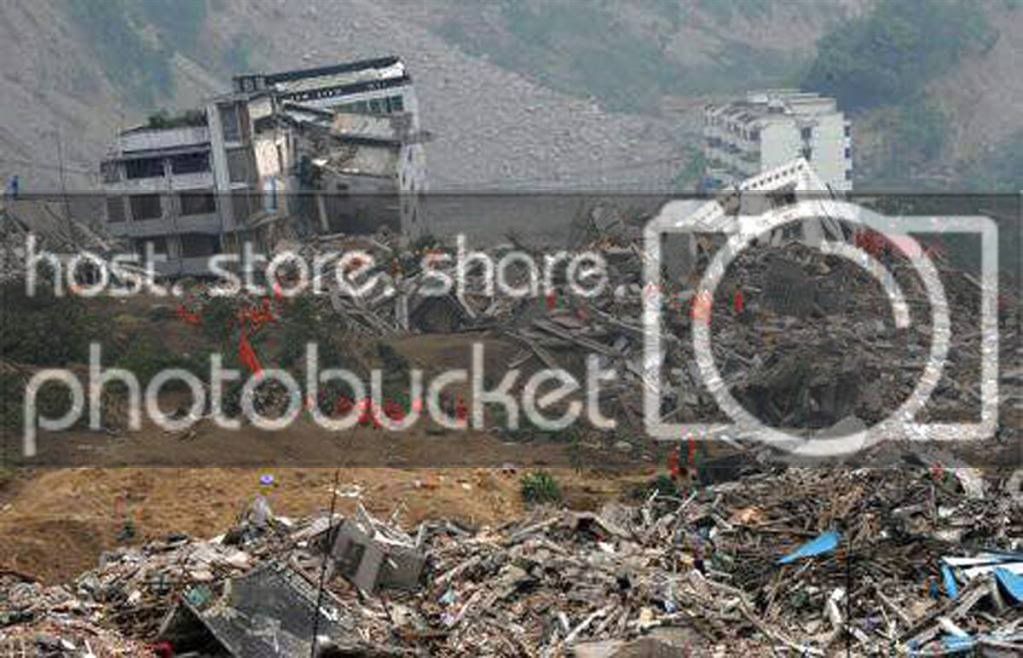
PORT-AU-PRINCE, Haiti - A powerful earthquake hit the impoverished country of Haiti on Tuesday, collapsing the presidential palace and other critical government buildings and raising fears of substantial casualties in what a witness called “a major, major disaster.”
The quake had a magnitude of 7.0 and was centered about 10 miles west of the capital, Port-au-Prince, according to the U.S. Geological Survey. It was followed by numerous aftershocks, one with magnitude 5.9, the USGS reported.
"People are out in the streets, crying, screaming, shouting," Karel Zelenka, director of the Catholic Relief Services office in Haiti told The Washington Post. "This will be a major, major disaster."
Reuters video showed numerous bodies beneath collapsed walls and the presidential palace lying in ruins. President René Garcia Préval was reported to be safe.
Numerous other public buildings were destroyed, including the parliament building, the Finance Ministry, the Public Works Ministry, the Palace of Justice and Cathédrale Notre-Dame de Port-au-Prince, the national cathedral, Haiti TV reported.
The headquarters of the U.N. peacekeeping mission sustained serious damage and a number of personnel were unaccounted for, said U.N. peacekeeping chief Alain Le Roy. He said other U.N. installations also were seriously damaged. The U.N. has a 9,000-member peacekeeping force in Haiti, following a 2004 rebellion.
A local employee for the U.S. charity Food for the Poor said more buildings were destroyed than were left standing along Delmas Road, a major thoroughfare in the city.
The earthquake also destroyed much of the Port-au-Prince air traffic control tower, and flights were being rerouted by other Haitian air traffic facilities.
‘A real killer’
USGS geophysicist Kristin Marano called it the strongest earthquake since 1770 in what is now Haiti. In 1946, a magnitude-8.1 quake struck the Dominican Republic and also shook Haiti, producing a tsunami that killed 1,790 people.
The temblor appeared to have occurred along a strike-slip fault, where one side of a vertical fault slips horizontally past the other, said earthquake expert Tom Jordan at the University of Southern California. The earthquake's size and proximity to populated Port-au-Prince likely caused widespread casualties and structural damage, he said.
"It's going to be a real killer," he said.
The shaking was felt more than 300 miles away in Santo Domingo, the capital of the Dominican Republican, which shares the island of Hispaniola with Haiti, and at the U.S. naval base at Guantanamo Bay, Cuba.
No damage or injuries were immediately reported in the Dominican Republic. Cuba, meanwhile, activated Civil Defense procedures in the island’s northeast region and evacuated some coastal villages as a precaution against a potential tsunami. Tsunami watches for much of the Caribbean were later canceled.
Yaumara Barrier, 28, a dock worker in Santiago, told NBC News that the “ground shook for a minute or more” and that she feared the earthquake was hitting Cuba.
U.S. says it’s ready to assist
U.S. officials in Haiti reported that all land telephones and cell phones were down in Port-au-Prince, a city of almost 2 million people.