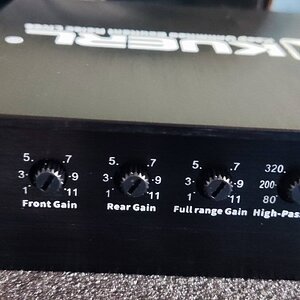
Here, try this from another forum -
HOW TO SET GAINS
~~~~~~~~~~~~~~~~~~~~~~~~~~~~~~~~~~~~~~~~~~~~~~~~~~ ~~~~~~
The ADD version -
1. Play a typically loud music CD in your headunit. Set volume to 75%. Wear ear protection.
2. Starting with the amp gains at their lowest setting, slowly raise one gain at a time until you hear clipping from the corresponding speaker. This will sound like audible distortion.
3. Once you've found the clipping point, back the gain down until you no longer hear the distortion.
4. Repeat for any addt'l gains on the amp/amps.
5. Your new maximum volume setting on the headunit is 75%, never exceed that for happy, healthy speaker life.
(This is the quick & dirty method, it'll get you 80% to proper settings. Read on for the other 20%.)
~~~~~~~~~~~~~~~~~~~~~~~~~~~~~~~~~~~~~~~~~~~~~~~~~~ ~~~~~~
How to do things right -
What's gain?
Also known as input sensitivity, gains are the small, typically recessed "volume knobs" on most equipment between the speakers & the headunit. All amps have them, also many EQ's, line output converters, some crossovers.
What's it for?
The idea is to properly match the output from different pieces of gear so that each communicates the cleanest signal to the other, resulting in maximum performance and minimal noise & risk of damage.
Know your enemy - Clipping.
Clipping is the tech term for the distortion that occurs when an amplifier is pushed beyond it's capabilities. In simple terms it sounds like significant distortion of the musical peaks. So for instance a big drum strike will sound muddy or distorted when turned up, but remains clear at a lower volume. That's clipping. What's happening is the amp momentarily runs out of power.
To properly understand this w/o an engineering degree you need to know the difference between constant power (RMS) and peak power. Constant power, very simply, is the amount of juice your amp can produce consistantly. Since there are some standards for measuring this it is one of the few benchmarks we have for amplifiers. But since sound waves are exactly that - waves, with peaks & valleys - understand that an amp's output is never constant, it has to increase & decrease with the music signal.
The amp's "reserve power" is what it uses to deal with the peaks in the music. This is called peak power, or my favorite, headroom. Headroom is typically about twice the RMS power of an amp, but can only be sustained for a few milliseconds before the amp gets totally winded.
So a good way to think of this is a 10 yr old jumping on a bed - that's the music signal. The bed is the amp's RMS power, the ceiling above is the headroom limit. If the kid jumps too high he whacks his head - that's clipping. Do it a couple times & he'll survive. Do it repeatedly & there WILL be permanant damage. This is the single biggest speaker killer out there.
So the object of the game is to adjust the bed height (by using the gains) to the right height so the kid can jump around like a caffeinated monkey without ever whacking into the ceiling. So setting the gains properly allows you to get the amp's maximum output without overtaxing the equipment. With me so far?
A few other basics -
To do this properly you'll need a few things:
Ear protection. Stuff some cotton in your ears if you don't have anything better.
A test CD with a sine wave set to 0db, a 50-80hz stereo tone is ideal. This is important - it's far more accurate than using a music CD. You can purchase these at most any guitar or pro music stores,
Amazon, or download a program to make your own. Making your own isn't recommended since there are a lot of variables in computers that can affect the final product.
If you have a crossover, you'll need test tones within the frequency range for each amp. For instance if you have a dedicated sub amp crossed over at 80hz, get a 60hz test tone. For your mains, work with a 120hz tone. If you have a 3-way or more crossover, adjust appropriately, just be sure the test frequency is within the bounds of the speaker range. Test each frequency seperately.
Fader, tone controls, loudness/expansion, etc.
Ideally you'll have the sound from your headunit/EQ completely flat on a normal basis. If so, be sure everything's this way before you test. However, if you KNOW you'll have the bass boost activated, some sort of expansion, or the tone controls preset in some way then go ahead & set them before you test.
Otherwise it's best to have everything flat. If you choose to adjust the tone controls later & leave them that way you can always repeat the process. Regardless, be sure the fader & balance are zeroed out.
Dedicated sub volume controls
A lot of amps have outboard sub volume knobs & headunits frequently have dedicated internal sub volume adjustments. If you plan on using these they should be maxed before setting your gains. If you're not going to use them, best to de-activate them.
Set all amp gains to their lowest point before starting. Usually full counter-clockwise.
Input sensitivity switches
If your amp has a selector switch for different input sensitivities, start by setting it to the highest setting. These are typically expressed in voltages, for example .2-1v, 1-3v, 3-8v. Start with the higher numbers (ex. 3-8v) (lowest sensitivity). If you can't get the amp to clip at those settings, try the next one down until you find the clipping point. You can disregard generally what the markings themselves say since there's no real standard for measuring that stuff. Never trust your system's well-being to those voltage numbers, they're just a guideline best ignored.
Work with one gain at a time.
For example, if you have a L&R gain for your front speakers, you'll be working with each side seperately. If multiple amps, unplug all but the amp you're working with. If a 4+ channel amp, typically you'll have only a single L & R gain, so treat it like a 2 channel. If it has more gains, isolate each & adjust seperately.
Here we go...
Play your test tone thru the headunit.
Adjust your headunit volume to 75% of max.
This doesn't need to be precise, just be sure you know where this setting is b/c it's now the HIGHEST you'll ever turn up the volume on the headunit.
(But the amps go to 11...! You're using 75% volume because some CD's will be louder than others. Also b/c there's a small amp in the headunit that will clip if pushed too far. Trust me on this one.)
Now turn up the gain you're working with until you hear the tone quality change - it'll be a distinct change in the tone, there will be distortion. This is where your amp clips. Now turn the gain back down to just below where that distortion occurs. That gain's now set. Repeat for all other gains. Repeat for all other amps.
Final tweaking -
Have an EQ? Want to use the "loudness" button? Want to adjust the bass/mid/treble controls? If you're making minor tweaks (+/-1) there's no real need to worry about gains. If you're talking about bigger changes (+4/-3, etc) you may want to run the tones again to be sure you're still set right.
Also now that the gains are properly set you can adjust them DOWN to balance your system. Need more front volume but don't have a fader? Turn down the rear gains. Sub underpowered? Turn down the mains. The important thing is to never turn them UP from where they are, just down.
A few other notes -
Can't I just use an O-scope or DMM to set gains?
Sure, IF you know the exact output (rarely the rated output) of your amp and you're a freakin' genius with your toys. Generally far easier to use your ears.
What about the gains on the EQ/X-over/line-output converter?
Oooh, good question. The general idea here is to follow the same process but use the gains that are the furthest UPSTREAM (I.E. closest to the headunit) and set all the others to their lowest setting. This will send the hottest signal possible thru all the components. Just remember that anywhere the signal splits you'll have to set them there also. For example, if you have a LOC & an outboard crossover you'll need to set gains on both, starting with the LOC. This can get tricky. Let your ears guide you.
What if my headunit says "9v output" and the amp only says "5v input?"
Eh, doesn't really matter. Again, there isn't really any set standard for measuring this stuff & it's usually just marketing. Also remember that music is a wave, not a line, so that rated output is usually a max, not a constant. Just set everything according to the above process, nothing changes.