Putting fans in...

run the power of the fans to the remote the ground to the ground on the amp..
Not this.

The remote isn't supposed to be pulling that many amps.

use a relay in conjunction with ur amp turnon. then run all the amp turn on and fans off of the relay
this will make it so the fans only kick on when the car is on

you need a relay or else it will fry the amp turnon i think due to too much power being pulled, especially if you are running more than one amp

This.

Even though 4 fans are usually equal up to 1 amp, it's still too much for the remote.

 
Forced Air Cooling Using fan cooling to force air through the fins of an amplifier's heat sink, will significantly increase the reliability of an amplifier. It is especially important when the air flow to an amplifier is restricted (like when it is under a seat). If you only install one fan on the amplifier, make sure it forces air through the fins of the heat sink. As I said in another section, the semiconductors are mounted to the heat sink. Some people cut a hole in the bottom of their amps to blow air onto the circuit board. If that's the only fan, it will do very little good. If you have a fan blowing on the fins of the heat sink and want to mount another fan blowing inside the amp. it will serve to keep the transformer and large filter caps cool (not necessary unless you're driving your amp hard for long periods of time). If the amplifier has a built in fan, make sure that the added fan does not interfere with the built in fan. For example, do not try to force air into the exhaust of the fan cooled amplifier. Also, if an amplifier has a built in fan, do not make any new openings in the amplifier's case. Chances are very good that you will adversely affect the cooling of the amplifier.


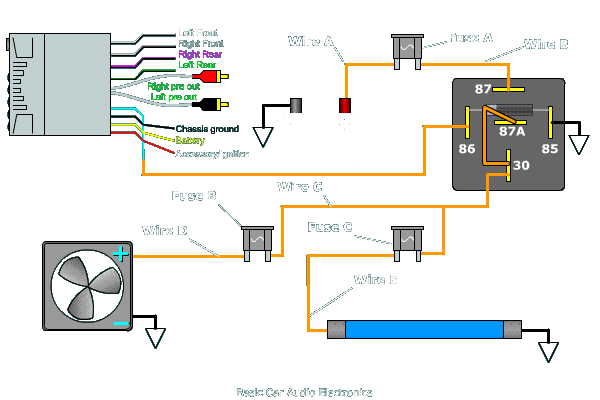
Current Flow and Safety: The following diagram shows the relay controlled by a switched 12 volt source. It shows a fan and a neon tube (it could be virtually any 12 volt device) being supplied power from terminal 30 of the relay. The power source is the battery/charging system. To have a safe system, we have a fuse at the battery. With a Bosch relay, you can use any fuse up to a 30 amp fuse (the relay is rated for 30 amps). The required size of wire segments A, B and C is determined by the size of the fuse (and the current demand from the electrical accessories). If the total required current draw will be only about 10 amps, you could use a 16g wire and fuse 'A' would need to be a 10 amp fuse. If the total current draw was going to be 25-30 amps, you'd need at least a 12g wire and a 30 amp fuse. The rating of fuse 'B' is determined by the current draw of the fan and the wire connecting the fuse to the fan. If the fan draws no more than 5 amps (very likely), you could use a 5 amp fuse and a 16g wire (16g is the minimum size I'd recommend using because when you use anything smaller, it's difficult to get good, reliable connections). The size of fuse 'C' and wire 'E' are determined by the current draw of the neon. Fuses 'B' and 'C' should be as close to the relay as possible.

relayfa3.gif


The main points to remember are...

  1. The wire supplying power to the relay must be protected by a fuse and the fuse must be rated to open before the wire overheats and converts your vehicle into a raging inferno.
  2. If there's a single wire carrying the current away from the relay to a fused distribution point (like wire 'C'), it must be the same size (or larger) as the main supply wire.
  3. The fuses going to the individual electrical accessories must be rated to protect the wires supplying the current to the device(s).
  4. If the wire feeding the individual accessories is the same as the main supply wire, the main fuse (near the power source) will protect all of the wires.
Possibly Helpful Links:

  1. Switches
  2. Controlling a Relay with a Switch
  3. Head Unit (for info on the remote output)


If you want your cooling fans to operate only when your amplifiers are on, it will be necessary for them to be powered only when the remote output lead has 12 volts on it (when your head unit is powered up). I would NOT recommend powering them directly from the remote power lead. It would probably be damaged by the current draw of the fans. The diagram below is a connection diagram that may be used to supply power to the fan(s). If you have multiple amplifiers and signal processors, the output from terminal 30 can also be used to supply power to the remote terminals of those devices.

From here-

http://www.bcae1.com/

 
I would assume that but wasn't sure if it would be overkill as they were saying before if I just run multiple off of the one from the HU it'll blow it...
That is correct. The idea of using a relay is to take the load of multiple items off the REM output of your h/u, as too many will short it out... Ive seen it happen many many times... I dont recommend hooking up more than 3 things to your head's REM unless you KNOW it can handle more.
Once the relay is wired in place, it takes all the load off the h/u except what is required tto actually trip the relay. I dont know what the limit is on one of those bosch style relays, but you wont surpass it with what you are trying to do.

BTW, that is officially known as a "bosch style relay"... so if you want to google it to find more info, use use that term.

 
??//content.invisioncic.com/y282845/emoticons/confused.gif.e820e0216602db4765798ac39d28caa9.gif??
I cant explain if you dont tell me what you didnt understand. Push-pull refers to having two fans, one at either end of the enclosure/space, one pushing fresh air into the enclosure, while one pulls the exhaust air out. Since a fan will only move so many CFM of air, having it push air into the space, then exit out a dead hole (hole with no fan) will be basically just as efficient as having one blowing in, and a second blowing out. Two fans, twice the current draw, twice the noise, yet no benefit over the single fan setup. Might seem obvious when I mention it like this, but Im always amazed how many people do a push-pull thinking they are going that extra mile to do it 'right'.

As said above, the key to getting a fan install right is understanding how your amplifier cools. The main path of air through the enclosure/space should pass through the amplifier's heatsink fins. Parallel through them, not perpendicular across them. This means the space needs to be sealed, semi-pressure tight, except for the passage(s) meant for the air to pass through. You dont just want to push air into the space, or pull it out, you want to direct it through it while taking a specific path. Ive also many times seen people doa fan setup, but leave the plexy unsealed so the fan sucks air through it at the closest location, neglecting to pass the air across the amp itself.

 
dude just do what the first guy said just fun the off the remote wire it will work fine those fans dont pull a lot of juice. it will be fine i have a friend that was hooking his amp up in the dark and accidentaly hooked up the remote the the bat+ and the power wire to the remoter terminal. he was asking me why every time some bass went to the subs the hu would turn of it will be fine

 
dude just do what the first guy said just fun the off the remote wire it will work fine those fans dont pull a lot of juice. it will be fine i have a friend that was hooking his amp up in the dark and accidentaly hooked up the remote the the bat+ and the power wire to the remoter terminal. he was asking me why every time some bass went to the subs the hu would turn of it will be fine
Uhm... no.
 
I'm using the amps below. I was actually just going to put a fan on each end of the enclosure and have holes in the plexi. Would that be sufficient or no?

 
dude just do what the first guy said just fun the off the remote wire it will work fine those fans dont pull a lot of juice. it will be fine i have a friend that was hooking his amp up in the dark and accidentaly hooked up the remote the the bat+ and the power wire to the remoter terminal. he was asking me why every time some bass went to the subs the hu would turn of it will be fine
sssshhhhh!

 
I'm using the amps below. I was actually just going to put a fan on each end of the enclosure and have holes in the plexi. Would that be sufficient or no?
That could work, depending on exactly how you did it. But most times its best to mount the fans at one end, and the exhaust (or intake) holes at the other end. This assures cooling air will pass completely across the amplifier.
 
dude just do what the first guy said just fun the off the remote wire it will work fine those fans dont pull a lot of juice. it will be fine i have a friend that was hooking his amp up in the dark and accidentaly hooked up the remote the the bat+ and the power wire to the remoter terminal. he was asking me why every time some bass went to the subs the hu would turn of it will be fine

WTF... i've seen a couple posts of yours.. please stop helping when you dont know what your talking about. thank you

 
well I actually sell relays so I'm going to order a 5 terminal one and work my way from there! Thanks guys for the help! I'll have a build log up soon for my new equipment! make sure to check it out!

 
and normally you want the fans on the side of the amp where the POS/NEG terminals are as that's where the most heat is generated.

And use the relay as suggested as it's not hard to wire and is the correct way to do it. I can help if you get confused as I run my amps like that. Chester's Electronics in Kenosha has fans for like $6 each if you need them locally...

 
Activity
No one is currently typing a reply...
Old Thread: Please note, there have been no replies in this thread for over 3 years!
Content in this thread may no longer be relevant.
Perhaps it would be better to start a new thread instead.

About this thread

Echo42987

10+ year member
CarAudio.com Veteran
Thread starter
Echo42987
Joined
Location
Antioch, IL
Start date
Participants
Who Replied
Replies
32
Views
1,833
Last reply date
Last reply from
audioholic
design.jpeg

WNCTracker

    May 22, 2026
  • 0
  • 0
IMG_2118.jpeg

WNCTracker

    May 22, 2026
  • 0
  • 0

New threads

Top