New 'super-Earth' found in space
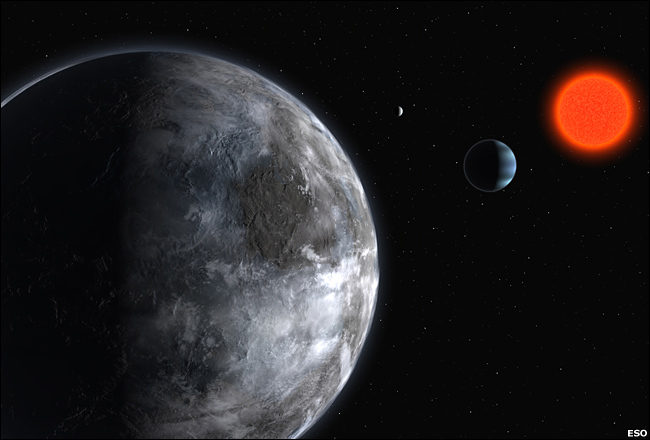
Astronomers have found the most Earth-like planet outside our Solar System to date, a world which could have water running on its surface.
The planet orbits the faint star Gliese 581, which is 20.5 light-years away in the constellation Libra.
Scientists made the discovery using the Eso 3.6m Telescope in Chile.
They say the benign temperatures on the planet mean any water there could exist in liquid form, and this raises the chances it could also harbour life.
"We have estimated that the mean temperature of this 'super-Earth' lies between 0 and 40 degrees Celsius, and water would thus be liquid," explained Stephane Udry of the Geneva Observatory, lead author of the scientific paper reporting the result.
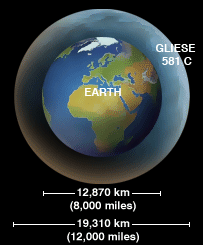
"Moreover, its radius should be only 1.5 times the Earth's radius, and models predict that the planet should be either rocky - like our Earth - or covered with oceans."
Xavier Delfosse, a member of the team from Grenoble University, added: "Liquid water is critical to life as we know it."
He believes the planet may now become a very important target for future space missions dedicated to the search for extra-terrestrial life.
These missions will put telescopes in space that can discern the tell-tale light "signatures" that might be associated with biological processes.
The observatories would seek to identify trace atmospheric gases such as methane, and even markers for chlorophyll, the pigment in Earth plants that plays a critical role in photosynthesis.
'Indirect' detection
The exoplanet - as astronomers call planets around a star other than the Sun - is the smallest yet found, and completes a full orbit of its parent star in just 13 days.
Indeed, it is 14 times closer to its star than the Earth is to our Sun.
However, given that the host star is smaller and colder than the Sun - and thus less luminous - the planet nevertheless lies in the "habitable zone", the region around a star where water could be liquid.
Gliese 581 is much cooler and dimmer than our own Sun
Gliese 581 was identified at the European Southern Observatory (Eso) facility at La Silla in the Atacama Desert.
To make their discovery, researchers used a very sensitive instrument that can measure tiny changes in the velocity of a star as it experiences the gravitational tug of a nearby planet.
Astronomers are stuck with such indirect methods of detection because current telescope technology struggles to image very distant and faint objects - especially when they orbit close to the glare of a star.
The Gliese 581 system has now yielded three planets: the new super-Earth, a 15 Earth-mass planet orbiting even closer to the parent star, and an eight Earth-mass planet that lies further out.
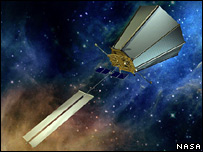
Future observatories will study exoplanets for signs of biology
The latest discovery has created tremendous excitement among scientists.
Of the more than 200 exoplanets so far discovered, a great many are Jupiter-like gas giants that experience blazing temperatures because they orbit close to hot stars.
The Gliese 581 super-Earth is in what scientists call the "Goldilocks Zone" where temperatures "are just right" for life to have a chance to exist.
Commenting on the discovery, Alison Boyle, the curator of astronomy at London's Science Museum, said: "Of all the planets we've found around other stars, this is the one that looks as though it might have the right ingredients for life.
"It's 20 light-years away and so we won't be going there anytime soon, but with new kinds of propulsion technology that could change in the future. And obviously we'll be training some powerful telescopes on it to see what we can see," she told BBC News.
"'Is there life anywhere else?' is a fundamental question we all ask."
http://news.bbc.co.uk/1/hi/sci/tech/6589157.stm
Astronomers have found the most Earth-like planet outside our Solar System to date, a world which could have water running on its surface.
The planet orbits the faint star Gliese 581, which is 20.5 light-years away in the constellation Libra.
Scientists made the discovery using the Eso 3.6m Telescope in Chile.
They say the benign temperatures on the planet mean any water there could exist in liquid form, and this raises the chances it could also harbour life.
"We have estimated that the mean temperature of this 'super-Earth' lies between 0 and 40 degrees Celsius, and water would thus be liquid," explained Stephane Udry of the Geneva Observatory, lead author of the scientific paper reporting the result.
"Moreover, its radius should be only 1.5 times the Earth's radius, and models predict that the planet should be either rocky - like our Earth - or covered with oceans."
Xavier Delfosse, a member of the team from Grenoble University, added: "Liquid water is critical to life as we know it."
He believes the planet may now become a very important target for future space missions dedicated to the search for extra-terrestrial life.
These missions will put telescopes in space that can discern the tell-tale light "signatures" that might be associated with biological processes.
The observatories would seek to identify trace atmospheric gases such as methane, and even markers for chlorophyll, the pigment in Earth plants that plays a critical role in photosynthesis.
'Indirect' detection
The exoplanet - as astronomers call planets around a star other than the Sun - is the smallest yet found, and completes a full orbit of its parent star in just 13 days.
Indeed, it is 14 times closer to its star than the Earth is to our Sun.
However, given that the host star is smaller and colder than the Sun - and thus less luminous - the planet nevertheless lies in the "habitable zone", the region around a star where water could be liquid.
Gliese 581 is much cooler and dimmer than our own Sun
Gliese 581 was identified at the European Southern Observatory (Eso) facility at La Silla in the Atacama Desert.
To make their discovery, researchers used a very sensitive instrument that can measure tiny changes in the velocity of a star as it experiences the gravitational tug of a nearby planet.
Astronomers are stuck with such indirect methods of detection because current telescope technology struggles to image very distant and faint objects - especially when they orbit close to the glare of a star.
The Gliese 581 system has now yielded three planets: the new super-Earth, a 15 Earth-mass planet orbiting even closer to the parent star, and an eight Earth-mass planet that lies further out.
Future observatories will study exoplanets for signs of biology
The latest discovery has created tremendous excitement among scientists.
Of the more than 200 exoplanets so far discovered, a great many are Jupiter-like gas giants that experience blazing temperatures because they orbit close to hot stars.
The Gliese 581 super-Earth is in what scientists call the "Goldilocks Zone" where temperatures "are just right" for life to have a chance to exist.
Commenting on the discovery, Alison Boyle, the curator of astronomy at London's Science Museum, said: "Of all the planets we've found around other stars, this is the one that looks as though it might have the right ingredients for life.
"It's 20 light-years away and so we won't be going there anytime soon, but with new kinds of propulsion technology that could change in the future. And obviously we'll be training some powerful telescopes on it to see what we can see," she told BBC News.
"'Is there life anywhere else?' is a fundamental question we all ask."
http://news.bbc.co.uk/1/hi/sci/tech/6589157.stm