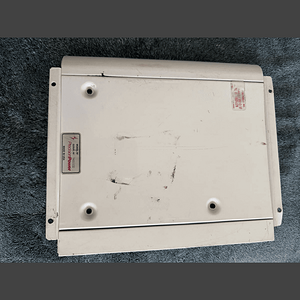
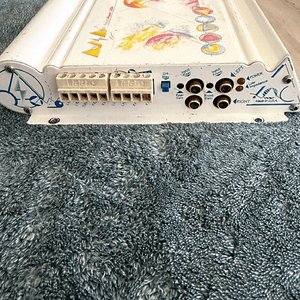
i'm thinkin to get an electronic x-over to add to the mix so i only have to use one amp to power the whole system... the x-over can be adjusted so that 4 channels of a 6 channel amp can be high's for the speakers and 2 channels can be low's for the subs... i dunno if i'm gettin' this right... but if i'm not... lemme know... also are audiobahn amps any good?? i see a 6 channel 600 watt amp on
ebay for like $250... looks like a good deal for a moderate system (like i want)... i'm not lookin to spend more than about 700 on my whole system...
Let's make sure you aren't confused on this... this is good stuff. //content.invisioncic.com/y282845/emoticons/wink.gif.608e3ea05f1a9f98611af0861652f8fb.gifWhat you typed makes sense, you don't seem off at all, I just want to be clear.
First off, a crossover is a combination of a high-pass filter and a low-pass filter, aligned together in such a way that either the phase response or the acoustical response across the crossover point (frequency) is smooth.
Differentiate that from what amp manufacturers sometimes build into their amps, where "crossover" is a misnomer.. amps usually only contain LP or HP filters, not a complete crossover.
Also, crossovers (and/or filters) come in either active, or passive varieties.
An active crossover is installed between your source unit and your amp, in the signal chain.
A passive crossover is installed between your amplifier and your speakers.
Usually active crossovers are electronic boxes, usually with switches or potentiometers on them that allow you to adjust the crossover or filter points, sometimes they have other features like attenuation adjustments, etc.
Passive crossovers on the other hand are not adjustable, although some include attenuation adjustments, which can be nice.
In all cases, a crossover takes one input [pair.. left and right channels

] and splits it out to as many outputs as there are filters.
A simple one would take input, and split out the highs to one output, the lows to another output.
So..
If you have an active crossover, you gain adjustability, but you need more amplifier channels, because you are splitting the signal up upstream of the amp.
That adjustability might not be valuable to you, because this isn't a setting like an EQ that is adjusted often (in fact even EQ's are generally "set it, and forget it"
).
If you have a passive crossover, you lose adjustability, but you can use a single 2 channel amplifier to run the whole range of speakers in your car...
And to do so without compromise, since power is frequency dependent.
This is an interesting thing, because you can present different impedances to your amp, and the amp will make different amounts of power to each frequency range, as they are each now isolated from the amp.
So, let's say you had an amp that did 100x2 at 4 ohms, and was capable of doing 200x2 at 2 ohms, or 400x1 bridged.
Say you built a passive crossover, for an 8 ohm tweeter above 4000Hz, a 4 ohm midrange from 4000Hz down to 80Hz, and a 2 ohm subwoofer below 80Hz.
In this way, the amp would only "see" an 8 ohm load above 4000Hz, so it would send 50x2 to the tweeters, and only from 4000Hz and up.
The amp would "see" a 4 ohm load between 80Hz and 4000Hz... so it would send 100x2 between 80Hz and 4000Hz, which only the mids would receive...
And the amp would see a bridged load of 4 ohms below 80Hz, so it would do 400x1 below 80Hz, to the 4 ohm subwoofer.
Interesting stuff! //content.invisioncic.com/y282845/emoticons/cool.gif.3bcaf8f141236c00f8044d07150e34f7.gif
If you do decide to go the all-active route, be sure to get a real
crossover, not a device that's simply a bunch of individually-adjustable high-pass and low-pass filters and leaves you to try to coordinate them together... that's a nearly impossible task.
If you do decide to go the all-passive route, be sure you know the impedance of your speakers, and the crossover points you want, because you will be locked into them once it is built. //content.invisioncic.com/y282845/emoticons/wink.gif.608e3ea05f1a9f98611af0861652f8fb.gif