From Wikipedia, the free encyclopedia
Jump to:
navigation,
search
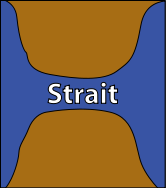
Simplified diagram
A
strait is a narrow
channel of water that connects two larger bodies of water, and thus lies between two
land masses. The terms
strait,
channel,
passage and
firth can be synonymous and interchangeable, although
channel and
firth have other meanings too. Many straits are economically important. Straits can lie on important
shipping routes, and
wars have been fought for control of these straits. Numerous artificial channels, called
canals, have been constructed to connect two bodies of water over land. Well-known straits in the world include the
Strait of Dover, between
England and
France, which connects the
North Sea with the
English Channel; the
Strait of Gibraltar, the only natural passage between the
Atlantic Ocean and the
Mediterranean Sea; the
Bosporus and the
Dardanelles, which connect the
Mediterranean and the
Black Sea; the
Strait of Magellan, connecting the Atlantic and Pacific Oceans north of
Tierra del Fuego, the
Bering Strait between
Alaska and
Siberia which connects the
Pacific and
Arctic Oceans; the
Strait of Hormuz connecting the
Persian Gulf and the
Gulf of Oman, through which Persian Gulf
petroleum is shipped to the world; the
Strait of Malacca, which lie between
Peninsular Malaysia and
Sumatra and connect the
Indian Ocean with the
South China Sea; and
Bass Strait which lies between mainland
Australia and
Tasmania and connects the
Indian Ocean with the
Pacific Ocean.
Although rivers and canals often form a bridge between two large lakes or a lake and a sea, and these seem to suit the formal definition of straits, they are not usually referred to as straits. Straits are typically much larger, wider structures that do not have water running in a single direction, and normally connect two seas.
Straits are the duals of
isthmi. That is, while straits lie between two land masses and connect two larger bodies of water, isthmi lie between two bodies of water and connect two larger land masses.