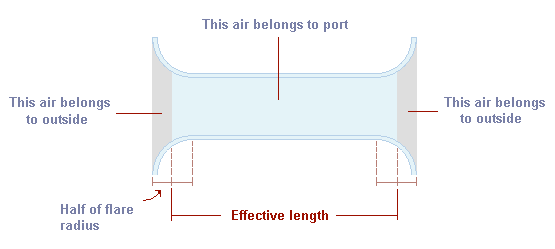
I have read the same info, that flared ports 'share' the airspace outside the port. But even a non flared port shares *some* airspace outside the port (remember that ports move the air back and forth, not just out). I have never seen an explanation of why a 3" port flared out to 4" acts different than a non-flared 4" port (for example).
I found this on the same site:
"Subwoofer ports have to flow a lot more air than their conventional speaker counterparts. Since increasing the area of a port quickly produces very long ports, the most effective means of moving more air is to increase the air velocity.
Ports operating below about 10 m/sec generally have no problems with turbulence and compression. As velocity is increased beyond this, turbulence occurs as air exiting the port is forced to slow too quickly as it encounters the surrounding still air.
Flared ports cause the airflow to expand and loose speed in a controlled fashion, allowing higher speeds without turbulence. This method targets the air in the "boundary layer", which is close to the walls of the port.
Increasing velocity even further, the air in the "core" of the port becomes turbulent. Flares are unable to help with this problem, which represents the limiting velocity for the port. By this stage the port is beginning to present a different load to the system, resulting in de-tuning and subsequent loss of output, known as compression. "
I've never stopped to consider the "why", I've just flared my ports because I knew there was such as thing as port noise and there must be a reason all the pro audio companies do it on their speakers.
Take it with a grain of salt, by all means, but these guys have a ****-ton of data to back up their claims and have done 100x experimentation than I'd ever care to.
Either way OP measures it, it's not going to make an earth shattering amount of difference anyway.