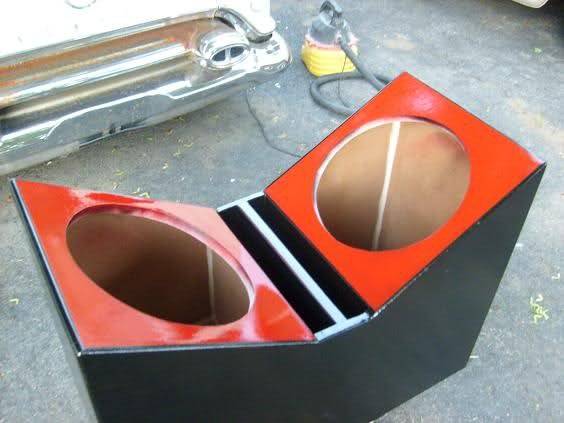
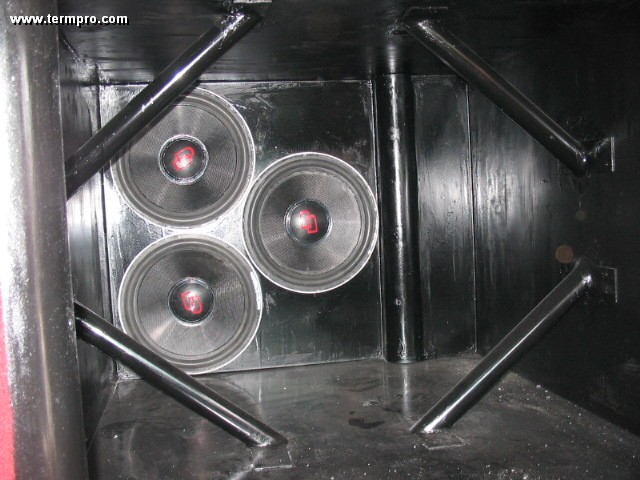
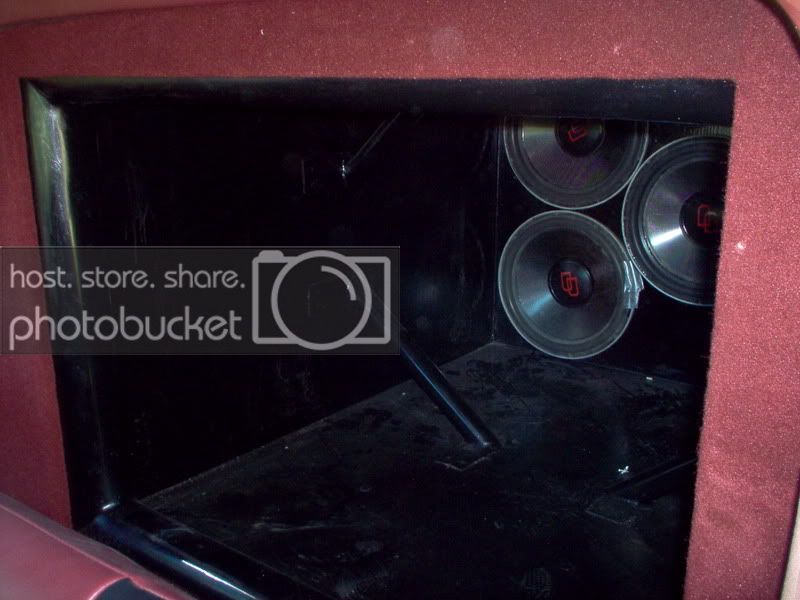
How does a clamshell work?

because...
a bandpass box loads pressure and tunes that pressure and acts like one big driver.

And what do you think a diamond does?
Doesn't a simple vented system also 'load pressure, tunes that pressure, and act like one big driver'? Bandpass, by definition is merely an effect that removes frequencies outside a specified window. Since virtually any speaker enclosure mounted in a car is, in essence, an enclosure mounted inside an enclosure, and does display the characteristics of bandpassing a frequency range, they are already a quasi-bandpass. How does the clamshell shape, even if it creates a high-pressure region between the subs, alter that phenomenon? Rear-firing subs mounted near the end of the vehicle are also 'front loaded' and create a high pressure region, with a corresponding high air velocity region. Does this make them more of a bandpass than a front-firing setup? Sometimes it does limit frequency response, but sometimes it improves it. *shrug*
 
i think we are saying the same thing but saying it in different ways.

When you have a rear firing enclosure...the depth of the enclosure also gives a tuning because of the pressure coming back across it

Like my old 4th order. Had the 4 18s firing foward into a chamber with a port....and thats EXACTLY what a diamond/tunnel has.

subs are loading in the middle and the size and shape of the diamond gives you the tuning along with the depth of the baffle.

You really think Tommy is doing a 166 on the dash with his 24 entry level 12s in a normal sealed box? lol

 
i think we are saying the same thing but saying it in different ways.
When you have a rear firing enclosure...the depth of the enclosure also gives a tuning because of the pressure coming back across it
So because an enclosure has a tuning frequency and a sealed portion it's a bandpass? That's incorrect logic. If there is no pressure zone that drives a radiating surface, then there is no ported section. If there isn't a ported section, it isn't going to be a bandpass.

Take these two ghetto illustrations for an example:

1)

u64aw.png


2)

2ustr40.png


Image 1 shows a bandpass enclosure design. There is a sealed chamber that the drivers sit in and they fire into another chamber that has a tunnel smaller than the original that leads to the open environment. The inner chamber will pressurize (hopefully equally) and that pressure will move the mass of air in the tunnel. That pressure will go from positive to negative and will move the mass in and out. That will create a uniform surface that will radiate -- something more commonly referred to as a port. The whole system will have bandpass characteristics.

Image 2 shows a sealed chamber with one end closed with a common chamber directly leading to the outside. This will NOT have bandpass characteristics since there is no radiating surface. It will, however, act like a transmission line for pressure based around the length of the chamber and it's geometry (in this case, it has a uniform line area). This WILL cause gain, just like a bandpass enclosure but with different characteristics. The enclosure will have a high pressure zone in the back wall of the enclosure and as you continue more towards the open end of the line, the pressure will decrease and the velocity of the air will increase. That is how transmission lines work. Once that high velocity end is exposed to another air mass (like the cabin of a vehicle), the air will be excited and it will pressurize. That's how Tommy is able to pull the numbers he can and with the low frequency extension he has.

Transmission lines that look like the one in Image 2 have a low frequency tuning that is 1/4 the wavelength of the length of the line. If the line is about 11 feet long with constant area, it will have an effective tuning of about 25hz. The roll off below that point will be much more shallow than a bandpass or ported enclosure allowing for very, very low frequency extension (sound familiar?) similar to the roll off found in sealed enclosures but with greater output.

Also, everything is relative. Sure all vehicles will show bandpass characteristics OUTSIDE the vehicle but not always INSIDE the vehicle. And more often than not, vehicles have more in common with mass loaded transmission lines than with bandpass enclosures until the ratio of enclosure airspace starts to come close to or be larger than the cabin volume.

 
it WILL have a bandpass effect....

size of the opening is relative to tuning!

The logic you are using looks great on paper, I've been competing for 8 years and have seen all of this in real world applications

You could do a sealed diamond or box just like the drawing you did above, and change the opening size by doing layers...and guess whats going to happen? Its going to change the tuning of the enclosure...i've done it before

 
also, what your saying is the way the sealed box its NOT a bandpass....but if I put an actual "port" over the opening you'd say it WAS a bandpass

The opening is already acting like a vent

 
Unless someone has an accurate way to predict this high pressure zone, and design the clamshell size/shape/alignment/position/distance apart/etc to incorporate this as a useful, measurable and repeatable process, Im not sure what the point of this debate really is.

 
My point is this....

Every install has a bandpass aspect to it

Wheter its tuning for outlaw SPL and using the vehicle as another chamber

Or its a simple sealed box firing back in the trunk of a car (the trunk opening along with the depth of the enclosure effectively tuning)

And the drawing he drew above, with the sealed chamber...is a bandpass, its tuning pressure = bandpass design

 
And the drawing he drew above, with the sealed chamber...is a bandpass, its tuning pressure = bandpass design
You obviously have no idea what the tuning frequency of a bandpass enclosure actually is. I'll give you a hint though: it has very little to do with the peak frequency.

So because you have built them, that means they're a bandpass? Excellent logic.

Changing the opening will change the characteristics of the sound. That's a no-brainer.

If the drawing I made in image 2 is a bandpass, it will have a constant pressure from the back wall to opening. Take your real world enclosure, your real world mic, play a real world frequency that has a 1/4 wavelength that is equal to the real world length of the tunnel and then measure the pressure from the back to the front and see what you get.

 
Umm...tuning of a 4th order...is realitive to the sealed chambers as well as the ported chamber

let me show you a pic of my old setup....

E7868W1M19493P10C.jpg


using your logic...i don't have a real loading wall, so I guess its just a sealed box?

 
it wasn't a port...it was pieces of PVC molded in

Did 4 tenths higher

Let me see if I can find some pics of Doms old suburban install, or rob eldgridges old nissan truck...both were just like mine but without a roll over...and it was a bandpass

And using your logic...if you molded PVC in to the face of the diamond it would be a bandpass?

 
Activity
No one is currently typing a reply...
Old Thread: Please note, there have been no replies in this thread for over 3 years!
Content in this thread may no longer be relevant.
Perhaps it would be better to start a new thread instead.

About this thread

vehementSPL

10+ year member
CarAudio.com Elite
Thread starter
vehementSPL
Joined
Location
indianapolis
Start date
Participants
Who Replied
Replies
50
Views
12,152
Last reply date
Last reply from
TSGP
IMG_20260516_193114554_HDR.jpg

sherbanater

    May 16, 2026
  • 0
  • 0
IMG_20260516_192955471_HDR.jpg

sherbanater

    May 16, 2026
  • 0
  • 0

New threads

Top