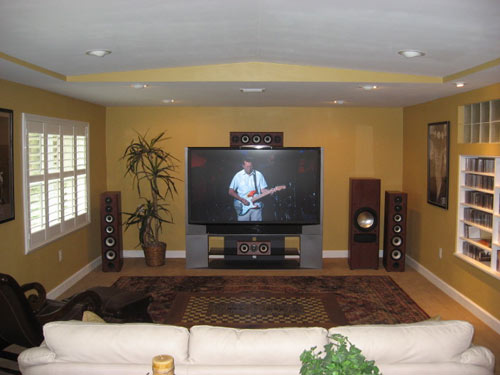
Do you want to DIY or not?
The good news if you plan on making this mostly theater dedicated is you can do each speaker exactly the same and don't have to spend more an you L&R channels like in a Stereo dedicated system.
What I would recommend is 4 good quality bookshelf speakers (2-Way I would imagine) and a matching center channel using the same components so it is voiced the same. THen of course a theater system wouldn't be complete with out a subwoofer. Which I would do sealed and in the 12" range of things.
As for which projects/speakers to choose, that relies more on your taste than anything. There literally 1000's of 2-way bookshelf designs out there. Some places to look would be on Madisounds kits page, parts express, & Zaph's web page.
If you are more brave you could even tackle the task of designing and making your own. But, that is a long road rarely walked correctly with many pot holes and pit falls.
I agree and disagree.No the center shouldn't actually be the same. It needs to reproduce voices first and foremost and is designed to do that. Your other speakers aren't nearly as vital. Without question, a center and subwoofer will either make or break a home theatre.
No the center shouldn't actually be the same. It needs to reproduce voices first and foremost and is designed to do that. Your other speakers aren't nearly as vital. Without question, a center and subwoofer will either make or break a home theatre.
What kind of speakers should I get for an all-new Dolby Digital system?
The ideal Dolby Digital playback system uses identical full-range speakers for the Left, Center, Right, and each Surround channel. If you do not have identical speakers, be sure that the overall tonal characteristic, or timbre, of all the speakers is similar. This is equally important for both Dolby Pro Logic and Dolby Digital playback.
Most speaker manufacturers offer timbre-matched home theater speakers. Many also offer systems combining matched compact speakers for the five main channels with one or more separate subwoofers for the non-directional bass; such a "satellite" system can prove an effective, space-saving solution
http://www.dolby.com/consumer/technology/dolby_faq_1.html#q14
-------------------------------
Dolby Surround Mixing Manual
Speakers and Amplifiers
Front speaker setup may be accomplished two ways. One, add a Center speaker that matches the
acoustic characteristics of the existing Left and Right soffit speakers or two, install three
identical near-field monitors. In either case, the design of all three front speakers must be
identical; panning from one type of speaker to another causes great differences in the sound. This
does not mean that they all have to be the same size. Large Left and Right speakers and a smaller
Center speaker from the same product line are acceptable. If possible, the Center speaker should
have the same high- and mid-frequency drivers as the Left and Right speakers.
...
2-9
Many speaker product lines contain different sized models of the same design. The midranges
and tweeters are normally exactly the same while the woofers differ in quantity and size. In cases
where soffit space is limited, a smaller version of the main Left and Right speakers may be the only option for the Center channel.
http://www.dolby.com/uploadedFiles/English_(US)/Professional/Technical_Library/Technologies/Dolby_Pro_Logic_II/44_SuroundMixing.pdf

Sweet! You can quote the dolby site! It would have helped if you looked at what people use for center channels in the real world, however.//content.invisioncic.com/y282845/emoticons/rolleyes.gif.c1fef805e9d1464d377451cd5bc18bfb.gif
Actually the main purpose of a center channel speaker is to provide proper center imaging no matter where in the room the listener is seated, to give the illusion that vocals are comming from the screen for everyone in the room. Otherwise, without a center speaker, there is only one "sweet spot" in the center of the room and all other positions would hear more of one speaker than the other, making the listening positions on either side sound like the vocals are comming from the side speaker nearest them, rather than the person on the screen in the center.That's not what I meant though. I didn't mean to imply that the other speakers should be lacking in vocal quality, but the center is what handles most of the voices unless it's music. With that said, you typically see centers with multiple midrange drivers when the fronts have a different design. Strong vocal clarity is essential and having 5 of the same speakers just doesn't seem to work.
The Center channel speaker is used to anchor dialogue and other sounds to the screen. Inconventional two-speaker configurations, the listener can only hear a balanced mix when seated
exactly in the center or sweet spot, Figure 2-8. This configuration provides a good phantom
image.
Figure 2-8 Listener in Sweet Spot
If the listener moves to either side of this sweet spot the mix becomes heavy on that side. The
listener perceives the Center channel as coming from a point other than halfway between the Left
and Right speakers, as in Figure 2-9. In this configuration, the phantom image is displaced off
the screen.
This produces an eye/ear conflict, since the visual and audio images don’t match. The addition of
a Center speaker ensures that the center information, such as dialogue, stays locked on the screen
no matter where the listener is seated, as shown in Figure 2-10.
So we're playing semantics now? Okay then, I'll say that most things that need to be "anchored" to the screen are voices from dialogue, therefore, the center is used to reproduce dialog aka voices. //content.invisioncic.com/y282845/emoticons/rolleyes.gif.c1fef805e9d1464d377451cd5bc18bfb.gifActually the main purpose of a center channel speaker is to provide proper center imaging no matter where in the room the listener is seated, to give the illusion that vocals are comming from the screen for everyone in the room. Otherwise, without a center speaker, there is only one "sweet spot" in the center of the room and all other positions would hear more of one speaker than the other, making the listening positions on either side sound like the vocals are comming from the side speaker nearest them, rather than the person on the screen in the center.
If you were the only listener and you sat in the "sweet spot" in the center, a center speaker would not be needed at all.
No the center shouldn't actually be the same.
The ideal Dolby Digital playback system uses identical full-range speakers
Lobing? //content.invisioncic.com/y282845/emoticons/laugh.gif.48439b2acf2cfca21620f01e7f77d1e4.gifI mean, if you want to get into a full blown discussion about lobing and D'Appolito design, then I'd be glad to, but please realize that there are reasons why center channels look like they do.
The reason many are different is because of a size restriction. Which is fine. It doesn't matter if the L&R and the center are the same speakers or not. As long as they are voiced the same. Which usually requires the same drivers or very very similar drivers and desing which is rather hard to come by. Because, once you change the box or driver quantity or quality you change the sound of the loudspeakers.That's not what I meant though. I didn't mean to imply that the other speakers should be lacking in vocal quality, but the center is what handles most of the voices unless it's music. With that said, you typically see centers with multiple midrange drivers when the fronts have a different design. Strong vocal clarity is essential and having 5 of the same speakers just doesn't seem to work.
Actually you did say the drivers can be different. Because, when you add a mid-range or whatever you change the entire design of the speaker. You can't just plop another mid-range driver in the box and say "woop there it is". I mean seriously what are you talking about Willis?Sweet! You can quote the dolby site! It would have helped if you looked at what people use for center channels in the real world, however.
http://forum.ecoustics.com/bbs/messages/34579/246660.jpg
http://www.audioark.com/images/C52_press-nogril_lo.jpg
http://forums.klipsch.com/forums/storage/74/989810/100_0129.jpg
http://images.smarter.com/300x300x15/3/56/28556.jpg
I did not say that the drivers needed to be differently, but the same design rarely works in the real world.