explain lobing in lamina terms

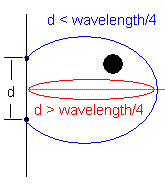
Imagine a speaker radiating a "sphere" of sound. Now, place another driver next to it radiating it's own sphere. Those two spheres will overlap. That's the lobe.

Some spheres will be bigger. Some smaller. Depends on the size of the driver and the frequencies being reproduced. The further the two drivers are apart, the smaller the lobe is liable to be.

Here... the black dot is the listening position and how lobing can affect the frequecny respone.

Acoustic_lobing_zps90a7c13a.gif


Here is a simple representation of how size and dispersion are inversly proportional.

Fig1EVsubWhitePaper_zps07a0287b.jpg


Does that help?

 
Imagine a speaker radiating a "sphere" of sound. Now, place another driver next to it radiating it's own sphere. Those two spheres will overlap. That's the lobe.
Some spheres will be bigger. Some smaller. Depends on the size of the driver and the frequencies being reproduced. The further the two drivers are apart, the smaller the lobe is liable to be.

Here... the black dot is the listening position and how lobing can affect the frequecny respone.

Acoustic_lobing_zps90a7c13a.gif


Here is a simple representation of how size and dispersion are inversly proportional.

Fig1EVsubWhitePaper_zps07a0287b.jpg


Does that help?
It does. when lobes overlap there is interference from my understanding. this is where time alignment comes in right? Explain how time alignment is related to this scenario.

Also how do you calculate you ta adjustments.

 
Lobing, as I'm speaking of, is more of a dispersion issue. Certain drivers won't have as wide of a dispersion pattern due to their size. And especially in a CA environment where your drivers can be 70* of axis (or worse). Best case scenario is having them all pointed right at your face. But we can't do that. Furthermore, the absolute best case is to have a single point source to play 20hz - 20khz. but we know that isn't possible.

A good coax is actually a better alignment than a comp set with the tweter further than 1/4 wavelength away. The only thing that suffers is directivity and stage height. But some of that can be fixed electronically. I say a coax is better because all of the noise is coming from the same spot. "point source".

The interference you're referring to is comb filtering. We may be on different pages here. Read up on comb filtering and see if that's what your concern is. I might be muddying the waters for you.

Comb filter - Wikipedia, the free encyclopedia

---------- Post added at 07:45 AM ---------- Previous post was at 07:44 AM ----------

[/COLOR @keep_hope_alive;
 
nice thread.

i don't have time right now to go into too much depth, but the overall message is that you are interested in the size of the sound sphere at the listening position (knowing that it's not a full sphere due to reflections and boundary surfaces). while you can delay the time the signal leaves the speaker, you cannot change the size of the sphere at the listening position. this is less crucial in a car but a huge deal in a large auditorium or performance hall, and is most applicable when designing rear monitors (like under a balcony).

time alignment will change the way the two spheres interact, and thus change the lobe shape and orientation. with time alignment you can "steer" the lobe. think about what happens as one speaker's sphere is allowed to grow larger before the other speaker starts.

comb filtering got its name because the response graph (dB vs frequency) looks like the fingers of a comb due to phase interference (both constructive and destructive). when two sources arrive at different times you will have both cancellation (at frequencies who's path length differs by 1/2 wavelength) and combining (at frequencies who's path length differs by a full wavelength). you also get that at harmonics of those frequencies - hence the comb shape in the response.

all of this is simple in free space with no reflecting surfaces. each reflection is another source. as sound continues to play, it keeps reflecting and you have more and more sources. increase room absorption and diffusion of sound, and you can stay focused on what is playing now, not what was playing a few seconds ago.

in a car - the door is the main culprit for acoustic distortion. sound inside the door cavity keeps bouncing around, building, until it eventually comes back out through the speaker cone as a muddy mix of crap. this is why songs seem to deteriorate the longer and louder you play them. doors with adequate absorption inside them (by adequate i mean as much as possible) do not suffer the same fate. the same concept is true for the cabin or listening space. lower reverberation time and you improve accuracy of the listening experience.

 
Ok I think I understand lobing. After reading the article and what you said a few times. a lobe is basically the Area around the speaker in which volume levels remain the same and appear to be omni directional. And where two lobes overlap the sound is more ideal. The further apart the drivers become the more directional the sound appears.

Let me ask something.

Today a drove with my head a little further back and I noticed that the sound had more clarity. I h ave 2 tweets in the dash mind you. And before, I had to eq alot because there seemed to be distortion, but today with my head further back there was more clarity and things just sounded good. Seems like what happed is what the article described when it said

Outside the lobe, the sound level is much less and this is what causes the speaker to have a change in tonality as one's listening height changes.
Do you know what happened when distortion turned to clarity due to my head being further back. Maybe my head before was in allot of interference?

 
nice thread.
i don't have time right now to go into too much depth, but the overall message is that you are interested in the size of the sound sphere at the listening position (knowing that it's not a full sphere due to reflections and boundary surfaces). while you can delay the time the signal leaves the speaker, you cannot change the size of the sphere at the listening position. this is less crucial in a car but a huge deal in a large auditorium or performance hall, and is most applicable when designing rear monitors (like under a balcony).

time alignment will change the way the two spheres interact, and thus change the lobe shape and orientation. with time alignment you can "steer" the lobe. think about what happens as one speaker's sphere is allowed to grow larger before the other speaker starts.

comb filtering got its name because the response graph (dB vs frequency) looks like the fingers of a comb due to phase interference (both constructive and destructive). when two sources arrive at different times you will have both cancellation (at frequencies who's path length differs by 1/2 wavelength) and combining (at frequencies who's path length differs by a full wavelength). you also get that at harmonics of those frequencies - hence the comb shape in the response.

all of this is simple in free space with no reflecting surfaces. each reflection is another source. as sound continues to play, it keeps reflecting and you have more and more sources. increase room absorption and diffusion of sound, and you can stay focused on what is playing now, not what was playing a few seconds ago.

in a car - the door is the main culprit for acoustic distortion. sound inside the door cavity keeps bouncing around, building, until it eventually comes back out through the speaker cone as a muddy mix of crap. this is why songs seem to deteriorate the longer and louder you play them. doors with adequate absorption inside them (by adequate i mean as much as possible) do not suffer the same fate. the same concept is true for the cabin or listening space. lower reverberation time and you improve accuracy of the listening experience.
Wow I think you just answered the question in my last post

 
Wow so distortion can beer mistaken as comb filtering?

(at frequencies who's path length differs by 1/2 wavelength) and combining (at frequencies who's path length differs by a full wavelength).
C an you explain this. Do you mean different frequencies being wavelengths ex 1/2 of 100hz being 50hz, a nd if the source arrives at different times there will be cancellation of some sort...

 
sound inside the door cavity keeps bouncing around, building, until it eventually comes back out through the speaker cone as a muddy mix of crap.
Is this what is referred to as a backwave. So reflected sounds from inside the door can actually come back through the speaker? So really alot of what can be mistaken as distortion could actually be just a bunch of interference from reflections off surfaces.

Sorry I keep posting I just keep taking more in the more I read...

 
Wow so distortion can beer mistaken as comb filtering?


C an you explain this. Do you mean different frequencies being wavelengths ex 1/2 of 100hz being 50hz, a nd if the source arrives at different times there will be cancellation of some sort...
Not cancellation of different frequencies, cancellation of the frequencies where the 2 drivers overlap (your crossover point and around there). Of course you're bound to have issues where your sub and mids cross since they're far apart from eachother, but the sub is pretty non-directional so some delay or phase adjustment can fix that easy enough.

Of course in a car you also have the issue of left and right won't hit your ear at the same time so there's going to be some issues there, but this article is concerned with where the two drivers are playing the same freq. As you said, changing listening position (or aiming of the drivers) can make a dramatic difference, and as others have said, coaxial in the kick firing straight at your face is the ideal way to minimize the effect. Next best would be mid and tweet mounted with the coils as equal distant from your ears and as close together as possible.

 
Is this what is referred to as a backwave. So reflected sounds from inside the door can actually come back through the speaker? So really alot of what can be mistaken as distortion could actually be just a bunch of interference from reflections off surfaces.
Sorry I keep posting I just keep taking more in the more I read...
I would bet with the shape of the inside of a car door, that's probably not a huge issue, not enough flat surfaces to build up a good standing wave IMO. Then again, untreated doors will sound like *** anyway.

 
Not cancellation of different frequencies, cancellation of the frequencies where the 2 drivers overlap (your crossover point and around there).
How far away from the crossover point does interference occur? Say 12DB/oct

And again, interference can be mistaken as distortion right?

 
Just out curiosity... Are you stockpiling info or having specific issues you're trying to alleviate? Planning an install an how best to minimize stuff you can control?

Because honestly, you can drive yourself bananas and get lost in the theoretical realm when in reality, you just have to do the best you can, try different locations and axes as tune to the best of your processing ability.

 
Activity
No one is currently typing a reply...
Old Thread: Please note, there have been no replies in this thread for over 3 years!
Content in this thread may no longer be relevant.
Perhaps it would be better to start a new thread instead.

About this thread

calebkhill

10+ year member
CarAudio.com Elite
Thread starter
calebkhill
Joined
Location
Phenix City, Alabama
Start date
Participants
Who Replied
Replies
32
Views
3,805
Last reply date
Last reply from
keep_hope_alive
IMG_20260516_193114554_HDR.jpg

sherbanater

    May 16, 2026
  • 0
  • 0
IMG_20260516_192955471_HDR.jpg

sherbanater

    May 16, 2026
  • 0
  • 0

New threads

Top