Well, it's early in the morning, and I figure this thread could use something else. So let's talk tube numbers and naming schemes //content.invisioncic.com/y282845/emoticons/biggrin.gif.d71a5d36fcbab170f2364c9f2e3946cb.gif
This seems to be a point of confusion for a lot of people starting out in tube audio...and you really need to know the terminology in order to make decisions about what to buy - after all, an EL34 amp and EL84 amp are two very different things. We'll just look at the European (Mullard/Phillips) and the US scheme, because those are the two most common you see on the used and new tube markets.
European system:
First letter: Filament
A 4V
B 0.18A (series)
C 0.2A (series)
D
E 6.3V (series/parallel)
F 12.6V
G 5V (parallel)
H 0.15A (series)
K 2V
L 0.45A (series)
P 0.3A (series)
U 0.1A (series)
V 0.05A (series)
X 0.6A (series)
Y 0.45A (series)
Second and subsequent letters: construction
A Diode (excluding rectifier)
B Double diode
C Triode (signal, not power)
D Power output triode
E Tetrode (signal, not power)
F Pentode (signal, not power)
L Power output tetrode or pentode
H Hexode or heptode (of the hexode type)
K Octode or heptode (of the octode type)
M Tuning indicator
Q Nonode.
Y Half wave rectifier
Z Full wave rectifier
First digit: Basing
1 Miscellaneous
2 Miniature 10 pin
3 International octal (eight pins)
4 8-pin miniature (B8A)
5 Magnoval (B9D)
8 Noval (B9A - nine pins)
9 Miniature (B7G)
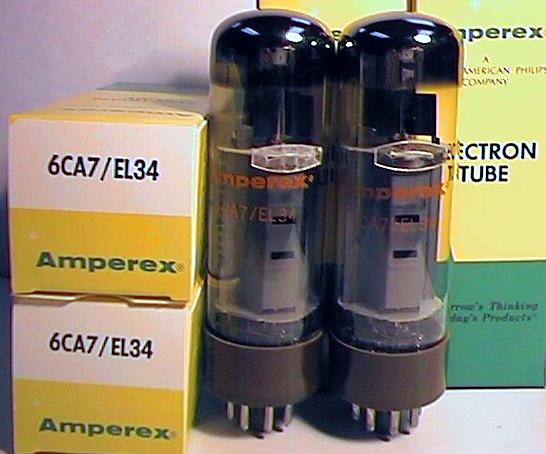
Example: If you find a tube and its box is marked "EZ81", then you've stumbled across a full wave rectifier that has a 6.3V filament voltage and fits a standard 9-pin socket. Or the commonly found EL84 is a power pentode with a 6.3V voltage and a 9-pin base. The EL34 differs in that it has an octal base (the 3 shows that) but other than that, it's simply a larger version of the '84. In practice, it works very similar to that - a single ended amp with the tubes wired in triode mode with EL84's does around 3wpc, while the same wiring scheme with '34s will up the power output to 6wpc.
EL34's on the left, EL84's on the right.
American system:
First number: filament voltage
0 Cold cathode (e.g. voltage regulator tube).
1 0.1 - 2.0
2 2.1 - 2.9
3 3.0 - 3.9
n n.0 - n.9
Letter or letters: sequence code
One or two letters to indicate the sequence code. When the single character codes were used up, double character codes were introduced.
Note that U - Z generally (but not always) as the only character, or last character, are used for rectifiers
Final number: Element count
The number of elements in the tube, the filament counting as 1. For example, the 6SN7 has two cathodes, two grids, two plates, and a filament.
Additional letters:
A Controlled heater warmup time, although can also be used to denote increased ratings or performance over and above the non-A model.
B Improved ratings/performance.
C Ditto.
G Glass bulb.
GT Glass tubular.
W Ruggedised version.
X Low loss ceramic base.
Y Low loss phenolic base.
The type designator is a sequentially assigned letter, or pair of
letters. Other than the fact that they started assigning rectifiers
in reverse order, the letter doesn't mean anything. When they ran
out of single letters, they used two. So a 12AX7 is a 12-volt signal input triode that has seven elements and has a 9-pin base. In that tube, there
are two cathodes, two grids, two plates, and a heater that make up the elements.
Furthermore, you can have different types of tube envelopes themselves...you can have a "coke bottle" shaped tube (G) suffix; straight-sided (GB), and a smaller coke bottle shape (GA). However, tubes that are marked like this might have other differences...for example, the 5U4G and 5U4GB are really different tubes, as the 'GB version can supply slightly more voltage. But the two are generally interchangeable in most circuits.
A 5U4GB is shown on the left, and an older style 'G is shown at right.
That's all for now, will include more when I get the urge to...like a detailed listing of all the tubes we're interested in for audio purposes and the different naming games that go on with that. I can't begin to figure it all out. But if you want to get into this sort of thing, it helps to know that a 6CA7 is the same thing as an EL34, or a 6BQ5 means an EL84, or a 6CA4...you get the picture. Can't do anything unless you speak the langauge first.