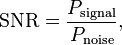
once again, that calculation is refering to signal to noise ratio in spl, which is what the amps represent, however, they are not really rated at those calculations.... that one would be used in calculating the s/n in an environment, such as rating the acoustic dampening, or feed-back/noise of a sound emitted in the said environment. did some searching, can't remember which site, but it is explained exactly what it is measuring, and how/why it is represented in decibels. in short, the rms (root mean square, with no detectable distortion, which could also be less than the rated rms, because they sometimes rate at higher levels of distortion) of the specific amp in question is a "floating point" i.e. no set value to compare all amps by. so, while in the rms range, they measure a noise, effected on the amp at the same voltage as the input signal, and measure the ratio of the 2 signals at the final outputs. decibel system was chosen to represent the ratio, however, it really does not relate to actual spl output. it is used as more of a metaphor to have something more universal. imho, they really should have assigned no unit to it, just a simple ratio. so, plain and simple, if your vehicle carries a signal through the power supply as strong as your input signal, it can be played at 1/70's the wattage that the desired signal is playing, but you would hae to have one huge half-broken alternator and no/weak battery to see it played at that level, imho. and, as for sub amps, it would not matter if it was 50, or 150, you will not hear any of it if your wiring is good, your battery is sufficient, and your alternator is good for the task.