300/4v3 and 600/1v3 Tuning

Krimsonviper

Junior Member
I'm using a DMM(Digital Multi-Meter) to tune my amps so I don't blow my speakers. The volts on that they're suppose to be at are 17.3 @ 4 ohms on each channel for the 300/4 and 49 @ 4 ohms for the 600/1 when the volume is 3/4 max. If I'm understanding this correctly, if my sub (12w6v3) is rated at 600 watt RMS, my sub won't blow, correct? My front components are rated at 70 watts and rears are 60 RMS. If I calculate this correctly, my channels from the amp are 75 watts, so the scaled back gains in volt translation should be 16.26 fronts and 13.84 rears? Or should I still listen and watch for distortion? First time really tuning a system correctly and I'd hate for my equipment to get hurt here.

I came up with these numbers by dividing my speaker's RMS by the amps RMS, assuming that it's 75 watts at 17.3 volts. I took the number I received and then multiplied that number by 17.3, effectively finding the percentage of power difference in volts.

Another question that I have is that I feel like my 300/4 is running hot, almost too hot to touch. Thermal has never kicked in, even when running it at about 60-66% percent full volume for 5+ hours. I don't believe it's a ground or power issue because my 600/1 is just warm. Same ground point, same size power and ground wire and the point has been sanded to bare metal. I never had this issue with my old 300/4v2 from back in the day and the shop who sold it too me says this amp usually runs this way, so long as thermal never kicks in. Should I be worried? What could the issue be?

Do you need more equipment info?

 
Which headunit are you using? Depending on the HU, some can go full volume without distortion while others hit distortion much earlier. How do the speakers sound right now? Does it sound pretty clear all the way or does it start distorting at high volumes? Using a DMM doesn't ensure that you're not clipping the signal. The proper way to do it is with a oscilloscope but you can use your ears too, just be on the conservative side. You basically wanna use more preout voltage and use less gain on your amp. If the amp is too hot to touch, you might be overdriving it so back the gains down some and use your ears. What kind of wires did you use for the amps? If it's cheap thin wire, that could cause the amp to heat up more.

Sent from my iPhone using Tapatalk

 
I unfortunately made the mistake of sticking with the stock head unit and using a line out converter, but I don't like how my sub is producing frequencies higher than I want, no matter the low pass frequency setting. I will be remedying this as soon as I figure out a suitable head unit.

I used JL's help desk and followed their instructions for the most part. I say that that way because when I have the input voltage set to "Low," the volts on the DMM read higher than 0, which means I'm suppose to switch over to "high." I did that, but then I can't reach the intended volts, even with the gain set to max, so I keep it at "Low." What can, or will, happen if I leave it like this? I heard a bit of distortion in my speakers, so I backed the gain down more until I couldn't hear it anymore, but the sub over powers it. So, I believe I need to lower the sub a little to match it, which is unfortunate.

I ran all new wire. Power and ground wire is Stinger 100% OFC 4 gauge all the way around, and the speaker wire is Knuconepts 16AWG 100% OFC.

 
I unfortunately made the mistake of sticking with the stock head unit and using a line out converter, but I don't like how my sub is producing frequencies higher than I want, no matter the low pass frequency setting. I will be remedying this as soon as I figure out a suitable head unit.
I used JL's help desk and followed their instructions for the most part. I say that that way because when I have the input voltage set to "Low," the volts on the DMM read higher than 0, which means I'm suppose to switch over to "high." I did that, but then I can't reach the intended volts, even with the gain set to max, so I keep it at "Low." What can, or will, happen if I leave it like this? I heard a bit of distortion in my speakers, so I backed the gain down more until I couldn't hear it anymore, but the sub over powers it. So, I believe I need to lower the sub a little to match it, which is unfortunate.

I ran all new wire. Power and ground wire is Stinger 100% OFC 4 gauge all the way around, and the speaker wire is Knuconepts 16AWG 100% OFC.
Stock headunits tend to have a big drop on the lower bass notes. It makes it so that your stock speakers don't blow by misuse. It has it's own EQ set so it's very hard to work together with your aftermarket stuff. Which LOC did you get anyway? Most of them are junk TBH. Audiocontrol LCi2 is decent but seriously, upgrading to an aftermarket headunit is one of the single biggest upgrades you can do to improve your sound. You would think that getting all new speakers and amps will do the trick but stock headunits most of the time is a weak link to your system. Even changing your low pass filter won't do anything to bring back those missing notes on your stock unit. Another option is buying a DSP and hooking it up to your stock headunit to it but it's cumbersome and expensive.

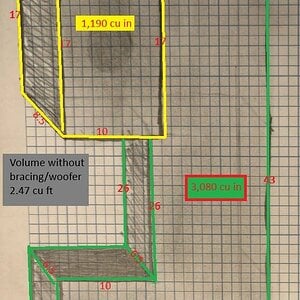
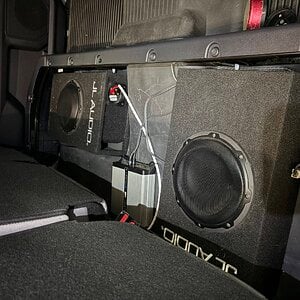
Yea I think it's supposed to be set to "high" output otherwise you won't get much output, which explains why your sub overpowers it. I think once you get that new headunit in, you will have more control of your speakers and your low notes will come back to the way it should be. If after you get the HU installed and your sub still doesn't hit the low notes the way you want it, it's probably an enclosure issue. What box is the 12w6v3 in right now? Do you know the specs of it?

BTW I don't think there's such thing as 100% OFC. It's always written as 99.99%. Close enough lol.

 
There are upgrades you can make to a stock HU that will trump every aftermarket HU.
I'm guessing you have a cheap LOC. Looking into the Audiocontrol LC-2i. That's a start.
I looked into that one and saw that it just has 1 RCA connection. You have to break that up with Y-connectors, right? I saw, and have heard of David Navone LOCs, have you guys had any experience with those?

 
I looked into that one and saw that it just has 1 RCA connection. You have to break that up with Y-connectors, right? I saw, and have heard of David Navone LOCs, have you guys had any experience with those?
Technically, the Slash amps don't need a LOC, and you only need one RCA connection using the output from the 600/1 to the input of the 300/4. I would suggest just saving your money for a new head unit.

The formula to find the voltage is V=√(W×Ω).

 
Activity
No one is currently typing a reply...
Old Thread: Please note, there have been no replies in this thread for over 3 years!
Content in this thread may no longer be relevant.
Perhaps it would be better to start a new thread instead.

About this thread

Krimsonviper

Junior Member
Thread starter
Krimsonviper
Joined
Location
Cali
Start date
Participants
Who Replied
Replies
7
Views
1,284
Last reply date
Last reply from
vaiboy
design.jpeg

WNCTracker

    May 22, 2026
  • 0
  • 0
IMG_2118.jpeg

WNCTracker

    May 22, 2026
  • 0
  • 0

New threads

Top