So the specs on the amp are:
- 1125 W X 1 RMS @ 2 ohm
- 563 W X 1 RMS @ 4 ohm
That 4-gauge wire kit should be fine for this setup. It's a 2-ohm stable amp, not 1 (which is fine, but it matters in how you wire up the sub).
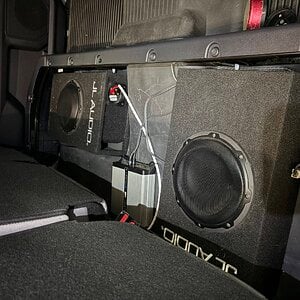
I assume that you have the following prefab subwoofer setup:
Its wired load is 2 ohms, which is what you want.
What
@supernov4 was alluding to is that OEM head units often employ circuits that monitor the low-end frequencies as the volume increases and decreases.
Kind of like the "loudness" button you used to find on your car and home stereo receivers.
Bass is power needy, requires a lot more energy to move enough air, and at low volumes, the loudness is kicked in, increasing the output at the lowest frequencies.
That's because at low levels, the mids or tweeters may only need as little as 5- 15 watts to play relatively loud, and if the woofers are only getting that level of wattage, they are hardly moving.
That's why, at low volume listening levels, you would then push the loudness button, redirecting the system to add emphasis at the lowest frequencies.
As you turn it, and the woofers start to get too loud relative to the rest, you turn the loudest off, and it evens out a bit, giving you loud playback that is balanced and not overdriven on the low end.
Car manufacturers, to give you more volume, do something like this, too, but for different reasons.
OEM car manufacturers (most) employ something a little broader: one for volume, one for frequency, and one for power distribution.
When you turn your system on and set the volume at low listening levels, it sends out a full signal with a little emphasis on the low frequencies.
As you turn it up, two things happen (again, most OEMs have some sort of this happening): the BASS boost is reduced, and as you get even louder, the boost is eliminated, and the frequency response is tapered off higher, actually reducing the low frequencies quite a bit, sometimes altogether above 60 Hz.
That allows them to use cheaper high-efficiency drivers, which give you a lot of volume, but that compromise also means the bass suffers quite a bit relative to the overall mix you hear.
Now that you have an understanding of what the OEM attention is that might be built into your head unit, what you're experiencing does not seem to follow this BUT, it may be one other thing that they do on the OEM head units.
As you drive, the car environment gets louder, and they have another feature, much like that which is mentioned above, that manipulates the volume to keep it relatively level as the volume of the car increases and decreases.
The good news is, you may be able to defeat the setting if it is a setting afforded to you in the system settings for the HU.
The bad news is, you may not have a setting in the HU that allows you to defeat these OEM features, and as such, unless you replace the head unit, you're SOL.
IF you can defeat these settings and get a full, unadulterated signal to your amp, then you need to consider the OEM speakers in the mix, as you will have now negated the features in the OEM HU that protected these rather inexpensive OEM speakers from low-frequency overload, a bit of a catch-22.
You indicated that you are using an LOC, didn't see it listed.