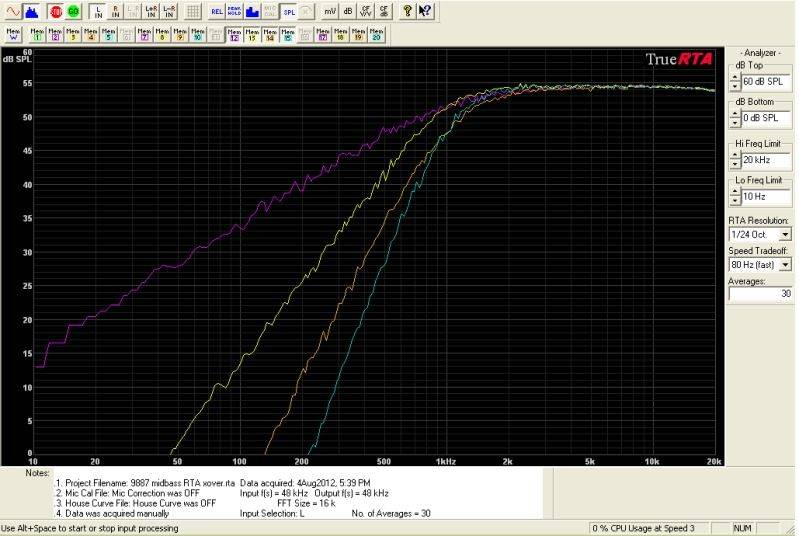
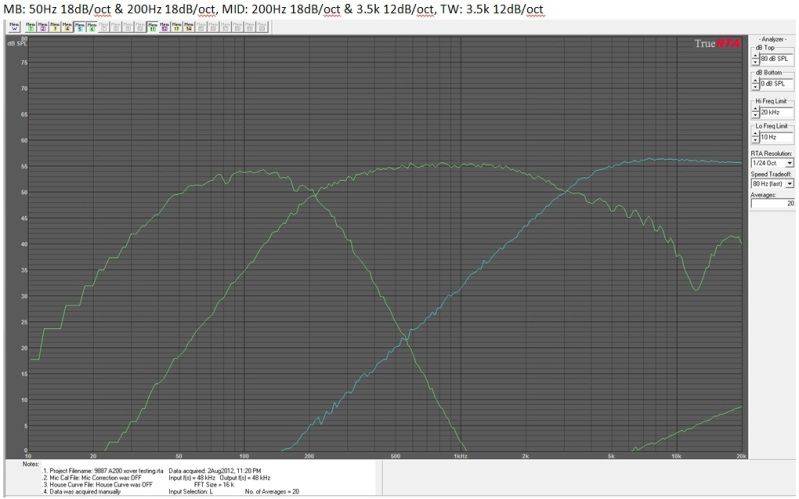
this is what changing slopes does to the frequency response
when adjusting points and slopes, you have control over how the speakers blend
but each slope has a different effect on phase.
6dB = 90 deg phase shift
12dB = 180 deg phase shift
18dB = 270 deg phase shift
24dB = 0 deg phase shift
30dB = 90 deg phase shift
36dB = 180 deg phase shift
i usually avoid 6dB and 18dB slopes because accounting for the phase shift is difficult unless you carry that through. if you have different slopes for each driver, you may need to change phase manually to keep the drivers in acoustic phase. if that sounds confusing, don't worry, very few people in car audio actually understand what crossovers do to phase.
the simple answer is stick with 24dB/oct and avoid phase shift issues.
if you use 12dB/oct you want to do that for both drivers or swap polarity on one of them. 12dB/oct lets more sound through.
by definition, a 12dB/oct HPF will result in a 12dB reduction at an octave below the crossover point.
and octave lower or higher is a halving or doubling of frequency at the crossover point, respectively.
so a 200Hz 12dB/oct HPF will result in a 12dB reduction at 100Hz and a 24dB reduction at 50Hz.