Silver Flute/Peerless, Home Audio Build

Haha, me too, I'm going to purchase birch tonite.

I should have my cuts done saturday night, I may possibly start on the xovers in the next day or so.

So I will definately have more pics ASAP

CT

 
What behooved you to purchase the drivers you did?

Why an 8 paired to a 25mm dome tweeter?

I have a hard time believing you'll have a homogeneous transition between the tweeter and the midrange, you'd be exploiting each's weakness. The Peerless is going to struggle greatly below 3khz im guessing, and with the Seas 27TBFCG (phenomenal performer that performs equally as incredible as its MUCH more expensive brother) being a few dollars more why did you choose it?

The silver flute specifically arent known to be very renowned performers...why not a smaller driver or a better engineered driver? I havent read any reviews on the specific driver you're using, but I have read some reviews on its smaller brother, the W14 (~5.5). It was specifically recommended to be used

Why not the Dayton RS225 (if you REQUIRE a low-cost 8, although most drivers of this diameter are incredibly undesirable for the upper midrange and lower treble) and RS28A/Seas 27TBFCG?

 
I found some data sheets on that Silver Flute and it appears to have a NASTY breakup occuring between 4-5khz and manifests itself sharply from 2khz upward. If you DO intend on using this driver, I would highly recommend on using an extremely high order filter around 1000hz maybe 1100hz. Otherwise you're going to have a very offensive passband (lots of odd order harmonics) in the area where the human ear is most sensitive...big no no.

 
What behooved you to purchase the drivers you did?
Why an 8 paired to a 25mm dome tweeter?

I have a hard time believing you'll have a homogeneous transition between the tweeter and the midrange, you'd be exploiting each's weakness. The Peerless is going to struggle greatly below 3khz im guessing, and with the Seas 27TBFCG (phenomenal performer that performs equally as incredible as its MUCH more expensive brother) being a few dollars more why did you choose it?

The silver flute specifically arent known to be very renowned performers...why not a smaller driver or a better engineered driver? I havent read any reviews on the specific driver you're using, but I have read some reviews on its smaller brother, the W14 (~5.5). It was specifically recommended to be used

Why not the Dayton RS225 (if you REQUIRE a low-cost 8, although most drivers of this diameter are incredibly undesirable for the upper midrange and lower treble) and RS28A/Seas 27TBFCG?
I found some data sheets on that Silver Flute and it appears to have a NASTY breakup occuring between 4-5khz and manifests itself sharply from 2khz upward. If you DO intend on using this driver, I would highly recommend on using an extremely high order filter around 1000hz maybe 1100hz. Otherwise you're going to have a very offensive passband (lots of odd order harmonics) in the area where the human ear is most sensitive...big no no.

Well, this set is being designed as a prototype, and it is really just a low cost experiment.

I believe the Peerless should fare just fine around 2.5khz, on a 4th order slope. These tweeters were actually given to me a while back by another forum member and I wanted to put them to use. They have a relatively low Fs (1050hz) and one would assume that they will work just fine.

Why an 8" midrange?

The FR graphs genuinely don't look that bad, and like I said this is designed to be a low cost setup. With a 2nd order network I believe -12db at 5khz will be sufficient enough.

Do I currently know what it is going to sound like?

No, all I can go on is what information the graphs have given me, and my fiddling with crossover software.

Have I had any past experience with Silver Flute products?

No, although in my free air experiences with this driver it does not come out harsh, nor muddy. It is a laid back, natural sound driver.

Do I still plan on building this set?

Absolutely.

Thadman, thank you for your input on my build project. I will hold all of your information into consideration once enclosure testing goes underway.

CT

 
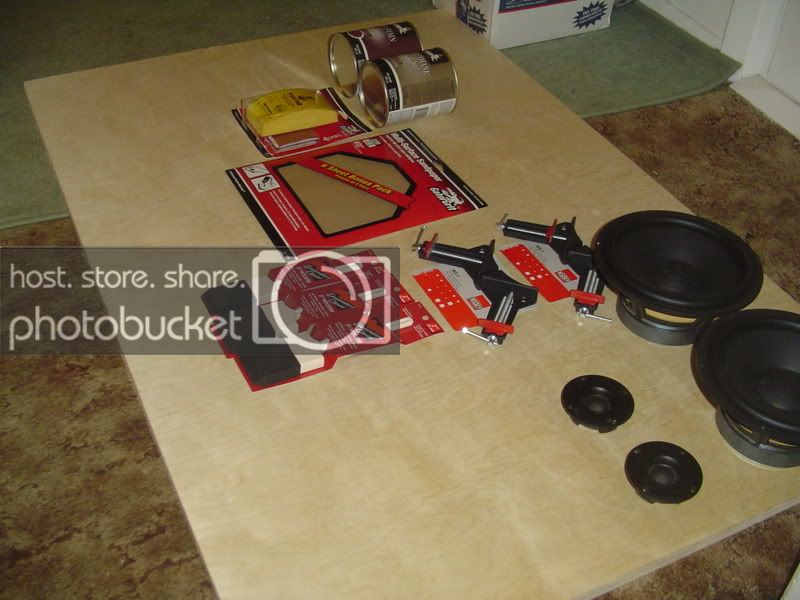
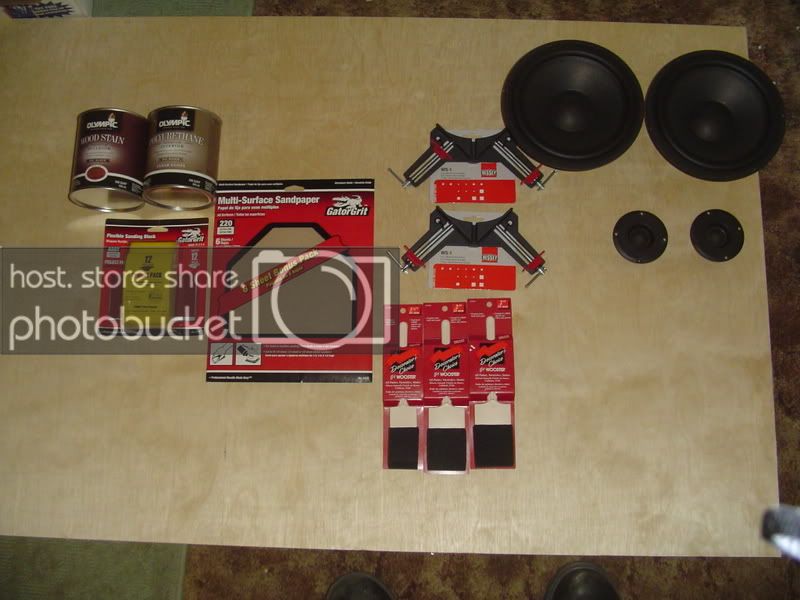
New pics

Stain

Polyurethane

Foam Brushes

Right angle clamps

Birch Ply

Sandpaper/sanding blocks

Plus the drivers

DSC00031.jpg


DSC00030.jpg


CT

 
You are misguided if you believe your 8 is going to cross that high without *****ing...a LOT of it mind you lol:laugh:

You can get an idea about how a driver is going to perform distortion wise by observing its frequency response. At 3-5khz we have a large peak, we will have high levels of 2nd order harmonic distortion between 1500 and 2500hz. We will also have high levels of (offensive) 3rd order harmonic distortion between 1000 and 1667hz as the 2nd and 3rd harmonics are multiples of the original peak. See my point? Crossing that high is a really bad idea.

 
I think he should be fine. This is a very good learning project. I give him the thumbs up!
Word up, thanks man

You are misguided if you believe your 8 is going to cross that high without *****ing...a LOT of it mind you lol:laugh:
You can get an idea about how a driver is going to perform distortion wise by observing its frequency response. At 3-5khz we have a large peak, we will have high levels of 2nd order harmonic distortion between 1500 and 2500hz. We will also have high levels of (offensive) 3rd order harmonic distortion between 1000 and 1667hz as the 2nd and 3rd harmonics are multiples of the original peak. See my point? Crossing that high is a really bad idea.
Well, currently I have the design plans all together, and the parts on hand.

I'm going to give it a shot.

If all else fails it's back to square one. I believe experimentation will breed knowledge.

I'm not disregarding your thoughts in any way shape or form, just so you know.

I'm one of those guys who has to hit his head off of a brick wall a thousand times to figure out that's not the way to do things.

//content.invisioncic.com/y282845/emoticons/laugh.gif.48439b2acf2cfca21620f01e7f77d1e4.gif

CT

 
W20RC38 - Wool-filled Paper Cone Woofer

http://www.madisound.com/silverflute.html

If the woofer you have is untreated paper cone, then read below.

Here's a tip. Some of the best sounding midranges are paper treated cones.

Non treated paper they can have sonic issues at the higher frequencies.

You can use the lacquer cone treatment mod on that woofer to tame the higher

frequency nasties, it should sound pretty sweet.

Get a $5 spray can of lacquer, clear type. Example;

http://www.builderdepot.com/RUSTOLEUM_BM/prodimg/6021257.jpg

Get an empty soda can like so;

http://moon.ouhsc.edu/dthompso/namics/gifiles/coke_can.gif

Get a 1" cheap paint brush like so;

http://www.impactdecor.com/acatalog/brush_syn_25mm.jpg

Cut the empty soda can in half.

Rinse and dry the can.

Spray some lacquer in the soda can.

Dip the paint brush in lacquer and apply a thin coat to the woofer cone, dust

cap, but not the surround.

Let dry. Repeat about 4 to 6 times to build up.

The spray can lacquer is ideal because it's not thick like the non-spray type,

this allows it to soak in the paper fiber. Lacquer coats meld with previous coats

to form a thick coat.

This will add mass the woofer, lower Fs, tame high frequency nasties, and you

loose a little bit of sensitivity. The paper is now protected against the environment and will last forever vs.

drying out and getting brittle over time. The SQ should improve.

Try this out.

Do two coats. Listen to the woofer full range, free air. Compare the sound to the unmodded woofer.

If you think there is progress, then do two - four more coats until you think it's good. The full range sound

test will tell alot, trust your ears.

 
W20RC38 - Wool-filled Paper Cone Wooferhttp://www.madisound.com/silverflute.html

If the woofer you have is untreated paper cone, then read below.

Here's a tip. Some of the best sounding midranges are paper treated cones.

Non treated paper they can have sonic issues at the higher frequencies.

You can use the lacquer cone treatment mod on that woofer to tame the higher

frequency nasties, it should sound pretty sweet.

Get a $5 spray can of lacquer, clear type. Example;

http://www.builderdepot.com/RUSTOLEUM_BM/prodimg/6021257.jpg

Get an empty soda can like so;

http://moon.ouhsc.edu/dthompso/namics/gifiles/coke_can.gif

Get a 1" cheap paint brush like so;

http://www.impactdecor.com/acatalog/brush_syn_25mm.jpg

Cut the empty soda can in half.

Rinse and dry the can.

Spray some lacquer in the soda can.

Dip the paint brush in lacquer and apply a thin coat to the woofer cone, dust

cap, but not the surround.

Let dry. Repeat about 4 to 6 times to build up.

The spray can lacquer is ideal because it's not thick like the non-spray type,

this allows it to soak in the paper fiber. Lacquer coats meld with previous coats

to form a thick coat.

This will add mass the woofer, lower Fs, tame high frequency nasties, and you

loose a little bit of sensitivity. The paper is now protected against the environment and will last forever vs.

drying out and getting brittle over time. The SQ should improve.

Try this out.

Do two coats. Listen to the woofer full range, free air. Compare the sound to the unmodded woofer.

If you think there is progress, then do two - four more coats until you think it's good. The full range sound

test will tell alot, trust your ears.

Thylantyr,

Thank you, the cone is actually made of wool on the particular driver I'm using.

That is a very good read though

CT

 
Im not sure if I would recommend strengthening the cone for such a high crossover. Point being that making the cone more rigid would result in a higher amplitude, but more concentrated peak vs a lower amplitude, wider peak. The result of this would probably be less average distortion over the drivers passband, but one horrendously offensive distortion peak.

The reason paper cones may subjectively sound good is because they have a warm sound signature, which comes as a result of high levels of distortion that resemble low amplitude *plateaus* rather than high amplitude peaks. This creates a more homogeneous distortion signature, rather than the abrupt, high amplitude distortion peaks associated with metal cone drivers. In most cases associated with stiff coned drivers (often with metal cone drivers), you cross before the high amplitude peak presents itself in the form of 2nd and 3rd order harmonics (ex. you would cross ~1400hz with a Seas W18EX). In your given situation, you are not going to be crossing low so I would advise against it.

This is just my recommendation and remember to take it with a grain of salt because ive never tested the driver nor the driver with cone treatment. Although you could test the driver to see what works best, it would be counter productive because you could buy a better driver instead of purchasing an additional driver and the cone treatment materials.

 
Activity
No one is currently typing a reply...
Old Thread: Please note, there have been no replies in this thread for over 3 years!
Content in this thread may no longer be relevant.
Perhaps it would be better to start a new thread instead.

About this thread

Thieroff

10+ year member
The Master of Meatcutters
Thread starter
Thieroff
Joined
Location
Pittsburgh Pa
Start date
Participants
Who Replied
Replies
48
Views
7,806
Last reply date
Last reply from
ballstothewall
IMG_20260516_193114554_HDR.jpg

sherbanater

    May 16, 2026
  • 0
  • 0
IMG_20260516_192955471_HDR.jpg

sherbanater

    May 16, 2026
  • 0
  • 0

New threads

Top