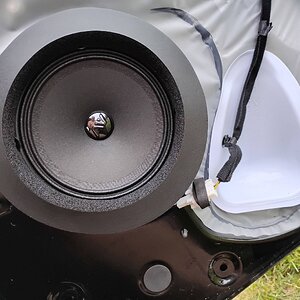
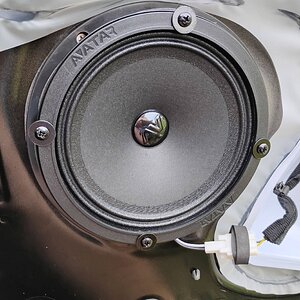
Is this sarcasm? I have the non red basket HCCA, so i'm guessing that they are the 1st gen?
no man...no sarcasm intended whatsoever...
the 1st gen HCCA's were very impressive for real
many peeps mistake a speakers sensitivity for it's efficiency...this is not so...they are very different....Although a speaker's efficiency rating is almost always correlated to its sensitivity rating...it's actually a different measurement. The efficiency rating for a speaker measures how well a speaker converts watts of electrical power into watts of acoustical power. Most speakers have a very low efficiency rating between 1% and 10% so manufacturers rarely provide this information, choosing instead to list sensitivity ratings.
A sensitivity rating tells you how effectively a speaker converts power (watts) into volume (decibels). The higher the rating, the louder your speakers will play with a given amount of amplifier power. Sensitivity is often measured by driving a speaker with one watt and measuring the loudness in decibels at one meter...for example...the rated power needed to produce a given volume to a speaker with a sensitivity of 85 dB is 100watts....another speaker with sensitivity of 88 dB will need only 50 watts of power to get at the same volume as the other speaker....
in theory...(but i'm sure that there exist instances where others have proved otherwise)...A speaker with a sensitivity rating that's 3 dB higher than another speaker's only needs half as much power to deliver the same amount of sound.
read this...bookechu
An interesting review of Orion Hcca generation one woofers...
read carefully..
Model Reviewed:
Orion HCCA 12
Summary:
(This review is actually for the HCCA 15D) Well you've all read the countless other reviews on HCCA subs, and the hype about this sub is true! But what no-one seems to talk about is why this subwoofer, released 5 years ago is so much better than the competition, even today!! It is the efficiency of the woofer that allows such modest wattages to outpump the competition. The first series of 15D’s released in 1999 boasts an SPL sensitivity of 99dB @1w@1m while the year 2000 revision actually downgraded this to 96dB.
This was Orion’s response to so many damaged subwoofers being returned from people putting too much power into them (the spider’s and surrounds would rip and become unglued), so the next year Orion released a more resilient revision which had slightly less efficiency but took more than the recommended 600WattsRMS without issues. The 600WattsRMS rating is based on longevity, but the subwoofer will competently handle burst’s- not peak- of 1200WattsRMS CLEAN power without question.
Most people seem to get conned when shopping for SPL subwoofers by looking for a high wattage rating first, and so companies have responded by making high power-handling, chrome plated boot ornaments to satisfy this market demand. This is one of the reasons why the old school Orion went broke and was forced to merge with DEI a couple of years back. They underrated their expensive but quality US made gear and received limited sales as few people ever saw past their competitors marketing garbage.
Orion has since stopped manufacture in the USA opting in favour outsourced production to Asia. The new line of H2 subwoofers have inferior SPL to the HCCA even when powered with their rated wattages (2000WRMS vs. 600WRMS) When looking for high dB readings people will typically go for products such as Fosgate, Kicker, JL, Phoenix Gold, Audiobahn, Digital Designs, Adire, Image Dynamics, Resonant Engineering, Beyond Audio and the Orion H2 series of subwoofers. These are common winners in the SPL arena but all suffer from one common trait when compared with the old school HCCA line, LOW-SENSITIVITY (usually in the order of 85dB-93dB). Although the HCCA line can’t take more than 1200wattsRMS, it uses this power to push a lighter cone than most with more compliance and more flexible surrounds/spiders.
It also creates more bass, not heat. Some of the worst power guzzling sub’s come from Kicker, Audiobahn and even the new Orion H2 series of woofers. They can be rated up to 4000WRMS but when compared with the HCCA powered with 1200WRMS they still fall behind in competition by up to 12dB. It is not just a matter of comparing woofer sensitivity’s either. A quality software program such as WinISD will reveal the truth about the HCCA’s superior frequency response and SPL gain in acceptable enclosure sizes. In one case it shows you would need TWO Digital Design 9515e subwoofers (each powered with 1200WRMS) to match the SPL of ONE Orion 1999 HCCA 15D (powered with 600WRMS). You would also need TWELVE Kicker L715’s (powered with 1000wattsRMS each) to match TWO Orion 1999 HCCA 15D’s (powered with 600WRMS each). Note this is not entirely accurate because of the 3.2” of peak excursion limitation of the HCCA 15” version, but the point I make is the ratio of wattages needed by competitors to match the modest HCCA wattage demanded.
This ratio matters because upgrading an electrical system to draw over 250 amps without voltage drops costs ALOT, not to mention all the extra amplifiers you need. Many people reading this will argue that what I have just stated is wrong “…Because their mate made blah blah dB with a pair of Audiobahn….blah blah’s”. My statistics stated above are based on equal electrical systems including, voltages, Capacitors, available battery current and the amplifiers with exact same output (ie. same bass boost). Another variable that changes my statement is that many people have their enclosures tuned for a large resonant peak which is where they take their SPL reading. The results I state above are based on enclosures designed for a dead straight frequency response to provide a fair basis for comparison. If any of these variables differ between two systems of course you are going to get completely different results. I commend those who own or plan to own any of the HCCA line of Subwoofers and Amplifiers. Did you know the range of HCCA amplifiers were built with Military spec’s/tolerances for reliable performance under battlefield heat stress? My primary occupation is subwoofer box design and I have not found a more well-rounded SPL sub than the HCCA series, although I highly commend the Image Dynamics IDMAX series as they have better SQ at a slight trade off in SPL. Neil
Strengths:
The HCCA series of subwoofers – especially the 1999 series – do what the others cant. It is very difficult to make such an efficient woofer that can take more than a couple of hundred watts RMS, and to do this Orion made these subs with EXTREME quality control, this is why the were expensive when new. SQ is very reasonable for the amount of output you will get with a clean amp. I consider a Rockford Fosgate amp an absolute minimum quality amp for running these subs. Zapco and the old school Soundstream reference amplifiers are the best match for these subs as they will control the cone movement best, preserving as much SQ as possible. Hell, these subs are so efficient you could probably get decent results running them off a head-deck!!
Weaknesses:
The only disappointing thing is that there are a lot more year 2000 model HCCA’s made than the better spec 1999 series(rated at 99dB @1w@1m!!!!!!). And seeing as you can only get these second hand nowadays, finding one that hasn’t had the voice-coils clipped by an idiot with cheap amps can be a problem. In my opinion Orion should dump the H2 line and start selling HCCA’s again! I could rave on about dB readings with these subs but that is such a subjective topic and gives little merit when people throw false dB readings all over the net. Unless the dB is measured in the official way at the dash with a properly calibrated microphone don’t believe a word people say about their impossibly high 150+dB readings with only 2 subs. Im sorry but your dB reader must be a ChineseCheapie from a flea market or your placing it next to a tweeter which will throw the needle off the scale.
Similar Products Used:
ID, RE, DD, RF, SS, etc (people who know their stuff should be able to decipher those prefixes)
http://www.carreview.com/ca...on/PRD_50418_1808crx.aspx